 Inspire
Isotonix Reviews: Our Scores for 26 Products, Compared
Isotonix sells a long list of products, and nothing on the bottle tells you which ones are worth the money. Our scores run from 3.2 to 4.8 out of 5, so it depends on the product: OPC-3 is the one we’d start with, and Resveratrol is the one we’d think twice about. We’re an independent distributor that has shipped Isotonix since 2012, and this page puts our Isotonix product reviews side by side.
Key takeaways
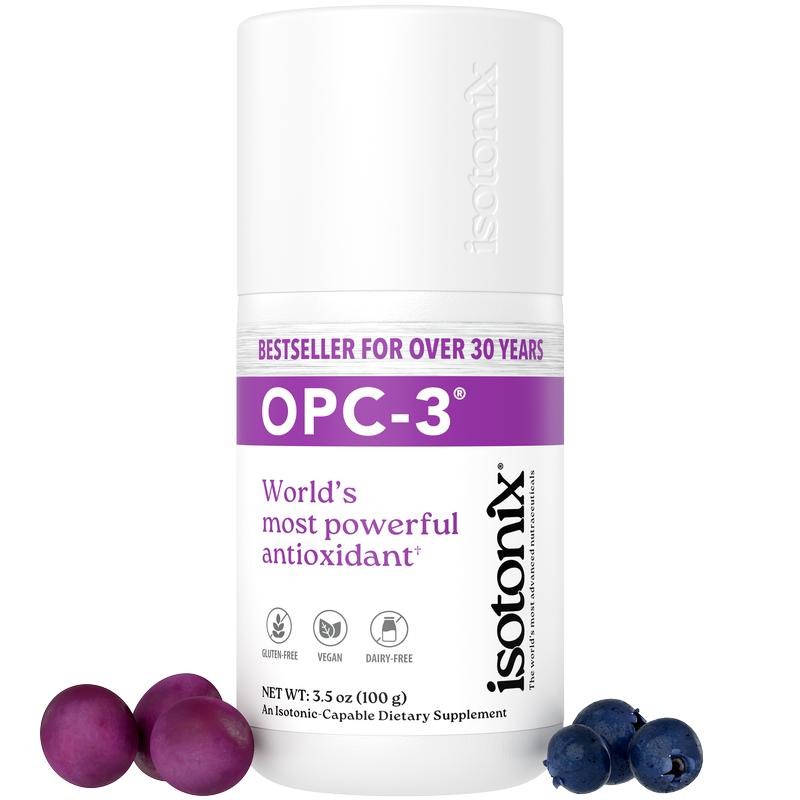
- Start with Isotonix OPC-3, our top score at 4.8. The Multivitamin (for adults over 50) and Daily Essentials follow at 4.6, tied with Bromelain Plus and Heart Health Omega III, which both come with caveats.
- These are our own scores from our own reviews, not customer ratings. We’re an independent distributor and we say so.
- The lowest scores are Resveratrol (3.2) and Astaxanthin (3.5). Resveratrol loses points on thin human evidence and a label with no total resveratrol figure, and Astaxanthin on having no published trial of the product itself.
- Customer star ratings quoted in our reviews all sit between 4.5 and 5.0, while our scores for the same products run from 3.7 to 4.8.
- Several labels print do-not-use warnings, and the US labels for Vitamin D with K2 and Magnesium list daily doses above NIH upper limits, so read the cautions below. Some products are also sold in only a few countries.
Is Isotonix good? The short answer
Across our Isotonix reviews the usual complaint is price: it’s a listed downside in 18 of the 26 scored reviews below. A handful of products earn the premium. Isotonix OPC-3 is the one we’d start with: 4.8 out of 5, the highest score we’ve given any Isotonix product. The two lowest, Resveratrol (3.2) and Astaxanthin (3.5), lose points on evidence and label gaps, not on how they’re made: thin human evidence and no total resveratrol figure on the label for Resveratrol, and no published trial of the product itself for Astaxanthin.
We’re an independent Market America distributor. We’ve stocked and shipped Isotonix since 2012, and we may earn a commission if you buy through our links. Every score here is our own, copied from a review we published. None of them is a customer rating, and we accepted no payment for positive reviews.
Start here: OPC-3 first, then two 4.6 picks
Five products score 4.6 or higher, and OPC-3 leads at 4.8. Four are tied at 4.6, so the order below is our judgment, not the scores.
- Isotonix OPC-3, 4.8. Four antioxidant extracts (grape seed, pine bark, red wine and bilberry) plus a citrus bioflavonoid complex, in an isotonic drink. It’s the only Isotonix review of ours that cites published studies on the finished formula, not just its ingredients. The catch is price. Read the OPC-3 review, or see whether you can take it every day.
- Isotonix Multivitamin, 4.6, if you’re over 50. It’s the 50+ formula: 20 vitamins and minerals on the US label, with activated B12 and folate. Calcium is only 8% of the Daily Value and there’s no iron, so it isn’t a bone or anemia plan. If you need an iron source, Isotonix sells a separate standard Multivitamin with iron (check with your doctor first), and our with-iron versus without-iron label review covers it. Read the Multivitamin review.
- Isotonix Daily Essentials, 4.6. A bundle of OPC-3, a multivitamin, Calcium Plus and Activated B-Complex. Our review calls the saving real but small: about 1% in the US at October 2026 list prices ($219.95 for the kit against $221.80 for the four bottles, with the no-iron multivitamin) and about 4% to 5% in Canada, Australia, Singapore, Hong Kong and Taiwan. Read the Daily Essentials review.
The two held back both show 4.6 too. Bromelain Plus carries a blood-thinner warning and do-not-use groups on its label. The Heart Health Omega III fish oil is a softgel from the separate Heart Health line, not an isotonic drink. Still choosing between antioxidants? Our antioxidant picker goes deeper.
Our Isotonix reviews, compared by group
That’s 31 products: 26 with a score and 5 without. “No score” means the review stops short of a number, and we won’t invent one. Each row takes the score, the best-for and the main downside from the linked review, checked against the official label (and, for a few, the US price) on October 17, 2026. Prices move by country and by month, so they’re not in these tables.
Antioxidants
| Our score | Best for | Biggest caveat | |
|---|---|---|---|
| OPC-3 | 4.8 | Daily antioxidant support, if absorption matters to you | Pricier than a standard capsule |
| OPC-3 Beauty Blend | 4.4 | OPC-3 fans who want a skin, hair and nails angle | About 1.5 to 2 times the cost per serving of standard OPC-3, depending on bottle size |
| Maximum ORAC | 4.4 | A broad, food-based antioxidant blend in one drink | The “3000 ORAC units” headline is a lab measurement, not a felt effect |
| Thymenol | 4.2 | Two patented plant antioxidants in a capsule, not a mixed drink | The US label says to check first if you take warfarin, other blood thinners or diabetes drugs, and it’s confirmed in only four stores (US, Taiwan, Hong Kong and Singapore) |
| Astaxanthin | 3.5 | A named-source astaxanthin at a stated 6 mg dose | No published trial of this product itself, and EFSA declined most of the health-claim categories it’s marketed around |
| H2TAB hydrogen tablets | 3.7 | Curious buyers who want a cheap try at an early-stage idea | The “12 ppm” claim is chemically implausible as a sustained concentration |
| Resveratrol | 3.2 | People who want concentrated resveratrol and accept thin human evidence | The label prints each extract’s weight but no total resveratrol figure, and the US label says not to use it with warfarin or other blood thinners |
| OPC-3 Burst (chew) | No score yet | Current OPC-3 users who want something for a bag or desk drawer | The product page doesn’t claim the chew absorbs as fast as the drink, and it costs more per serving than the drink in the US |
Daily vitamins and minerals
| Our score | Best for | Biggest caveat | |
|---|---|---|---|
| Multivitamin (50+) | 4.6 | Adults over 50 who want one daily drink instead of several bottles | Only 8% of the Daily Value for calcium, and no iron |
| Daily Essentials | 4.6 | People who’d buy all four bundled products anyway | Only good value if you want all four |
| Daily Essentials Packets | 4.1 | Frequent travellers who already take Daily Essentials | About 5% more per day than the bottles, and a packet holds one capful of Calcium Plus where the bottle label says two a day |
| Activated B-Complex | 4.5 | People who don’t process folic acid or B12 well, and plant-based eaters low in B12 | Premium cost over a standard B-complex tablet |
| Vitamin C | 4.4 | A real 500 mg dose without a big tablet | 1 g of added sugar per serving (2 g of total sugars) |
| Magnesium | No score | People who know their magnesium intake is low and want a drink | The US label suggests two capfuls a day (400 mg), above the 350 mg upper limit for supplemental magnesium (NIH), and says not to use it if you’re pregnant or breastfeeding. Confirmed in only the US, Canada, Australia and Singapore stores |
| Prenatal Activated Multivitamin | 4.4 | Pregnant or trying to conceive, and struggling with big prenatal tablets | Sold only in the US and Taiwan; confirm with your OB first |
| Immune | 3.8 | A daily immune drink built on one researched ingredient (250 mg Wellmune) | That ingredient rests on a single trial, and zinc and vitamin C sit below cold-duration research doses |
Digestion
| Our score | Best for | Biggest caveat | |
|---|---|---|---|
| Digestive Enzymes | 4.4 | Bloating or heaviness after meals | Pricier than capsule enzymes, taken with meals, and the bottle differs by store (the US version adds a probiotic, Canada’s doesn’t) |
| Ultimate Aloe | 4.5 | Regular bloating or sluggish digestion, if drugstore aloe juice let you down | A recent reformulation added “aloe vinegar” and changed the taste |
Heart, bone and joint
| Our score | Best for | Biggest caveat | |
|---|---|---|---|
| Calcium Plus | 4.3 | Anyone who has quit calcium tablets over stomach upset or pill size | Costs more than a basic tablet, and it’s a twice-a-day habit (375 mg of calcium per capful on the US label) |
| Vitamin D with K2 | No score | People who know or suspect low vitamin D and want it paired with K2 | The US label dose is 125 mcg (5,000 IU) of vitamin D3, above the 4,000 IU adult upper limit (NIH), and it says not to use it with digoxin, verapamil, diltiazem, calcipotriene or a thiazide diuretic. K2 can interact with warfarin; get a blood test before dosing |
| Prime Joint Support | 4.5 | Stiff knees, hips or hands, with glucosamine in a drink | Contains shellfish (glucosamine HCl is shellfish-derived) |
| Bromelain Plus | 4.6 | Active adults with everyday soreness or stiff joints | White willow bark can interact with blood thinners, and the label has a do-not-use list |
| Coenzyme Q10 | 4.0 | Adults who want a heart-focused CoQ10 with a printed dose (100 mg per capful on the US and Canadian labels) | Our review puts 100 mg at the bottom of the research range, and the Taiwan label prints only 30 mg. Taken with a meal, and confirmed in only the US, Canada and Taiwan stores |
| Heart Health Omega III (softgel) | 4.6 | People who quit fish oil over the burps or the smell | Premium price, and the independent lab’s name and full heavy-metal results aren’t published on the product page |
Energy, focus and specialty
| Our score | Best for | Biggest caveat | |
|---|---|---|---|
| Essentials Turn Up | 4.5 | A lighter alternative to a big coffee for a midday focus boost | A long do-not-use list on the label (see the cautions below), and 24 mg of caffeine still counts toward your daily total |
| Essentials Turn Down | 4.3 | A caffeine-free, melatonin-free wind-down before bed | A relaxation aid, not a sedative. The Hong Kong and Taiwan labels say not to use it if you’re pregnant or breastfeeding |
| Acai Advanced Energy | 4.1 | Healthy adults without the conditions on its warning label | A long do-not-use list on the label (MAOI and ACE inhibitor drugs, high blood pressure, thyroid disease, pregnancy) |
| MochaTonix | No score | Healthy adults who handle caffeine well and aren’t stacking stimulants | 216 mg of caffeine plus synephrine, guarana, green tea and yerba maté, and the Cappuccino and Vanilla labels say not to use it with MAOI drugs or if you’re pregnant or breastfeeding |
| Isochrome | 4.4 | Blood sugar and metabolism support, with chromium and CoQ10 in one bottle | Label says pregnant or breastfeeding women should not use it |
| Complete Greens | 3.7 | A convenient top-up if you don’t eat enough vegetables | Spirulina is 350 mg and chlorella 225 mg per serving, well below the roughly 1 g a day used in spirulina and chlorella research |
| Pure Collagen+ | No score | A plain bovine collagen powder with biotin, if you expect gradual change | Skin and joint evidence for collagen is mixed, and it isn’t vegan |
Skip it, or think twice
None of these caveats means “never buy”. They mean read that review first.
Read the label, not just the product page
- Resveratrol (3.2): the label prints each extract’s weight (200 mg of a 5% resveratrol grape extract, 50 mg of blueberry extract and 10 mg of grapevine extract) but no total resveratrol figure.
- Open the Supplement Facts image as well as the page text. It can print doses that the product description leaves out, such as 100 mg of CoQ10 in Coenzyme Q10 (missing from the US description, printed on the US and Canadian labels), 500 mg of black cumin oil (3% thymoquinone) plus 25 mg of pine bark extract in Thymenol, 60 mg of CoQ10 in Turn Up (US label) and 25 mg each of five extracts in OPC-3 Burst.
The dose or the claim runs ahead of the evidence
- Astaxanthin (3.5): small human trials have used 6 mg a day, but we found no published trial of this product itself. The EU’s food safety authority (EFSA) declined most of the health-claim categories in its 2009 and 2011 reviews, and the maker’s “superior to competitors” line is its own comparison.
- Complete Greens (3.7): the spirulina and chlorella doses sit well below the research amounts, and the “alkalize” and “support pH balance” framing overstates what diet can do to blood pH.
- H2TAB (3.7): the “12 ppm” claim is roughly 7.5 times what hydrogen gas can stably hold in water (about 1.6 ppm), and the human research is early.
- Maximum ORAC (4.4): ORAC is a lab test, and USDA pulled its own ORAC food database in 2012. Buy it for the ingredients, not the number.
Medication and health cautions
This is the short list. For label doses set against NIH limits, and how to report a reaction, see our Isotonix side effects guide.
- Several labels print do-not-use warnings, including Bromelain Plus, Acai Advanced Energy, Turn Up, MochaTonix, Isochrome, Vitamin D with K2, Magnesium and Resveratrol. Bromelain Plus contains white willow bark. Its label says to check with your provider if you take warfarin or other antiplatelet or anticoagulant drugs, and not to use it if you’re allergic to pineapple or aspirin, have peptic ulcers, or are pregnant or breastfeeding. Acai Advanced Energy and Turn Up share a long list: MAOI and ACE inhibitor medications, PKU, high blood pressure, thyroid disease, schizophrenia and bipolar disorder. Pregnancy and breastfeeding are also on Acai’s do-not-use list, and on Turn Up’s Taiwan label, which also names warfarin.
- MochaTonix is a stimulant stack, so skip it with a heart condition, high blood pressure or arrhythmia, if you’re under 18, or if you already drink coffee or take a pre-workout. Its Cappuccino and Vanilla labels say not to use it with MAOI drugs such as antidepressants or if you’re pregnant or breastfeeding, and to avoid it with phenylketonuria.
- Resveratrol’s US label says not to use it if you use warfarin or any other antiplatelet or anticoagulant drug. The Thymenol and Heart Health Omega III labels (and the Complete Greens label, which also names immunosuppressants) say to consult your provider first if you use warfarin or other blood thinners, and Thymenol’s also names antidiabetic medication and says to take it 4 hours apart from prescription drugs.
- Isochrome’s label says pregnant or breastfeeding women should not use it (its Taiwan label also names warfarin), and Turn Down’s Hong Kong and Taiwan labels say the same about pregnancy and breastfeeding.
- Our reviews flag blood-thinner interactions for Vitamin D with K2 and Coenzyme Q10. NIH says vitamin K can interact with warfarin, and that CoQ10 may interact with warfarin. Magnesium can interact with some antibiotics and osteoporosis drugs, diuretics and long-term proton pump inhibitors can affect magnesium levels, and kidney problems raise the risk of too much (NIH).
What the customer star ratings say
Sixteen of our reviews quote a customer star rating, mostly from the Isotonix store. We don’t fold those into our scores, but they’re worth reading beside ours. These are the figures each review quoted when it was written, and OPC-3’s was checked in September 2026. isotonix.com now redirects to MarketAmerica.com, so today’s counts may differ.
| Our score | Customer rating | Reviews counted | |
|---|---|---|---|
| OPC-3 | 4.8 | 4.6 | 382 |
| Complete Greens | 3.7 | 4.6 | 64 |
| Vitamin C | 4.4 | 4.5 | 51 |
| Magnesium | No score | 4.8 | 99 |
| Essentials Turn Up | 4.5 | 4.8 | 99 |
| Essentials Turn Down | 4.3 | 4.6 | 62 |
| Prime Joint Support | 4.5 | 4.5 | 50 |
| Ultimate Aloe | 4.5 | 4.5 | 176 |
Eight more reviews quote a rating without naming the page: Coenzyme Q10 (4.8 across 20 reviews), Acai Advanced Energy (4.8 across 22), Isochrome (5.0 across 10), Thymenol (4.8 across 42), Bromelain Plus (4.6 across 32), Prenatal (4.6 across 25), Vitamin D with K2 (4.8 across 134) and MochaTonix (4.5 across 203).
Every customer rating our reviews quote sits between 4.5 and 5.0. Our scores for the same products run from 3.7 to 4.8. Customer ratings tell you buyers are mostly happy. They don’t separate a well-dosed formula from a thin one: Complete Greens is 4.6 in the store and 3.7 here. Check the count, too. Isochrome’s perfect 5.0 rests on 10 reviews.
How to read Isotonix reviews yourself
That includes ours. Four checks catch most of the problems we’ve found.
- Find the dose on the label first. Then compare it with what the research used. Our CoQ10 review notes that heart-health research generally used 100–300 mg a day, and the US label’s 100 mg per serving sits at the low end of that range (the Taiwan label prints 30 mg). One heart-failure trial, Q-SYMBIO, gave 300 mg a day.
- Treat the five-minute absorption claim as the maker’s claim. Our Calcium Plus review points out that the minutes-versus-30-to-60 comparison comes from Isotonix’s own materials, not an independent trial. OPC-3 is a partial exception: a 2009 study compared its isotonic form with tablets and found a faster drop in a plasma oxidative-stress marker within the first ten minutes, though it didn’t time a five-minute absorption. The edge is clearest for water-soluble nutrients. See Isotonix vs capsules and what an isotonic supplement is.
- Ask what testing actually means. Isotonix says it follows GMP and tests for purity and potency, but OPC-3 isn’t universally presented as USP Verified or NSF Certified. The full answer is in Is Isotonix OPC-3 third-party tested?
- Check your country’s store. A glowing review is no use if your store doesn’t carry the product. Our reviews found Prenatal only in the US and Taiwan, MochaTonix and Pure Collagen+ only in the US, and Turn Up, Turn Down and Resveratrol only in the US, Taiwan and Hong Kong.
If you’re really asking whether the company is legitimate, that’s a separate question from product quality, and our straight answer is here. The NIH’s National Center for Complementary and Integrative Health says the FDA is generally not authorized to review dietary supplements for safety and effectiveness before they’re marketed, and that supplements may interact with your medications. Ask a pharmacist to check your list before you add anything.
More Isotonix guides
There’s also a Chinese edition of this roundup. Most of the Prime range (such as NAD+, NMN and Colostrum), Tower+, GoTrim and the skincare lines aren’t Isotonix, so they’re not in these tables. Prime Joint Support is the exception: it’s sold as Prime Joint Support Formula by Isotonix, and our review calls it an isotonic drink. The Market America products hub links to every one we’ve reviewed.
Frequently asked questions
Can I trust Isotonix reviews written by a distributor?
Is Isotonix good for you?
Are Isotonix vitamins good quality?
Which Isotonix products are the best?
What are the most common complaints about Isotonix?
Does Isotonix have side effects?
Are these Isotonix reviews current for 2026?
What does Reddit say about Isotonix?
What is the purpose of Isotonix products?
“Start with OPC-3, read the caveat before you buy anything else, and check the Supplement Facts label for the dose yourself.”
Our scores run from 3.2 to 4.8 across the 26 products we’ve scored. The best earn their premium over a capsule, and the weakest are held back by thin or missing evidence and by label gaps rather than by how they’re made. Prices and availability change by country, so confirm both in your store, and ask a pharmacist first if you take medication.

See the Subscribe and Save option →
Sources
- Our own Isotonix reviews, linked in each table row above. Scores, customer ratings and label warnings are quoted from those reviews, which cite the official Isotonix product pages.
- Official Supplement Facts and warning panels, as shown in the product photos on the official store pages and read on October 17, 2026, for Coenzyme Q10 (US and Taiwan), Thymenol, Turn Up, Turn Down (Hong Kong and Taiwan), Resveratrol, OPC-3 Burst, Complete Greens, Multivitamin Fifty Plus, Vitamin C, Calcium Plus, Bromelain Plus, Acai Advanced Energy, MochaTonix, Isochrome, Vitamin D with K2, Magnesium and Heart Health Omega III.
- NIH National Center for Complementary and Integrative Health: Using Dietary Supplements Wisely; Coenzyme Q10. NIH Office of Dietary Supplements, fact sheets for health professionals: Vitamin D, Vitamin K and Magnesium.
- OPC-3 formula-specific research: Cesarone MR, et al. “Improvement in circulation and in cardiovascular risk factors with a proprietary isotonic bioflavonoid formula OPC-3.” Angiology 59(4):408-14, 2008 (PMID 18628275); and Cesarone MR, et al. “Accelerated antioxidant bioavailability of OPC-3 bioflavonoids administered as isotonic solution.” Phytotherapy Research 23(6):775-7, 2009 (PMID 19172583).
- CoQ10 dose example: Mortensen SA, et al. “The effect of coenzyme Q10 on morbidity and mortality in chronic heart failure: results from Q-SYMBIO: a randomized double-blind trial.” JACC Heart Fail 2(6):641-9, 2014 (PMID 25282031).
Related reading
-
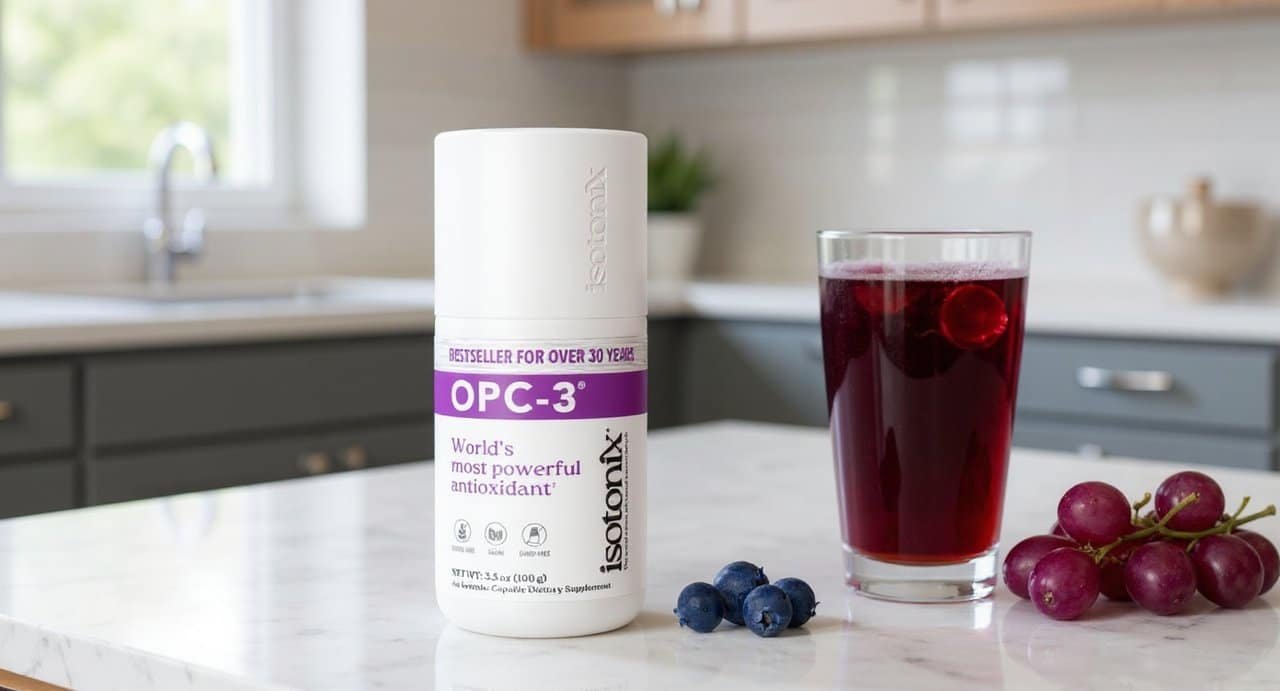 ReviewIsotonix OPC-3 reviewOur top-scored Isotonix product: four extracts plus a citrus bioflavonoid complex, isotonic form, and the research behind it.
-
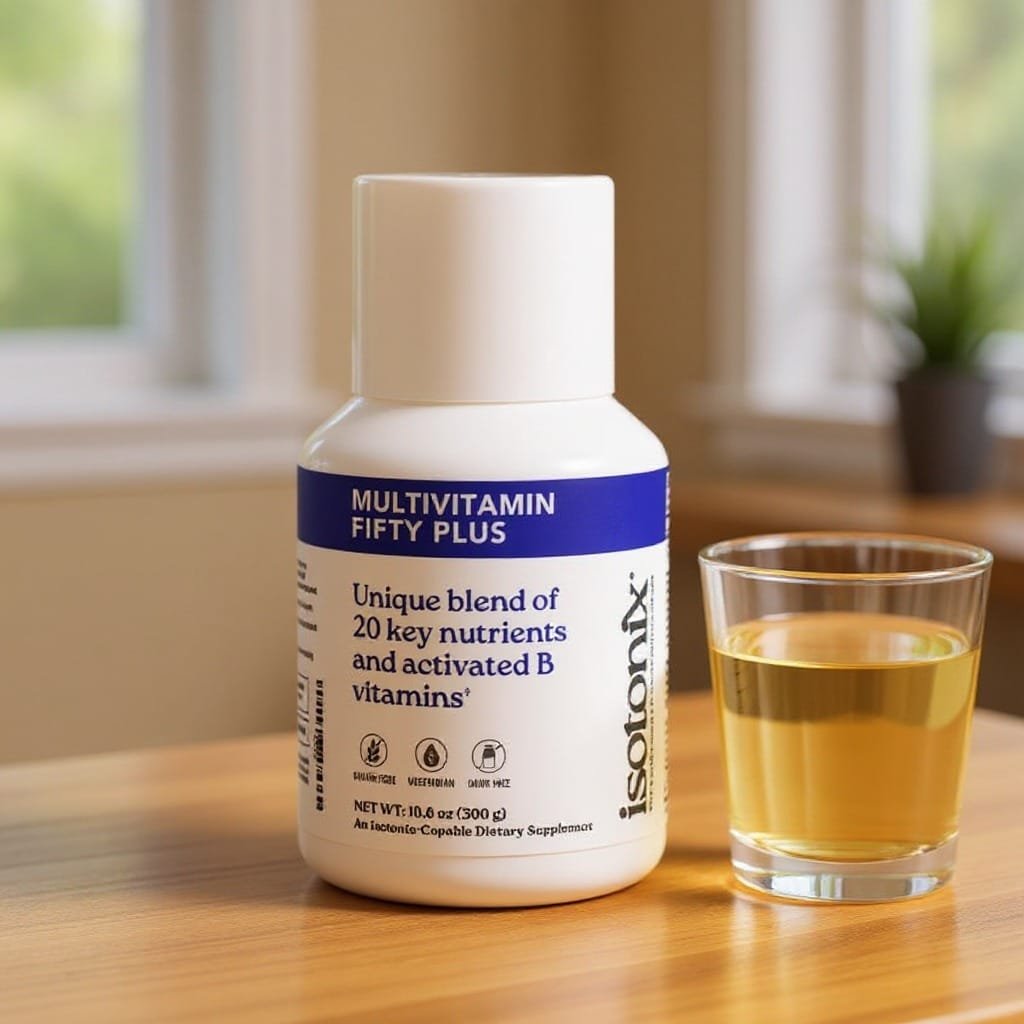 ReviewIsotonix Multivitamin reviewThe 50+ formula. Does the drink format actually absorb better?
-
 ComparisonIsotonix vs capsulesWhat isotonic delivery changes, and where a capsule is just as good.