 Inspire
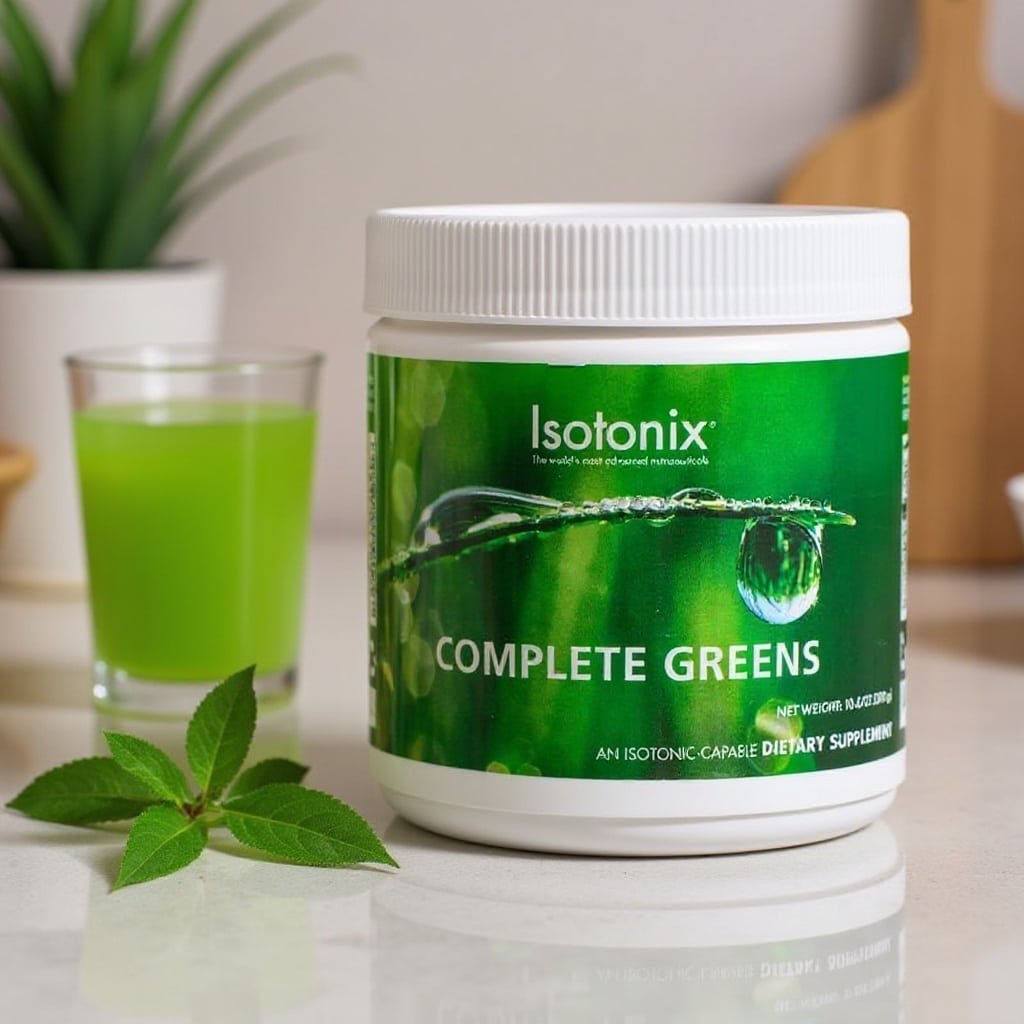
Isotonix Complete Greens Review
Most people don’t eat enough vegetables, and a green powder can’t fully fix that. Here’s exactly what’s in this one — eight named organic ingredients, no proprietary mystery blend — and an honest read on what a greens powder can and can’t do.
our rating
What we liked
- All 8 active ingredients are named on the label — no hidden “proprietary greens blend”
- Real 4.6-star rating across 64 customer reviews at the time of writing, several specifically mentioning digestive regularity
- Isotonic powder format mixes into water in seconds, no capsules
- Vegan, dairy-free, no detectable GMOs per the product’s own classification
What to know
- Each of the 8 ingredients is dosed in the 225–350 mg range — well below the roughly 1 g/day amounts used in the clinical research behind ingredients like spirulina and chlorella specifically
- The “alkalize” and “support pH balance” framing overstates what diet can do — your lungs and kidneys tightly regulate blood pH regardless of what you eat, so treat this as marketing language, not a mechanism
- A greens powder supplements your vegetable intake, it doesn’t replace it — whole-vegetable fiber isn’t replicated here (this product contains no listed fiber)
- At the time of writing this product is backordered due to demand — check current stock before planning around it
Key takeaways
- The formula names all 8 organic ingredients directly: spirulina, wheat grass, barley grass, alfalfa grass, chlorella, broccoli powder, spinach powder, and cabbage powder.
- Real customer reviews (64 at time of writing, 4.6 average) repeatedly mention digestive regularity as the most noticed effect, more than any other benefit.
- This product is currently backordered due to demand — worth checking current stock status before you commit to it as a daily habit.
- A greens powder is a genuine convenience tool, not a substitute for eating vegetables — the fiber structure and full nutrient matrix of whole food isn’t fully replicated in powder form.
Who it’s for (and who should skip it)
Greens powders are one of the more honestly useful supplement categories, as long as you’re clear on what they actually do.
Buy it if…
- You genuinely fall short on vegetable intake most days and want a quick, real-food-sourced top-up
- You want a fully named ingredient list, not a proprietary “greens blend” you can’t break down
- You’re fine mixing a powder daily rather than eating more actual vegetables
Skip it if…
- You already eat a genuinely vegetable-heavy diet — you likely don’t need this on top of that
- You’re looking for a fiber replacement specifically — whole vegetables deliver more usable fiber than a powder blend
- You have a sensitivity to any of the 8 named greens/grasses — check the full list before buying
The 8 ingredients, by name
Here’s the simple version: this isn’t a mystery “super greens blend” with a proprietary-formula shield around it. All 8 active ingredients are individually named on the label.
| Ingredient | What it is |
|---|---|
| Organic Spirulina | Blue-green algae, a source of plant-based protein and natural pigments (chlorophyll, phycocyanin) |
| Organic Wheat Grass | The young grass of the wheat plant, harvested before the grain forms |
| Organic Barley Grass | Young barley grass, similarly harvested pre-grain |
| Organic Alfalfa Grass | A legume grass, traditionally used as a source of trace minerals |
| Organic Chlorella | A single-cell freshwater algae, another chlorophyll-dense ingredient |
| Organic Broccoli Powder | Dried, powdered broccoli |
| Organic Spinach Powder | Dried, powdered spinach |
| Organic Cabbage Powder | Dried, powdered cabbage |
Sodium and potassium (as bicarbonates) are also included, standard for Isotonix’s isotonic delivery format, alongside fructose, citric acid, and natural orange/vanilla flavor for taste. One scoop mixes into 8 oz of water; the full canister covers 30 servings.
What a greens powder actually can and can’t do
This is worth being direct about, because greens-powder marketing tends to overreach, and this label is no exception. Start with the “alkalize” and “pH balance” claim: your body regulates blood pH within a very narrow range through your lungs and kidneys, essentially regardless of what you eat. That regulation happens whether or not you take a greens powder, so we’d treat that specific framing as marketing language rather than a real physiological mechanism this product changes.
What we do trust here: the real customer feedback pattern. Across reviews on the official product page, the single most repeated theme is digestive regularity, not a specific “superfood” claim. That’s a plausible, honest effect consistent with a plant-based ingredient blend, even without the higher clinical-study doses. The fair way to think about this product: a modest, convenient nutrient top-up for a day light on vegetables, not a clinically-dosed supplement and not a replacement for actually eating vegetables.
Frequently asked questions
What’s actually in Complete Greens?
Does it contain fiber?
Are the ingredient doses comparable to what’s used in research?
Can this replace eating vegetables?
Does it really help “alkalize” the body?
Is it currently in stock?
“A fully transparent ingredient list undercut by doses well below clinical-study amounts and an “alkalizing” claim your body already handles on its own.”
Every ingredient is named, which is more than most greens powders offer, and the real customer feedback (digestive regularity, repeatedly) is plausible and honest. But at 225–350 mg per ingredient, this sits well below the doses used in the research behind these same ingredients, and the pH-balance framing doesn’t hold up to how the body actually regulates blood pH. Treat it as a mild, convenient top-up, not a clinically-dosed formula.

Related reading
-
 ExplainerIs Isotonix Immune Worth Taking Daily?Built around Wellmune, a specific researched beta-glucan.
 -
 ReviewIsotonix Astaxanthin ReviewA 6 mg AstaReal dose, and what makes astaxanthin different.
 -
 ExplainerIs NutriClean Safe? What’s Actually in the CleanseAn honest look at detox-cleanse claims.
Sources
- How the body actually regulates blood pH: Merck Manual on Acid-Base Balance.