 Inspire
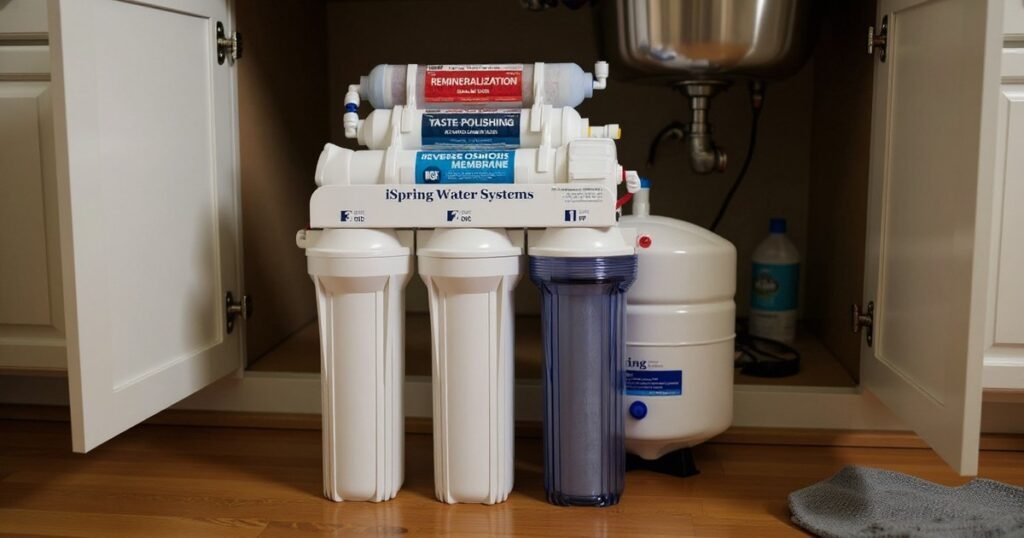
Best Reverse Osmosis System in Canada (2026)
Six under-sink systems, the NSF 58 listings we could confirm, and what they really cost to run.
Prices checked November 21, 2026 · 9 min read · Includes affiliate links
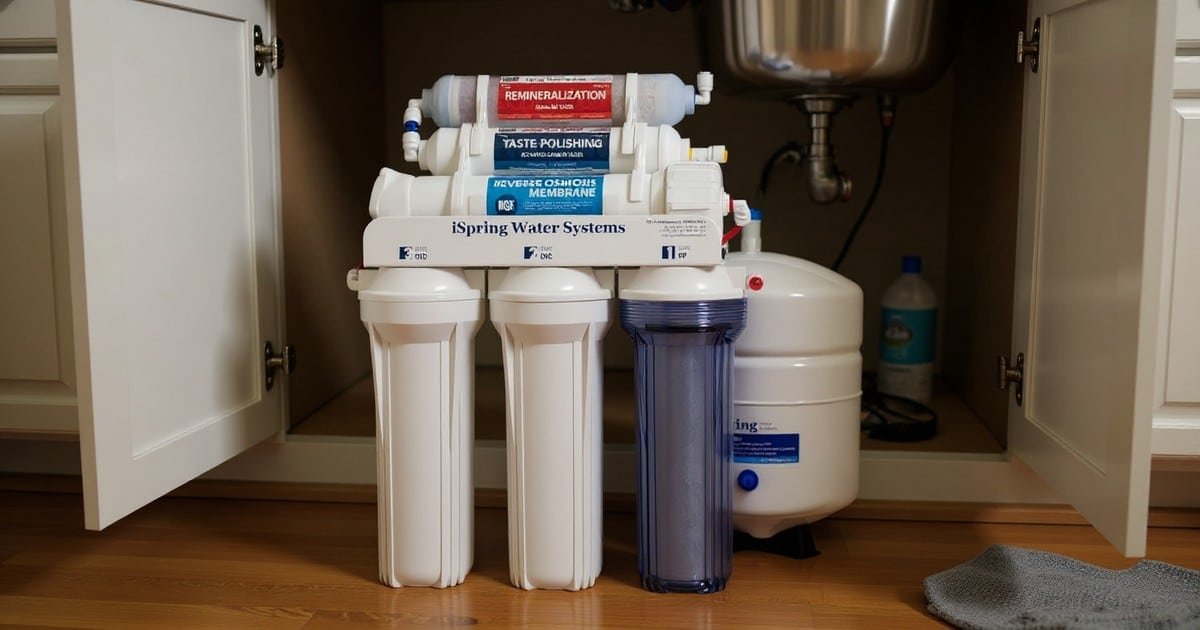
For the best-documented RO system at the best price, buy the iSpring RCC7AK-BN. Want tankless? It runs about $170 to $240 more, needs a power outlet, and comes with open questions.
We didn’t lab-test any of these. We read the listings, searched the NSF database and checked Health Canada’s guidance, and we say where the proof stops.
Some links on this page are affiliate links, and we may earn a commission at no extra cost to you. As an Amazon Associate we earn from qualifying purchases. Prices were seen on Amazon.ca on November 21, 2026, during Black Friday week. Prices change.
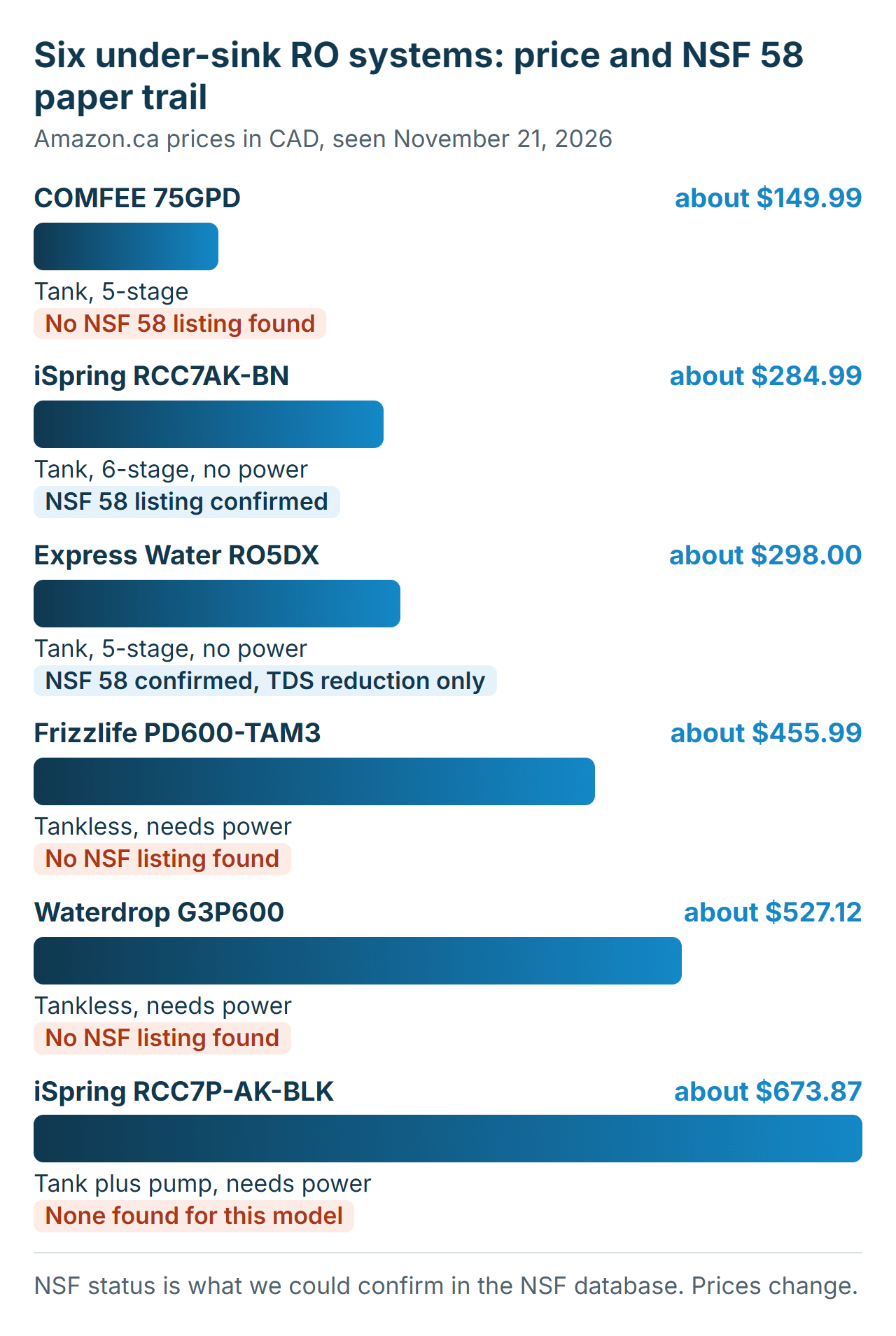
- Best documented: iSpring RCC7AK-BN, about $284.99. NSF/ANSI 58 listing confirmed.
- Also confirmed: Express Water RO5DX, about $298.00. Listed for TDS reduction only.
- Best tankless: Frizzlife PD600-TAM3, about $455.99. We found no NSF listing.
- Cheapest: COMFEE 75GPD, about $149.99. Thinnest paper trail.
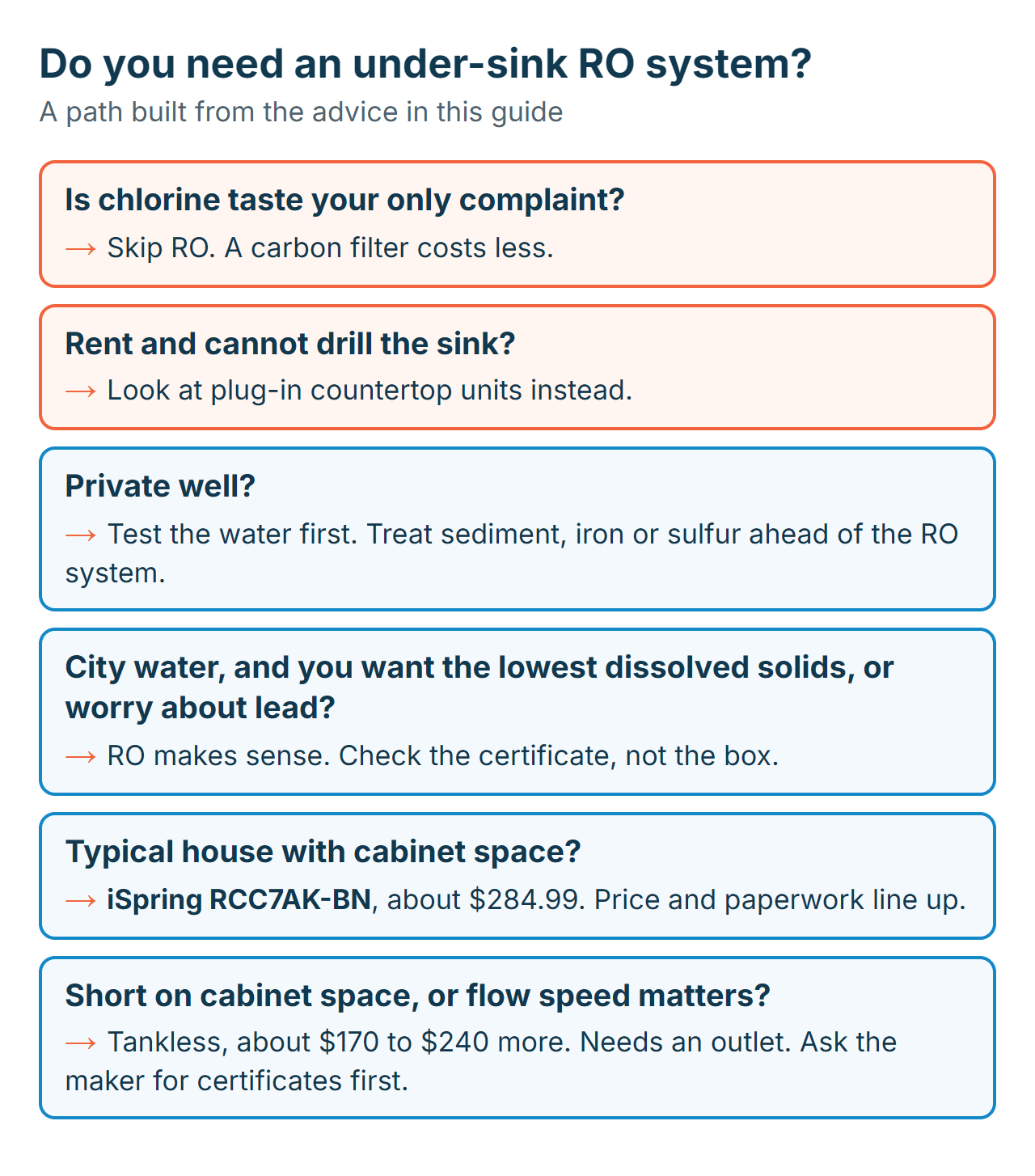
- Skip RO if chlorine taste is your only complaint. A carbon filter costs less.
Our picks at a glance
| System | Type | Price seen | Needs power | NSF 58 listing we could confirm |
|---|---|---|---|---|
| iSpring RCC7AK-BN | Tank, 6-stage | about $284.99 | No | Yes, in the NSF database |
| Express Water RO5DX | Tank, 5-stage | about $298.00 | No | Yes, TDS reduction only |
| Frizzlife PD600-TAM3 | Tankless, 600 GPD | about $455.99 | Yes | None found |
| Waterdrop G3P600 | Tankless, 600 GPD | about $527.12 | Yes | None found (the listing claims it) |
| COMFEE 75GPD | Tank, 5-stage | about $149.99 | No | None found (title says “NSF Certified”, text names 372 only) |
| iSpring RCC7P-AK-BLK | Tank plus pump | about $673.87 | Yes | None found for this model |
Who actually needs RO in Canada
Most people on a city supply don’t need RO for safety. Health Canada says water from a community system that meets the Guidelines for Canadian Drinking Water Quality usually needs no extra treatment for health reasons.
RO makes sense in a few cases. Your tap water tastes off and you want the lowest dissolved solids you can get. You have a private well and your test shows something a carbon filter can’t handle. You worry about lead in older plumbing. Or you’re hauling bottled water and want to stop.
If chlorine taste is the whole complaint, read our RO vs carbon filter comparison and our best under-sink water filters guide first. For Ontario city water, reported hardness by city is a quick way to see what you’re starting with.
What NSF/ANSI 58 means, and what “tested by SGS” doesn’t
Health Canada strongly recommends a device certified to the applicable NSF/ANSI standard, and standard 58 is the one for RO systems. Its Q&A page says certification means the device adds nothing harmful to the water and the maker’s claims covered by the standard were verified. The mark has to come from a body accredited by the Standards Council of Canada, such as CSA Group, NSF, UL or the Water Quality Association. It also warns that makers can make claims outside the standard that certification doesn’t check.
In practice the listings use three different phrases:
- Certified to NSF/ANSI 58: there should be an entry in a certifier’s database. We could confirm that for two systems.
- Certified to NSF/ANSI 372: lead-free materials. It says nothing about what the membrane removes.
- Tested by a lab, such as SGS: a lab report. Not certification.
Two examples. The iSpring listing claims TDS reduction of 93 to 98%, PFAS 96 to 99% and more than 1,000 other contaminants. The NSF entry we read for the RCC7AK-BN lists asbestos, barium, cadmium, chromium III, copper, fluoride, lead, selenium and TDS. That doesn’t mean the PFAS claim is false. It means the certification we could see doesn’t cover it.
The Waterdrop G3P600 title says NSF/ANSI 42, 53, 58 and 372 certified, and the text says certified against 58 for TDS reduction. Our NSF search for Waterdrop returned nothing. It may be certified through another body, so ask Waterdrop for the certificate number and look it up.
Tank vs tankless: drain, pressure and space
Tank systems (the iSpring RCC7AK-BN, the Express RO5DX and the COMFEE) fill a storage tank slowly and need no electricity, going by their listings. They take more room. The iSpring listing gives the unit as 12.5 kg.
Tankless systems (Frizzlife, Waterdrop) filter on demand. The listings say a cup fills in 8 to 10 seconds. Both need an outlet under the sink, and the Waterdrop listing says to drill two holes, one for the 1-inch faucet and one for the drain connection.
Booster pump: the iSpring RCC7P-AK adds a pump to push water through the membrane. It also needs an outlet.
Drain ratios are maker figures. The three listings that state one say 2:1. The tank models’ listings we read state none.
Pressure matters. COMFEE’s own note says its 75 GPD drops to 50 if water pressure is below 0.25 MPa (about 36 psi) and the water is colder than 25°C. Treat every GPD number in a product name as a best case.
The 6 systems reviewed
If we were buying for a typical house with cabinet space, we’d take the iSpring RCC7AK-BN. It’s the one where the price and the paperwork line up. The Express Water RO5DX is a fair second if you want the leak-stop valve. We’d only pay for tankless if cabinet space or flow speed is a real problem, and then we’d ask the maker for certificates first.
Who shouldn’t buy: renters who can’t drill a sink, and anyone whose only gripe is chlorine taste.
Real cost: purchase, filters and water
| System | Price seen | Filter schedule on the listing | Filter price we saw |
|---|---|---|---|
| iSpring RCC7AK-BN | about $284.99 | Sets for 6 months, 1, 2 and 3 years (F4AK, F9K, F19K75, F28K75) | Maker says $0.17 a day, about $62 a year. That is their figure |
| Express Water RO5DX | about $298.00 | Pre and post filters twice a year, membrane once a year (maker) | 3-year set of 23 filters, $107.69, so about $36 a year if the label holds |
| COMFEE 75GPD | about $149.99 | Sediment 4 to 6 months, carbon stages 6 to 12 months, membrane 2 to 3 years (maker) | CMP10-F replacement set, $97.99. The listing doesn’t say how long a set lasts |
| Frizzlife PD600-TAM3 | about $455.99 | Carbon 1 year, membrane 2 years, mineral stage 1 year | First-stage filter ASR211, $56.99 |
| Waterdrop G3P600 | about $527.12 | Carbon 6 months, carbon block 12 months, membrane 24 months | Optional MNR35 mineral filter, $49.99. We didn’t see prices for the main filters |
| iSpring RCC7P-AK-BLK | about $673.87 | Not stated in the listing we read | Not seen |
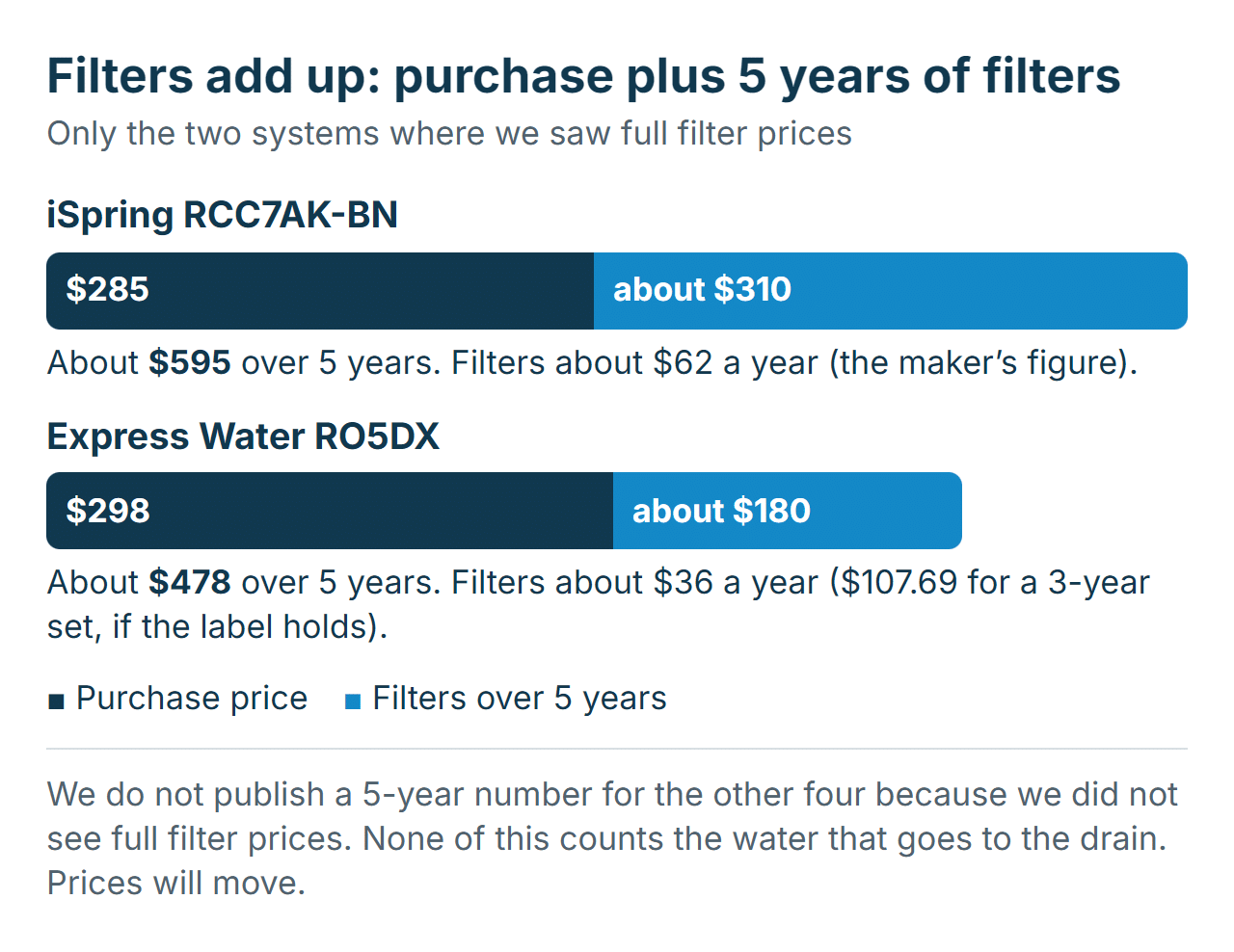
Here’s the math where we have the numbers. The iSpring RCC7AK-BN at about $62 a year in filters (their figure) comes to roughly $595 over 5 years. The Express RO5DX at about $36 a year from the 3-year set price comes to roughly $478. We don’t publish a 5-year number for the others because we didn’t see full filter prices. None of this counts the water that goes to the drain. Prices will move, so redo the sum with the filter price on the day you buy.
Installing in a Canadian kitchen
Tie into the cold-water supply and follow the manual. Check your shutoff valve first. The iSpring adapter fits 1/2” NPT and 3/8” compression, and Express Water says its brass feed adapter fits 1/2” and 3/8” pipes.
The hard part is usually the faucet hole. Drilling stainless steel or stone takes the right bit and some patience, and one iSpring reviewer says to have a pro drill granite. Another iSpring buyer says they installed it in a couple of hours.
Tankless and pump models need an outlet under the sink. If you don’t have one, budget for an electrician or pick a no-power tank model.
Put the unit in a drip tray or add a water alarm. Buyers on most of these listings mention leaks, and Express includes a leak-stop valve in the box.
If you rent, ask your landlord first. Drilling a sink is permanent. If they say no, our best countertop reverse osmosis filters in Canada guide covers plug-in units that need no plumbing.
Well water and RO: test first
Health Canada says private well owners should test their water regularly, and lists point-of-use devices as one option for an unsafe supply, with a qualified water treatment specialist consulted. Start with our well water problems diagnostic guide.
Express Water and iSpring both describe their sediment and carbon stages as protecting the RO membrane. If your well water carries sediment, iron or sulfur, plan on treating it ahead of the RO system.
None of the NSF entries we read list a bacteria claim, so don’t treat any of these as disinfection. If a lab finds bacteria, follow your health unit’s advice.
How we picked
We didn’t buy or lab-test these systems. On November 21, 2026 we read each Amazon.ca listing, searched the NSF certification database by brand and company name (a system listed under its factory’s name would not show up), and read Health Canada’s guidance on treatment devices and PFAS. We picked six in-stock systems across a range of prices and formats. A spec we couldn’t source was dropped, not guessed. We don’t know the commission rate on any of these and it didn’t change the order.
Frequently asked questions
Does reverse osmosis remove PFAS?
Only if the specific system is certified for it. Health Canada’s objective is 30 ng/L for the sum of 25 PFAS, published August 9, 2024 and meant to stand until a full guideline is developed. Its page says RO devices can be certified to NSF/ANSI 58 for reducing seven PFAS to a total of 20 ng/L or less. iSpring’s listing claims 96 to 99% PFAS reduction, but the NSF entry we read for the RCC7AK-BN lists metals and TDS, not PFAS. Before you buy for PFAS, ask the maker for the certificate and check that the PFAS claim is on it.
Does RO waste a lot of water?
The three listings that state a ratio (Waterdrop G3P600, Frizzlife PD600, iSpring RCC7P-AK) say 2:1, meaning about one cup of drain water for every two cups of pure water. The tank models we looked at don’t state a ratio, so we won’t guess one. These are maker figures. Our RO vs carbon filter comparison has a water-waste section.
Is RO bad because it removes minerals?
RO does remove minerals like calcium and magnesium. Health Canada says that in Canada drinking water is a minor source of them compared with food, and that people eating a reasonably balanced diet don’t need a supplement for that reason. We don’t make health claims for the alkaline or mineral stages.
Will it fix lead in my water?
Check the certificate, not the box. Health Canada’s limit is 0.005 mg/L (5 µg/L), set in a technical document dated March 8, 2019. The NSF entry for the iSpring RCC7AK-BN lists a lead reduction claim. We found no NSF entry for the others, so for them you’re relying on the maker. If lead is the worry, test your tap water first.
How often do the filters need changing?
Use the maker’s schedule from the cost table above. They range from 6 months for the first stages to 2 or 3 years for the membrane. Health Canada says following the maintenance instructions is very important for keeping a treatment device effective, and that the upkeep can feel like a burden.
Can I install it myself?
Every listing pitches it as a DIY job. One iSpring buyer says they installed it in a couple of hours, and another suggests a pro drill the faucet hole in granite. If you aren’t comfortable cutting into a drain line or drilling a sink, hire a plumber.