 Inspire
Best Radon Detector in Canada (2026): 5 C-NRPP Approved Monitors
Health Canada says to buy only monitors that passed C-NRPP testing. Here are five on that list that you can buy on Amazon.ca, and the ones to skip.
November 21, 2026 · 9 min read · Includes affiliate links
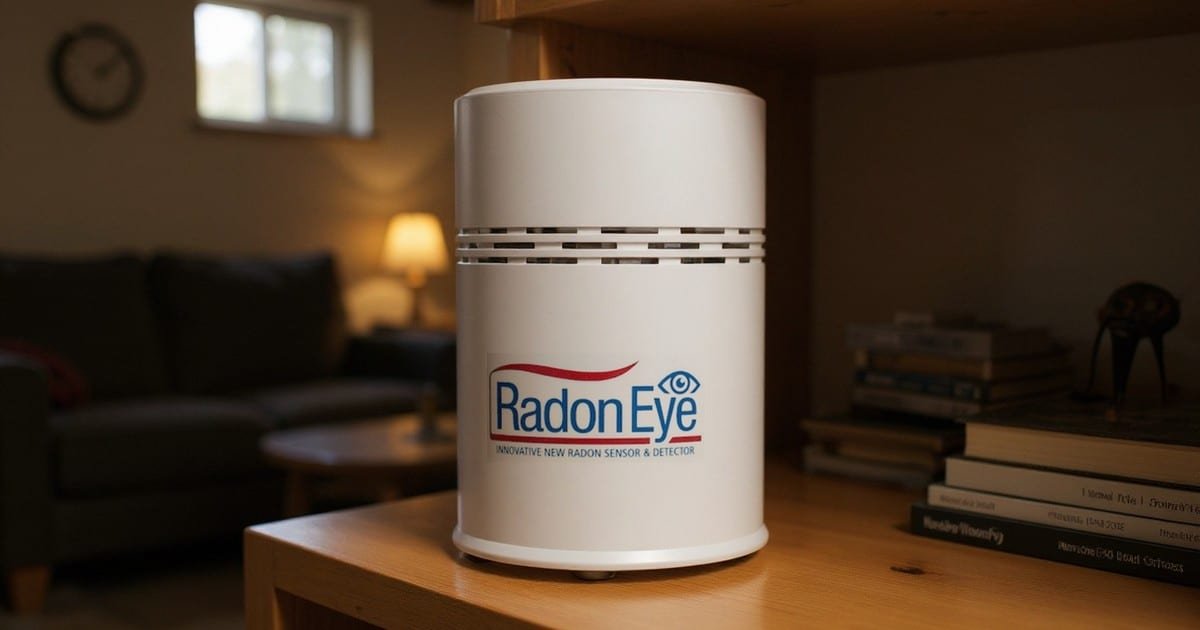
Only buy a radon monitor that is on the C-NRPP approved list.
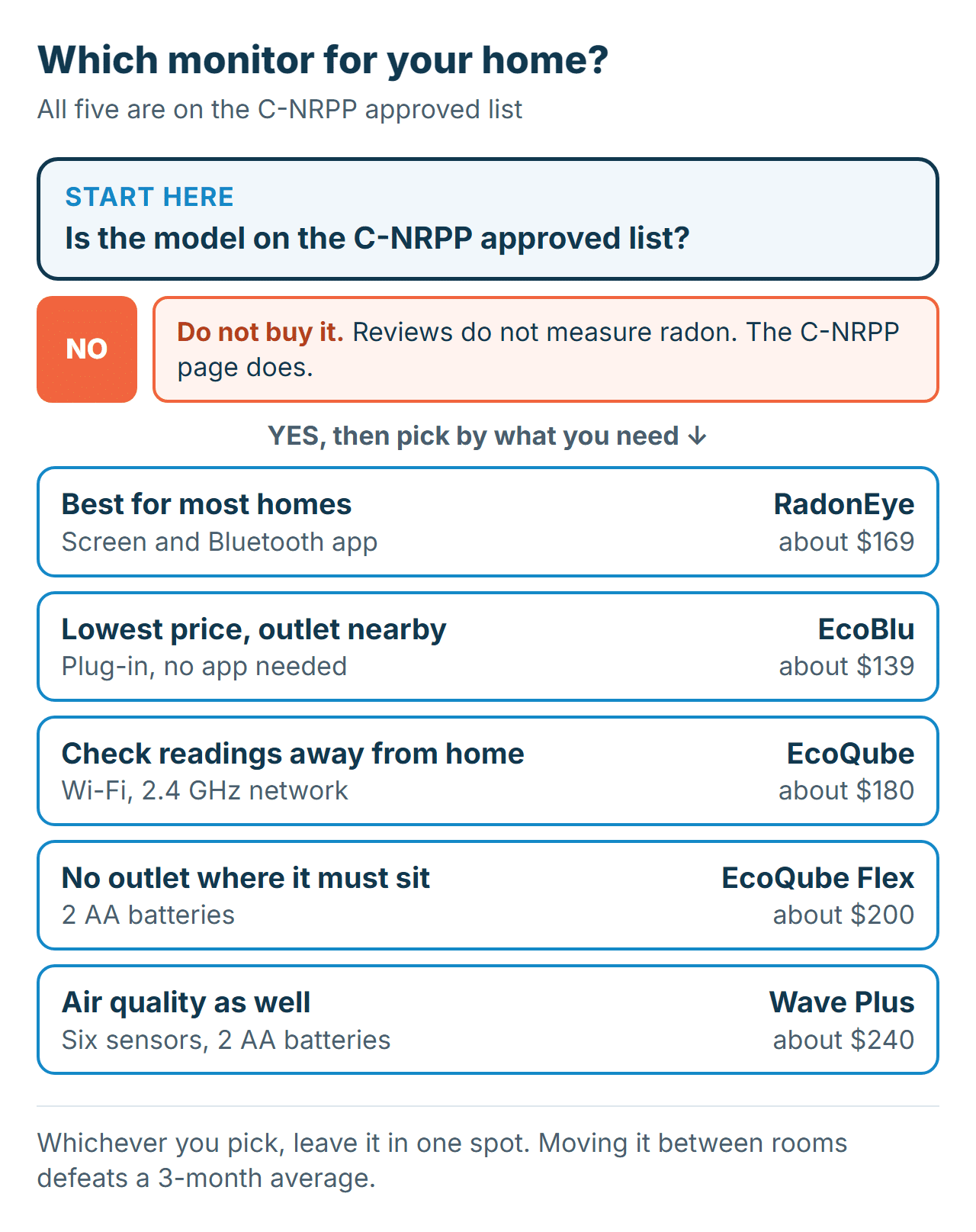
- Ecosense RadonEye: best for most homes, about $169.
- Ecosense EcoBlu: best budget, about $139, plug-in.
- Ecosense EcoQube: best if you want Wi-Fi, about $180.
- Ecosense EcoQube Flex: best on batteries, about $200.
- Airthings Wave Plus: best if you want air quality too, about $240.
Some links below are affiliate links. If you buy through them we may earn a commission, at no extra cost to you. It doesn’t change our picks. Prices are from Amazon.ca on November 21, 2026 and change.
What counts as a valid radon test
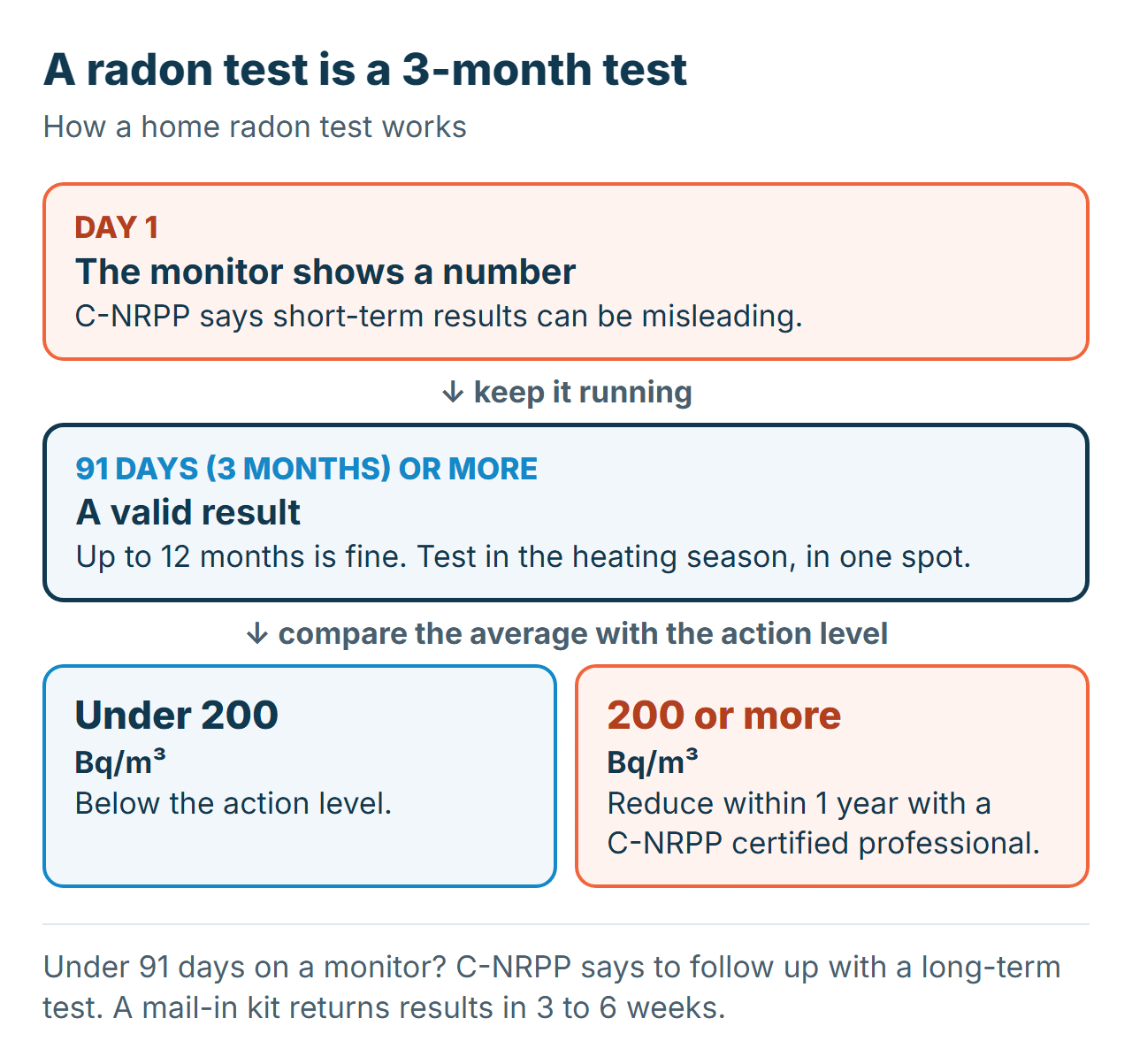
Health Canada’s test instructions give you two options. One is an electronic radon monitor that has passed C-NRPP performance testing. The other is a long-term detector from a mail-in kit, which goes to a lab and comes back with results in 3 to 6 weeks.
Either way, the test runs for at least 3 months. Health Canada says up to 12 months is fine. The action level is 200 Bq/m³. If your result is 200 or higher, Health Canada says to reduce it within 1 year, using a C-NRPP certified mitigation professional.
That 3-month figure is the part most people miss. A monitor shows a number on day one, but C-NRPP says short-term results can be misleading. If you use a monitor for less than 91 days, C-NRPP says to follow up with a long-term test.
The recall problem on Amazon.ca
Health Canada’s Radiation Protection Bureau tested some radon detectors sold on Amazon.ca and found they measure radon inaccurately. Its May 7, 2025 advisory named the Funny Kitchen Home Radon Detector (HRDM-02) and the Boyd Gresham “Toolhome” Radon Detector (HRDM-01B). Amazon.ca removed both. If you own either, Health Canada says to stop using it and dispose of it under your municipality’s electronic waste rules.
The problem hasn’t gone away. On November 16, 2026, during Radon Action Month, Health Canada posted a public advisory on inaccurate radon detectors sold online. It says a faulty monitor can read too low or too high, and the biggest risk is that you stay exposed to high radon without knowing you should act. It tells you to test in winter, to run a long-term test of at least 3 months, and to buy only electronic monitors that have passed C-NRPP performance testing. Health Canada’s recalls site has the full list of recalled detectors.
C-NRPP keeps a published list of tested monitors. Its not-approved list marks these as recalled by Health Canada: Air Steward, Boyd Gresham, Funny Kitchen HRDM-02, Hanchen, INKBIRD Home Radon Meter, INKBIRD INK-RD2, LifeBasis LSRM001 and LCARM001, Radon Guard, and Spolehli. The list has other names on it that aren’t marked as recalled but also didn’t pass.
A cheap monitor with a nice app and thousands of reviews can still be on that list. Reviews don’t measure radon. The C-NRPP page does.
Our picks
This section contains affiliate links. We may earn a commission at no extra cost to you.
Every monitor below is on C-NRPP’s approved list, and every one had a live Amazon.ca listing with a price when we checked. We haven’t tested any of them ourselves.
The 5 compared
| Model | C-NRPP stated accuracy | How you read it | Price (CAD) |
|---|---|---|---|
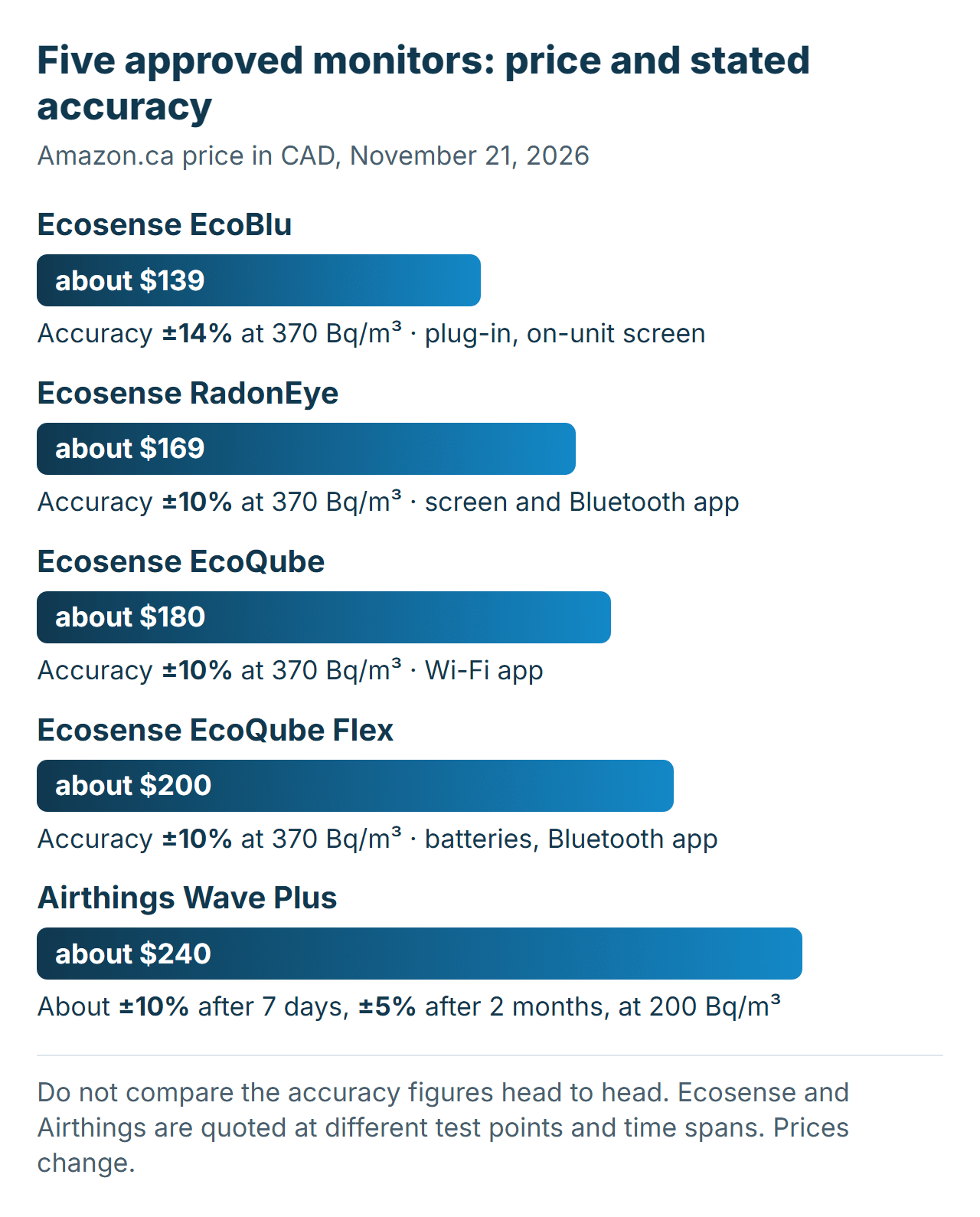
| Ecosense RadonEye | ±10% at 370 Bq/m³, 10 hours | Screen, Bluetooth app | about $169 |
| Ecosense EcoBlu | ±14% at 370 Bq/m³, 10 hours | Screen, plug-in | about $139 |
| Ecosense EcoQube | ±10% at 370 Bq/m³, 10 hours | Wi-Fi app | about $180 |
| Ecosense EcoQube Flex | ±10% at 370 Bq/m³, 10 hours | Screen, Bluetooth app, batteries | about $200 |
| Airthings Wave Plus | ±10% after 7 days, ±5% after 2 months (Airthings states these at 200 Bq/m³) | Bluetooth app, web dashboard | about $240 |
Prices are an Amazon.ca snapshot from November 21, 2026 and change. Don’t compare the accuracy percentages head to head. Ecosense and Airthings are quoted at different test points (370 vs 200 Bq/m³) and over different time spans.
Models we left out
The original Airthings Corentium Home is on the C-NRPP list. Its Amazon.ca listing (about $179.99) was out of stock when we checked, so there’s no button for it. If it comes back, it’s worth a look.
The Airthings View Plus is also on the C-NRPP list and was listed on Amazon.ca at about $375. We left it out because of the price.
A few other models sell on Amazon.ca and don’t appear on the C-NRPP page we read on November 21, 2026: the Airthings Corentium Home 2, the Airthings Wave Radon, the Aranet Radon Plus and the X-Sense monitors. That’s not a finding that they’re inaccurate. It means we couldn’t confirm they passed, and Health Canada’s advice is to buy ones that did. Look at the C-NRPP page again before you buy any of them, because its list can change.
How we picked
We started with C-NRPP’s approved list and kept the models sold on Amazon.ca with an in-stock listing and a price. Specs come from C-NRPP, Airthings’ help page and the Amazon listings, and anything we couldn’t source we left out. We didn’t lab test or live with these units.
One more thing from C-NRPP. These monitors can’t be professionally calibrated and aren’t approved for use by radon measurement professionals. A home monitor is a way to find out about your own home. It isn’t a replacement for a professional measurement.
What we do with radon at home
I’m Michael with Inspire Company. We have tested radon ourselves, and the main lesson is to keep testing. One reading is only a snapshot. Radon moves with the season, the weather and how closed-up the house is, and a renovation or a new furnace can change it. Health Canada says to test for at least 91 days, ideally between October and April, and to test again every five years.
It is also more common than most people expect. Health Canada’s page on its national survey puts nearly 18% of Canadian homes at or above 200 Bq/m³. Our radon table by health region shows how much it differs by area.
Where to put it
Health Canada says to use the lowest level of your home where people spend time, like a family room, bedroom, playroom or finished basement. Keep the monitor at breathing height, about 0.5 to 2 m off the floor, on a flat surface or hung from a wall or ceiling.
Avoid kitchens, bathrooms, laundry rooms, closets and unfinished basements. Stay away from windows, doors, vents, exterior walls, heat sources like fireplaces and direct sunlight, and electronics and appliances. C-NRPP adds that the room should be one you’re in for at least 4 hours a day, and that you should test in the heating season, when indoor levels are typically highest.
Then leave it alone. Moving it to check different rooms defeats the point of a 3-month average.
Basements and humidity
If your only lived-in level is a finished basement, that’s where the monitor goes. If the basement is damp, check the humidity rating first. The Amazon listing for the Wave Plus gives a non-condensing humidity range of 0 to 85%, and a basement that’s dripping with condensation is outside that. We couldn’t find the same limit stated for the Ecosense models, so read the manual for the one you choose.
Radon and dampness are separate problems. Health Canada points to a C-NRPP certified mitigation professional for lowering a high radon level. For the moisture side, our best dehumidifier for a basement guide covers sizing and low-temperature operation. If you’re sealing up the house for winter, see our guides to humidifiers for dry winters and air purifiers for allergies. And if a smart thermostat is on your list, there’s a Canadian thermostat comparison too.
What to do with your number
Under 200 Bq/m³ after 3 months or more. That’s below Health Canada’s action level. Keep the monitor for another season if you like, since readings move.
200 Bq/m³ or higher. Health Canada says to reduce it within 1 year. Hire a C-NRPP certified radon mitigation professional.
A high number in the first few days. Short-term readings can be misleading. Keep the monitor running for the 3 months Health Canada’s long-term test calls for. If the average is 200 or higher, move to the next step.
Used a recalled detector. Stop using it and test again with a C-NRPP approved monitor or a long-term kit.
Frequently asked questions
How long do I need to test for radon?
Health Canada says at least 3 months, and up to 12 months is acceptable, for both electronic monitors and long-term detectors. C-NRPP recommends testing in the heating season. If you use a digital monitor for less than 91 days, C-NRPP says to follow up with a long-term test.
What radon level is too high in Canada?
Health Canada’s action level is 200 Bq/m³. At 200 or higher, it says to take action to reduce the level within 1 year. Use a C-NRPP certified mitigation professional.
Why does it matter which radon detector I buy?
Health Canada found some detectors sold on Amazon.ca measure radon inaccurately, and says they likely pose a danger to human health or safety. A reading that’s too low can falsely reassure you. Health Canada describes long-term radon exposure as the second leading cause of lung cancer in Canada after smoking. Its advice is to buy only electronic monitors that have passed C-NRPP performance testing.
Can a digital monitor replace a long-term test or a professional?
A monitor that passed C-NRPP testing and ran for 3 months or more is one of the two options Health Canada lists for a long-term test. It isn’t a professional measurement. C-NRPP says these devices can’t be professionally calibrated and aren’t approved for use by radon measurement professionals.
I already own a monitor. How do I check it?
Look for the exact model name on the C-NRPP consumer report, in both the approved and not-approved lists. If it’s marked recalled, Health Canada says to stop using it and dispose of it under your municipal electronic waste rules. If it isn’t listed at all, we can’t tell you either way.
Where should I put the monitor?
On the lowest level where you spend time, at breathing height (about 0.5 to 2 m), away from kitchens, bathrooms, laundry rooms, closets, unfinished basements, windows, doors, vents and heat sources. It should be a room you’re in at least 4 hours a day.
Last updated November 21, 2026. Prices and listings change, so check before you buy.
As an Amazon Associate we earn from qualifying purchases.