 Inspire
Best Cooling Fan for a Canadian Heat Wave (2026)
About 1 in 3 Canadian homes has no air conditioning at all. Here’s what a fan can actually do about a heat wave, and where it stops working.
Updated July 25, 2026 · 8 min read · ✓ Fact-checked · Includes affiliated links
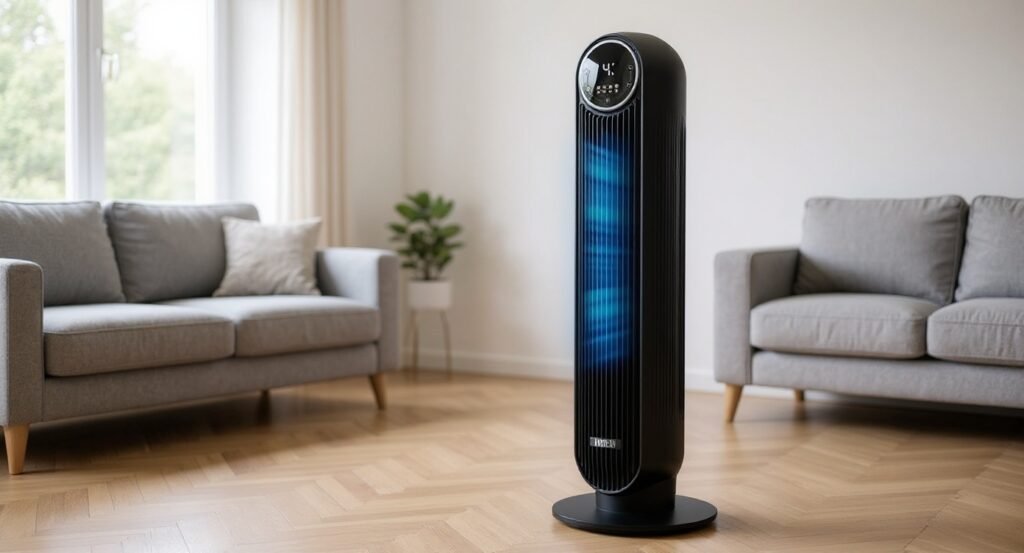
Health Canada’s own guidance: a fan helps you feel cooler, but stops actually cooling your body above roughly 35°C. Below that, the DREO tower fan is the strongest all-around pick, quiet enough for a bedroom with real oscillating coverage. Need to actually move air in a big room, the Hurricane box fan has real CFM behind it. Worried about a power outage, the Caframo Sirocco II runs for days on a car battery or power station instead of hours.
This isn’t a small caveat. Health Canada states it directly: fans are “ineffective at cooling the body at temperatures over 35°C.” Past that point, a fan is just moving hot air around.
Every pick below has a real, verified Amazon.ca listing, price, and review history. But the honest starting point is Health Canada’s own limit: a fan doesn’t lower your body temperature once the air itself passes about 35°C, it just circulates heat faster. Below that threshold, a good fan genuinely helps and costs a fraction of running air conditioning. We picked for real airflow, real noise levels, and what actually shows up in owner reviews, not marketing copy.
Our picks
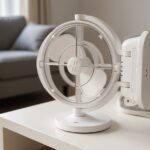
Why a fan stops working above 35°C
Health Canada’s own heat safety guidance states it plainly: “Use a fan to help you stay cool and aim the air flow in your direction. Note: While fans can help you feel more comfortable, they are ineffective at cooling the body at temperatures over 35°C.”
The mechanism is simple. A fan cools you by speeding up evaporation and convection, moving air across your skin so sweat evaporates faster and body heat transfers into the surrounding air. That only works while the air is cooler than your skin. Once the air itself passes roughly 35°C (the exact threshold shifts a few degrees with humidity and clothing), a fan is just blowing hot air across you faster, which can feel worse, not better.
Below that threshold, a fan is genuinely useful and costs a fraction of running air conditioning. Above it, the real fix is a cool space, whether that’s air conditioning, a basement, or a public cooling centre, not a stronger fan setting.
Why this matters more in Canada than it sounds
Statistics Canada’s own numbers: only 68% of Canadian households have air conditioning at all. In homes built before 1960, that drops to 58%. In BC specifically, it’s just 45%, meaning more than half of BC households have no AC to fall back on. For a real share of the country, a fan isn’t a supplement to air conditioning, it’s the only cooling equipment in the house.
That gap showed up directly this July: Ontario and Quebec saw heat warnings from late June into mid-July, with humidex values reaching 38-45. The heat came with real grid strain, Hydro-Québec reported 100,000 customers without power on July 2 (50,000 still out the next morning), and close to 44,000 Nova Scotia Power customers lost power in the Halifax area July 3-4. If you’re weighing a battery or dual-power fan for exactly that scenario, our portable power station guide and portable generator guide cover the bigger backup-power picture.
Frequently asked questions
Do fans actually cool a room, or just move air around?
A fan doesn’t lower a room’s actual temperature, a thermometer reads the same before and after you switch one on. What changes is evaporation and convection off your skin, which is why standing in front of one can feel several degrees cooler. That only holds while the air is cooler than your skin; past roughly 35°C, per Health Canada’s guidance, a fan stops helping and can even feel worse, since it’s just moving hot air faster across you. The exact cutoff shifts a few degrees with humidity and what you’re wearing, so treat 35°C as a guideline, not a hard line.
At what temperature should I stop relying on a fan alone?
Health Canada’s own number is 35°C air temperature. Past that, a fan isn’t cooling your body anymore, it’s circulating hot air, and the fix is a genuinely cooler space: air conditioning, a basement, or a public cooling centre. Worth knowing in advance where that space is, since Statistics Canada found only 68% of Canadian households have air conditioning at all (as low as 45% in BC), so for a lot of people that fallback isn’t just down the hall.
Can I run a fan during a power outage?
A standard AC-only fan won’t run without grid power, so you need something battery-powered or 12V. The Sirocco II pick above is built for exactly this: its draw is low enough, as little as 0.06A, that a car battery, an RV battery, or a portable power station keeps it going for multiple days instead of a few hours. Pair it with a larger power station or generator for a longer outage, and it’ll outlast what batteries alone can manage.
Does CFM or dBA matter more when choosing a fan?
Depends on the room. CFM (cubic feet per minute) is the real measure of how much air a fan actually moves, higher means more airflow for a larger room. dBA is noise level, lower is quieter. For a bedroom, prioritize a low dBA rating even if it means less CFM. For a large living room or basement, prioritize CFM, since a quiet fan that can’t move enough air won’t help much in a bigger space.