 Inspire
Best Well Water Treatment System for Iron, Sulfur & Sediment (Canada, 2026)
Real systems for iron, sulfur, and sediment — matched to what’s actually in your water, not just your budget.
Updated July 2026 · 8 min read · ✓ Fact-checked · Includes affiliated links
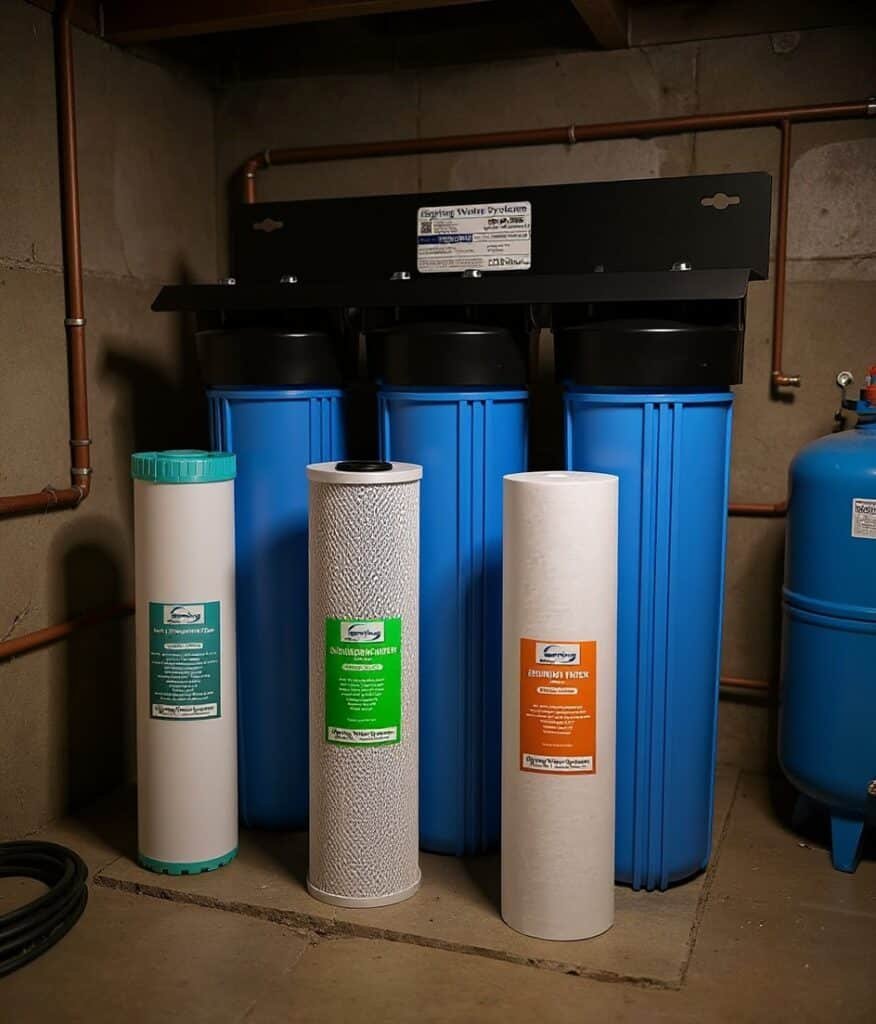
Iron, sulfur, and sediment are three different problems with three different fixes — the wrong one won’t just underperform, it’ll clog within weeks.
Match the system to what’s actually in your water, not the price tag. Already have a Big Blue housing and light iron or sulfur? A ~$228 refillable KDF cartridge is enough. Starting from nothing with a dedicated iron/manganese problem? The iSpring WGB32BM (~$826, 4.4★ from 1,300+ buyers, several confirmed on real Canadian well water) is the safest default. Also dealing with hard water on top of iron and sulfur? A combined softener-and-filter bundle like the PRO+AQUA Elite (~$2,530) treats both in one install.
Test your water first — iron, sulfur, and hardness need genuinely different media, and guessing wrong means paying twice.
Key takeaways
- Iron, sulfur, and hardness need different filter media — a system built for one won’t fix the others, and using the wrong one can clog within weeks.
- Ontario well systems run $3,000–$9,500 installed; sediment-only fixes run $200–$800; dedicated iron/sulfur treatment runs $900–$4,000.
- The iSpring WGB32BM has real Canadian well-water reviews confirming it clears rust staining and sulfur smell — the strongest track record of any pick here.
- Test before you buy: iron, sulfur, and hardness each need a different test kit, and treating the wrong contaminant wastes both money and time.
Our picks
The three problems compared
| Problem | Fixes it needs | Typical cost (Canada) |
|---|---|---|
| Sediment only (cloudy, gritty water) | Simple mechanical filter | $200–$800 |
| Iron or sulfur (staining, rotten-egg smell) | Dedicated KDF or air-injection media, matched to the specific contaminant | $900–$4,000 |
| Iron/sulfur + hard water together | Combined filter + softener system | $3,000–$9,500 installed |
Iron, sulfur, and sediment are three different problems
Sediment — sand, silt, rust particles — is purely mechanical. Any decent filter traps it, no special media required. Iron and manganese are different: they need an oxidizing media like KDF or an air-injection system to convert dissolved metal into a solid a filter can actually trap, which is why the iSpring WGB32BM’s iron stage is rated separately from its sediment and carbon stages (reducing iron from a max of 3.0 ppm down to 0.01 ppm, and manganese from 1.0 ppm to 0.01 ppm).
Hydrogen sulfide — the rotten-egg smell — responds to the same KDF-style media as iron, but needs enough of it: one Oceanic Water Systems buyer noted their filter cleared the smell but recommended a heavier KDF85-to-KDF55 ratio than the standard mix for a genuinely high-iron well. If your water tests high on more than one of these, that’s the actual argument for a multi-stage or combined system instead of a single cartridge.
What it actually costs in Canada
A full installed system in Ontario runs $3,000–$9,500 depending on how many contaminants it has to handle, according to local installer pricing guides. Sediment-only filtration is the cheapest fix at $200–$800 since it’s just mechanical filtration. Dedicated iron and sulfur treatment lands in the middle at $900–$4,000. The three picks above span that same range: the Oceanic cartridge is a sub-$250 upgrade to an existing housing, the iSpring WGB32BM is a complete mid-tier system around $826, and the PRO+AQUA bundle sits at the top around $2,530 before installation.
One real cost most listings leave out: a plumber for a multi-stage install. One iSpring buyer priced out a full setup — pre-filter, the WGB32BM, a softener, and a UV stage — at roughly $1,500 including labor for the extra fittings alone, on top of the equipment itself.
Test before you buy — guessing wastes money
Iron, sulfur, and hardness each need a different test, and the systems above are built for specific concentration ranges — the iSpring listing itself says to add a separate softener first if your water tests above 300 ppm TDS, not to expect the iron filter to handle both. A dedicated well test kit tells you what you’re actually dealing with before you spend $200–$2,500 on the wrong media.
Check the NTL Problem-Check well iron test kit →
If you haven’t already, our symptom-by-symptom well water diagnostic guide walks through what each smell, stain, or taste actually points to before you buy anything.
Installation reality
Single-cartridge systems like the Oceanic refill are the easiest — if you already have a housing, it’s a filter swap. The iSpring WGB32BM’s own Canadian reviews describe it as manageable for anyone comfortable with basic plumbing, with Teflon tape on the NPT fittings being the one step reviewers flagged as easy to get wrong. The PRO+AQUA bundle is a bigger job: it’s three separate units that need to be plumbed together in the right order, and at least one buyer specifically hired a plumber after a DIY attempt went sideways. Budget for professional installation on any multi-stage or combined system unless you’re genuinely comfortable with residential plumbing.
Frequently asked questions
Will a whole-house filter remove iron from well water?
Only if it’s specifically rated for iron — look for KDF media, air injection (AIO), or greensand in the specs. A generic sediment-and-carbon filter alone won’t touch dissolved iron or manganese.
How often do I need to change a well water filter?
It depends heavily on how much iron or sulfur is actually in your water. Manufacturer estimates like “up to 12 months” assume moderate levels — real reviewers on high-iron wells report needing to swap cartridges every 3–4 months instead.
Can I install a well water filtration system myself?
Cartridge-style systems and single-tank units are commonly DIY-installed by anyone comfortable with basic plumbing. Larger combined filter-and-softener bundles involve plumbing multiple units together correctly and are more often worth a professional install.
Do I need a water softener too, or just an iron filter?
That depends on whether hardness (calcium and magnesium) is also a problem, separate from iron and sulfur. See our whole-house filter vs. water softener breakdown for how to tell which one you actually need.
The Bottom Line
iSpring WGB32BM 3-Stage Iron & Manganese System
The safest default for a dedicated iron and manganese problem — the strongest review base of any system here, including real Canadian well-water buyers confirming it clears rust staining and sulfur smell without stripping the water’s minerals.
Already have a Big Blue housing and the iron is mild? Oceanic’s refillable KDF cartridge is a quarter of the price and covers light iron or sulfur without a new install.
Fighting hard water on top of iron and sulfur? the PRO+AQUA Elite bundle adds an 80,000-grain softener to the same install instead of paying for two separate systems.
Related reading
 Water & AirWhat’s Wrong With Your Well Water? A Symptom-by-Symptom Diagnostic GuideSymptom-by-symptom: what each smell, stain, or taste in well water actually points to.
 Water & AirWhole-House Water Filter vs. Water Softener: Which One Do You Actually Need?The two get confused constantly — here’s what each one actually fixes.
 Water & AirBest Whole-House Water Filter for Canada (2026)For municipal water problems — chlorine, taste, odor — not well-specific contaminants.