 Inspire
Best Water Softener for Hard Water in Canada (2026)
Grain capacity, real customer reports, and the shipping fine print, not just the spec sheet.
Updated July 18, 2026 · 8 min read · ✓ Fact-checked · Includes affiliated links
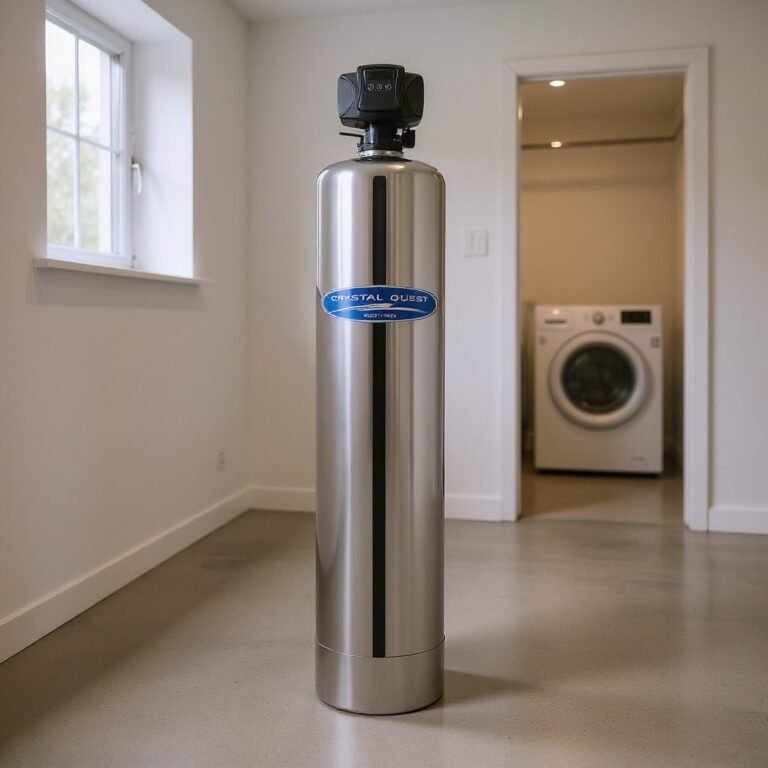
For most homes, the Crystal Quest Whole House Water Softener is the best overall pick. Salt-based ion exchange, fiberglass or stainless housing, and a straightforward setup. If you rent or can’t modify plumbing, the Aquasana SimplySoft is a real (if different) alternative. For 4+ bathroom homes, the SpringWell SS4’s 48,000-grain capacity has more headroom.
Test your water hardness first (a $15 strip test works), then match the grain capacity to it.
Hard water in Canada isn’t a minor annoyance, it scales pipes, shortens the life of water heaters and dishwashers, and leaves the film on glassware that no amount of rinse aid fixes. A water softener fixes the actual mineral problem instead of masking it. The three picks below cover the three real situations: own your home and want it handled properly, rent and can’t touch the plumbing, or have a bigger household that’ll outgrow a starter unit fast.
Our picks
The three, side by side
| System | Best for | Type | Capacity | Price (USD) | Flow rate |
|---|---|---|---|---|---|
| Crystal Quest | Most homes | Salt-based | 1.5–2.0 cu ft (45,000–60,000 grain) | From $1,531 | 9–13 GPM |
| Aquasana SimplySoft | Renters | Salt-free | Conditioner, not softener | Varies by retailer | ~11 GPM real-world (16.6 GPM advertised) |
| SpringWell SS4 | 4–6 bathrooms | Salt-based | 48,000 grain | $1,785 sale ($2,100 regular) | 13 GPM |
Softener vs. conditioner: these solve different problems
A true water softener uses ion exchange, it swaps calcium and magnesium for sodium, and the water genuinely gets “soft.” That’s what the Crystal Quest and SpringWell systems do.
A salt-free conditioner like the Aquasana SimplySoft doesn’t remove the minerals. It uses Template Assisted Crystallization (TAC) to change their structure so they can’t stick to pipes and fixtures, real scale protection, independently tested at 87% reduction, but the water itself isn’t “soft” in the traditional sense. If the slippery feel and lather matter to you, get a real softener. If you just want to stop scale from wrecking your appliances and can’t run a drain line, the conditioner is the honest answer.
How to actually size a softener
Test your water hardness. A basic hardness test strip runs under $15 and gives you a grains-per-gallon (GPG) number to work from.
Multiply GPG by daily household water use. A rough rule: (GPG × people in the household × 75 gallons/day) gives you the grains you need to remove between regenerations.
Buy headroom, not the exact number. A softener that regenerates every day wastes salt and water. Sizing up one tier (like SpringWell’s SS4 over the SS1) means fewer regeneration cycles.
Frequently asked questions
Is Canadian tap water actually harder than US tap water?
It depends heavily on region, not country. Prairie well water and the Grand River basin in Ontario run extremely hard (20–30+ GPG), while cities on softer surface-water sources can be much lower. Test your specific water rather than assuming based on the country.
Do I need a plumber to install a whole-house softener?
Salt-based systems like the Crystal Quest and SpringWell tie into your main water line and typically need a drain nearby for the brine discharge, most homeowners hire a plumber for the initial install even on a DIY-marketed unit. The Aquasana SimplySoft skips this entirely since it doesn’t need a drain line.
Will a water softener make my water taste salty?
No. Ion exchange softeners add a small amount of sodium, but it’s far below what you’d taste, comparable to what’s naturally in many municipal water supplies already. If sodium intake is a medical concern, a potassium-chloride regenerant is available for most salt-based systems as a substitute.