 Inspire
Best Whole-House Water Filter for Canada (2026)
A whole-house filter handles chlorine taste, odor, and sediment at every tap. Here’s what’s actually worth installing.
Updated July 19, 2026 · 9 min read · ✓ Fact-checked · Includes affiliated links
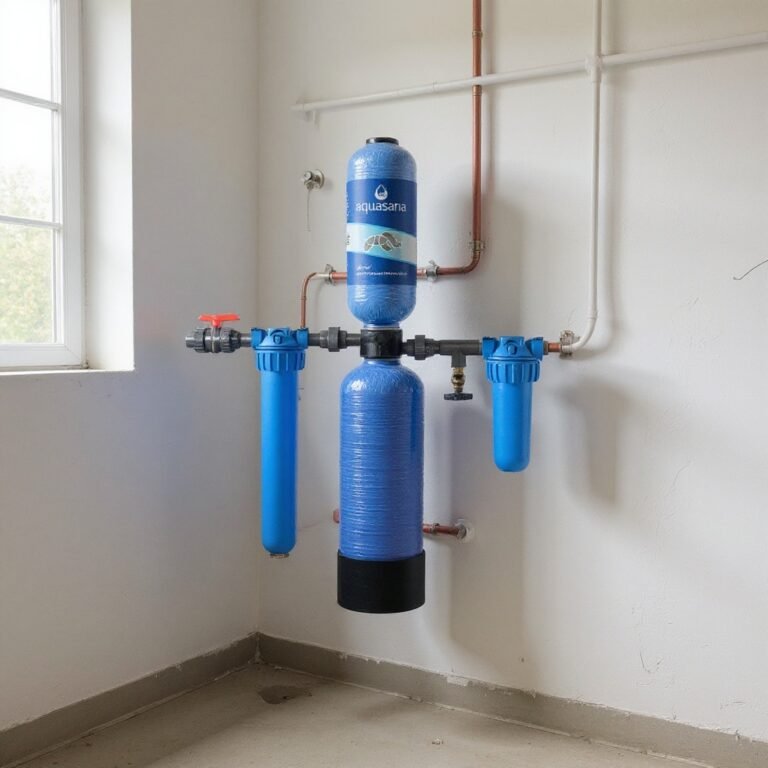
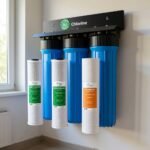
The Aquasana EQ-1000 is the strongest overall pick, it’s the only one here with an independently documented NSF/ANSI 42 chlorine-reduction test and a Canadian marketplace seller that addresses duty concerns directly. iSpring’s WGB32B is the budget pick with by far the largest real review base. SpringWell suits larger households that need higher flow, with an honest caveat about cross-border shipping costs.
None of these remove lead. If lead is your concern, you need point-of-use treatment at the tap, not a whole-house system, see the filter-vs-softener guide above for why.
Not sure a filter is what you need instead of a softener? See our filter-vs-softener breakdown first. If it is: whole-house filter marketing leans hard on stage counts and dramatic before/after photos. What actually matters is simpler: real flow rate, real filter capacity, and whether the company stands behind the product when something breaks. We checked all three below, including the complaints companies leave out of their own marketing.
Our picks
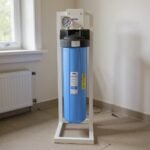
Why flow rate matters more than stage count
A whole-house filter with too low a flow rate for your home means noticeably weaker pressure the moment two fixtures run at once, a shower going flat when the washing machine fills. Match the GPM rating to your household size and fixture count, not just the marketing page’s stage count, an 8-stage filter rated for 6 GPM will disappoint a 4-bathroom house more than a simple 3-stage system rated for 15 GPM.
What a whole-house filter won’t do
Worth repeating plainly: none of the filters above are certified for lead reduction, and whole-house systems generally aren’t the right category of tool for it. If lead is a real concern for your home, especially an older home or one with a lead service line, the fix is point-of-use treatment at the specific tap you drink and cook from, not a system treating your whole water supply. Our filter-vs-softener guide covers the reasoning in more depth.
Frequently asked questions
How often do whole-house filter cartridges need replacing?
It depends on your household’s water usage and how much sediment is in your supply, anywhere from every few months for cartridge-style systems like iSpring’s, to several years for higher-capacity tank systems like Aquasana’s Rhino line. Check the specific product’s rated gallon capacity rather than assuming a fixed schedule.
Will a whole-house filter reduce my water pressure?
Some pressure drop is normal, typically a few PSI when the filter is new, growing as it loads up with sediment. If your home’s water pressure is already on the low side (under 50 PSI), factor a booster pump into your budget, especially for cartridge-style systems.
Does a whole-house filter remove fluoride?
Not meaningfully. Standard carbon and sediment whole-house filters aren’t designed for fluoride reduction, independent testing on more than one product in this category found minimal fluoride removal. If that’s specifically what you need, look at reverse osmosis at the point of use instead.