Inspire
Isotonix Astaxanthin Review
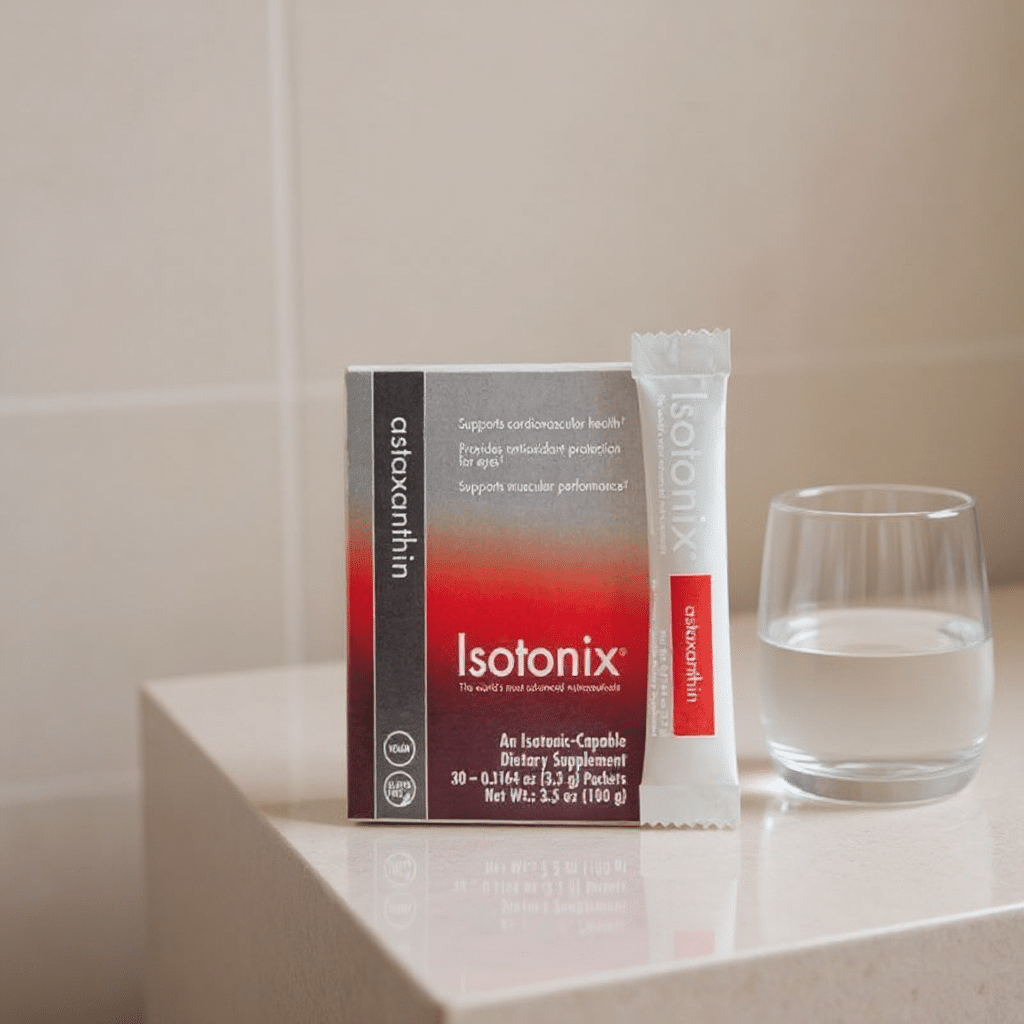
Astaxanthin gets called “the strongest antioxidant” on a lot of labels, and most don’t say compared to what, or how much you’re actually getting. This one states a real number: 6 mg of a named, branded source. That makes it worth an honest look.
our rating
What we liked
- 6 mg of AstaReal® per serving, a named, independently branded astaxanthin source rather than an unspecified extract
- The maker’s product page puts a “typical” astaxanthin formula at 4 mg, so 6 mg is 50% more, a real, checkable comparison
- Includes vitamin E and acerola-sourced vitamin C alongside the astaxanthin
- AstaReal is genuinely one of the more established astaxanthin brands in the supplement industry
What to know
- We found no published trial of this product itself. Human trials of astaxanthin at 6 mg a day exist, but they’re small and short, so they support the ingredient, not this drink
- The EU food safety authority (EFSA) formally declined to approve most of the health-claim categories astaxanthin products in this category use (2009/2011 reviews)
- The largest available meta-analysis found no significant effect on blood pressure at typical supplemental doses
- “Superior to competitors” is the manufacturer’s own wording on its product page, not an independent head-to-head study we could verify
Key takeaways
- The active dose is 6 mg of AstaReal® astaxanthin per serving. It’s a named, branded ingredient, not a generic unlabeled extract.
- 6 mg a day is a dose small human trials have used (examples below), but none of them tested this product, so don’t assume it replicates any one study’s results.
- The EU’s food safety authority (EFSA) reviewed astaxanthin health claims in 2009 and 2011 and declined to approve most of the claim categories this ingredient is commonly marketed around.
- The “superior to competitors” framing on the maker’s product page is the manufacturer’s own positioning; we treat it as marketing comparison, not an independently verified head-to-head result.
Who it’s for (and who should skip it)
Astaxanthin has a genuine, if still-developing, research base. Here’s the honest fit.
Buy it if…
- You want a dosed, named-source astaxanthin supplement rather than guessing at an unlabeled extract elsewhere
- You’re interested in the eye, skin, and muscular-endurance angles astaxanthin research explores
- You already take other Isotonix products and want to add this to an existing routine
Skip it if…
- You’re buying it specifically because it’s marketed as “superior to competitors” (that framing isn’t something we could independently verify)
- You take it consistently on a completely empty stomach with zero dietary fat, since absorption may be lower that way
- Budget matters and you haven’t compared regional pricing first, since it varies meaningfully by storefront
What’s actually in it
Here’s the simple version: the headline ingredient is AstaReal®, a specific, branded astaxanthin source, dosed at 6 mg per serving. The maker’s product page draws the comparison directly: “Typical astaxanthin formulas contain 4 mg per serving,” which puts this one’s 6 mg at 50% more (our arithmetic).
The label says to pour 1 packet (3.3 g) into a cup, add 2 fl oz (60 mL) of water, stir, and take it once daily. It doesn’t give a meal or empty-stomach instruction. Because astaxanthin is fat-soluble, taking it alongside a meal that contains some dietary fat may support absorption better than on a fully empty stomach. That’s a general principle for fat-soluble compounds, not a claim specific to this product.
The label’s warning says to talk to your healthcare provider before using it if you take prescription medications, have an ongoing medical condition, or are pregnant or breastfeeding.
Examples at 6 mg a day: 36 healthy men took it for 6 weeks in a placebo-controlled trial, with improved crow’s feet wrinkles, skin elasticity and water loss through the skin (Tominaga et al., Acta Biochim Pol, 2012, PMID 22428137). Fourteen active men took it for 4 weeks and had about 7% higher glutathione, with no significant change in the other oxidative stress markers measured (McAllister et al., Int J Sport Nutr Exerc Metab, 2022, PMID 34611051). In a 20-man single-blind study, 10 days of 6 mg a day shortened whole-blood transit time in a lab test compared with placebo (Miyawaki et al., J Clin Biochem Nutr, 2008, PMID 18818755).
Not every trial gave a clear result. A 96-person, 12-week cognition trial tested 6 mg and 12 mg a day: CogHealth scores improved in the 12 mg group, and Groton Maze scores improved earlier in both astaxanthin groups than on placebo, but the authors said the sample was too small to show a significant difference between groups (Katagiri et al., J Clin Biochem Nutr, 2012, PMID 22962526). And 20 mg a day for 4 weeks didn’t improve time-trial performance or fat oxidation in trained cyclists (Res et al., Med Sci Sports Exerc, 2013, PMID 23274592).
What astaxanthin actually is
Astaxanthin is a carotenoid, the same broad pigment family as beta-carotene and lutein, and it’s what gives salmon, shrimp, and flamingos their pink-red color. It’s most commonly sourced from the microalgae Haematococcus pluvialis, which produces it as a defense compound against oxidative stress and UV exposure.
That natural role is part of why it’s been studied as an antioxidant in humans, with research exploring effects on eye health, skin, and exercise-related muscular endurance.
There’s a regulatory data point worth knowing too. When the EU’s food safety authority (EFSA) reviewed astaxanthin health claims in 2009 and 2011, it declined to approve most of the claim categories this ingredient is commonly marketed around. That’s not the same as saying astaxanthin does nothing, but it reflects a genuinely cautious independent read on the evidence at the time.
More recent research has continued since those reviews, though the cardiovascular angle specifically remains weak: the largest available meta-analysis found no significant blood-pressure benefit at the doses typically used in supplements.
Where this leaves the evidence
What’s more solidly established: astaxanthin is a real, legitimately studied carotenoid antioxidant. And 6 mg is a meaningful, clearly stated dose rather than a token amount, and it’s a dose small human trials have used, even though none of them tested this product. That’s a reasonable basis to try it on, without needing the “superior to competitors” framing or the blood-pressure angle to be true.
Frequently asked questions
This section contains affiliate links, and we may earn a commission at no extra cost to you. See our full evaluation policy at the end of this guide.
How much astaxanthin is actually in one serving?
Is astaxanthin really stronger than CoQ10?
Has astaxanthin been independently reviewed for its health claims?
What is AstaReal?
When’s the best time to take it?
“A clearly dosed, named-source astaxanthin supplement, held back by the lack of any published trial of the product itself and a regulatory record that’s more cautious than the marketing suggests.”
6 mg of AstaReal is a real, stated dose from an established branded source, which is more transparent than most competitors. But 6 mg a day is a dose small human trials have used, and none of them tested this product. EFSA declined to approve most of the claim categories this ingredient is marketed around, and the cardiovascular angle specifically isn’t backed by the largest available meta-analysis. Reasonable to try, not a slam dunk.

See the Subscribe and Save option →