 Inspire
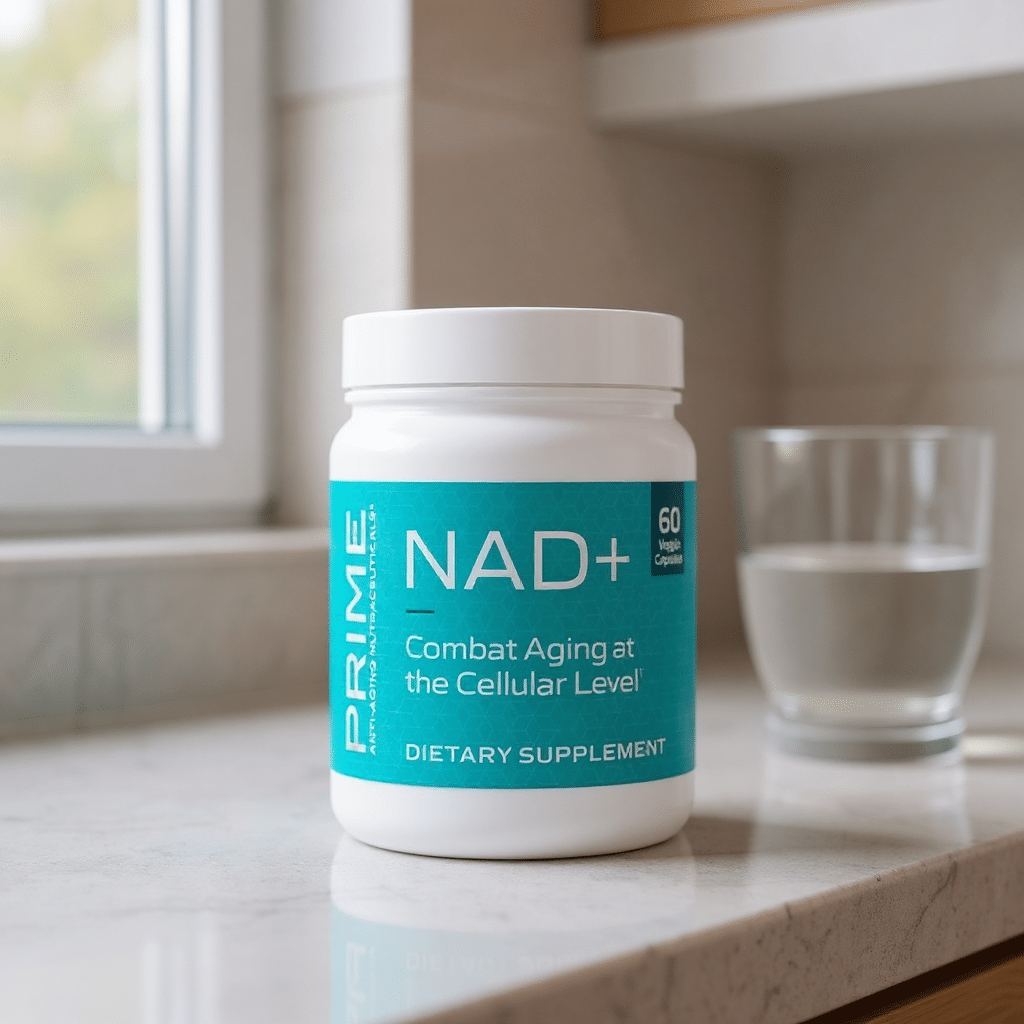
What Is NAD+ and Does Prime’s Version Actually Work?
“NAD+” is suddenly on every anti-aging label, and most of them don’t explain what it is or why a pill would help. Here’s the honest version: what NAD+ does in your body, why this supplement doesn’t actually contain any, and a 2026 study that complicates the whole category.
our rating
What we liked
- Real ingredients at studied doses: 250 mg nicotinamide riboside + 50 mg pterostilbene (the “NRPT” combo)
- This exact combination has an actual published human trial behind it, not just a mechanism story
- Vegan capsule, no animal-derived ingredients, third-party-checkable ingredient list
- Restrained label language: “support healthy NAD production,” not “reverse aging”
What to know
- The name is misleading: it contains zero NAD+ itself, only two precursor compounds
- The 2017 trial behind this combo was funded by a company that sells the same formula, a real conflict of interest even with an independent lab running it
- A 2026 study found blood NAD+ doesn’t reliably track aging, undercutting the category’s core premise
- Standard price $49.95, “subscribe & save” price closer to $44.95, not what you pay on a first one-off order
Key takeaways
- This product does not contain NAD+. It contains 250 mg nicotinamide riboside (NR) and 50 mg pterostilbene — two compounds your body can use to help make its own NAD+.
- That specific combination, called NRPT, was tested in a real randomized trial: blood NAD+ rose 40–90% over 8 weeks in adults 60–80. The company that funded the trial also sells the same formula.
- A larger 2026 study found that blood NAD+ levels don’t reliably decline with age or predict how someone ages — which raises a real question about what raising that number is actually worth.
- Direct oral NAD+ barely absorbs (some estimates put it under 5%), which is exactly why this formula uses precursors instead. That part of the science is solid, even where the bigger anti-aging story isn’t.
Who it’s for (and who should skip it)
This is one of those supplements where the honest answer to “does it work” depends entirely on what you mean by “work.” Here’s how we’d split it.
Buy it if…
- You want a well-formulated NR + pterostilbene supplement and understand that’s what you’re buying, not “NAD+ in a bottle”
- You’re fine with “raises a blood marker in a real trial” as the bar, not “reverses aging”
- You already take other Prime or Isotonix products and want to add this to an existing routine
Skip it if…
- You’re buying it expecting to feel a difference — the trial measured a blood marker, not energy or mood
- You’re pregnant or breastfeeding (the label itself says to avoid it)
- You’re on prescription medication and haven’t checked for interactions with your doctor — drug-interaction data here is genuinely incomplete
- Budget is tight and unproven “maybe” supplements aren’t where you want to spend $45–50/month
What NAD+ actually is (the part that’s not controversial)
Here’s the simple version: NAD+ (nicotinamide adenine dinucleotide) is a molecule every cell in your body needs to turn food into usable energy. It shuttles electrons around during that process, and it’s also the fuel two other important enzyme families run on — sirtuins, which are involved in how cells respond to stress, and PARPs, which repair damaged DNA. Both of those enzyme families compete for the same limited pool of NAD+, which is part of why researchers got interested in whether topping it up matters.
That mechanism is textbook cell biology, not a supplement-industry invention. Where things get murkier is what happens when you try to raise NAD+ with a pill.
What’s actually in the bottle
This is the part most shoppers skip, and it matters: despite the product name, Prime Anti-Aging Nutraceuticals NAD+ does not contain NAD+. It contains two precursor compounds — ingredients your body can convert into NAD+ on its own:
Why not just put NAD+ itself in the capsule? Because it mostly wouldn’t survive digestion. NAD+ is a large, charged molecule, and published estimates put how much of an oral dose reaches your bloodstream intact at somewhere under 5–10%, sometimes less. Some studies find oral NAD+ doesn’t meaningfully raise blood levels at any tested dose. Using a precursor your body already knows how to convert — which is exactly what this formula does — is the scientifically defensible choice here, even before you get into whether raising NAD+ matters at all.
Serving is 2 vegan capsules a day, with or without food. No mixing, no isotonic drink format like the core Isotonix line — this is a straightforward capsule product under the separate Prime brand.
The actual trial behind this exact formula
Most “NAD+ boosting” supplements point vaguely at “the research on NAD+.” This one can point at something more specific: the 250 mg NR + 50 mg pterostilbene ratio matches a combination called NRPT, which was tested in a real randomized, double-blind, placebo-controlled trial — 120 healthy adults aged 60 to 80, over 8 weeks, published in NPJ Aging and Mechanisms of Disease in 2017.
- Blood NAD+ rose about 40% at the standard dose and up to 90% at double dose, settling around 55% by week 8
- No serious side effects showed up
- Some secondary measures, like mobility test scores, improved slightly at the lower dose
A conflict of interest worth flagging
That’s a genuinely more solid evidence base than most products in this category have. But there’s a catch worth naming directly, in keeping with how we review everything: every author on that trial was affiliated with the company that sells this same NRPT combination under its own brand. That company funded the study.
The trial itself was run by an independent contract research organization, which is a real mitigating factor, not just a formality. But a company-funded trial of a company’s own ingredient combination is still a conflict of interest worth knowing about before you weigh the results.
The 2026 study that complicates the whole category
Here’s the part most NAD+ product pages leave out entirely, and it’s the most important thing in this article. A large 2026 study published in Nature Metabolism — over 300 participants spanning different age groups, athletes, frail seniors, and people already taking NAD+ supplements — looked at whether blood NAD+ actually tracks aging the way the entire “boost your NAD+” industry assumes it does.
It found that whole-blood NAD+ levels don’t reliably decline with age and don’t respond in a predictable way to lifestyle interventions. The researchers went as far as saying blood NAD+ “cannot be used to track the aging process in humans.” When a supplement raises your blood NAD+ number, that’s better understood as proof the pill did something measurable — not proof it’s doing anything for how you age.
| What the 2017 NRPT trial showed | What the 2026 study found | |
|---|---|---|
| Does NR + pterostilbene raise blood NAD+? | Yes, measurably, in a real RCT | Not disputed |
| Does blood NAD+ decline with age in the first place? | Assumed, not directly tested | Found no reliable age-related decline |
| Does a higher blood NAD+ number mean healthier aging? | Implied by marketing, not measured | Explicitly said this can’t be concluded |
Put plainly: the pill reliably does something measurable to your blood chemistry. Whether that something is worth $45–50 a month toward “anti-aging” is a genuinely open question that the newest research makes harder to answer yes to, not easier.
Frequently asked questions
This section contains affiliate links — we may earn a commission at no extra cost to you. See our full evaluation policy at the end of this guide.
Does this supplement actually contain NAD+?
Is there real research behind this specific formula?
Does raising NAD+ actually slow aging?
Is it safe to take?
How much does it cost?
“A genuinely well-formulated NR + pterostilbene supplement with real trial data behind it — just don’t confuse “raises a blood marker” with “slows aging.””
The ingredient choice and dosing here are defensible and backed by an actual human trial, which puts it ahead of most NAD+-branded products on the market. What it can’t claim, honestly, is that raising NAD+ translates into feeling or aging any differently — the newest research on that link is genuinely unresolved.

Related reading
- Health Canada — Licensed Natural Health Products Database
- Dellinger RW, et al. “Repeat dose NRPT (nicotinamide riboside and pterostilbene) increases NAD+ levels in humans safely and sustainably: a randomized, double-blind, placebo-controlled study.” npj Aging and Mechanisms of Disease 3:17, 2017 (PMID 29184669).
- Trętowicz MM, et al. “Human whole-blood NAD+ levels do not vary with age or lifestyle interventions.” Nature Metabolism, 2026 (DOI: 10.1038/s42255-026-01537-5).