 Inspire
Does Molecular Hydrogen (H2TAB) Actually Do Anything?
Drop a tablet in water, watch it fizz, drink it — the pitch is simple. Whether the science backs it up is more complicated, and one number on the label doesn’t hold up to basic chemistry. Here’s the honest read on molecular hydrogen, including the part most reviews skip.
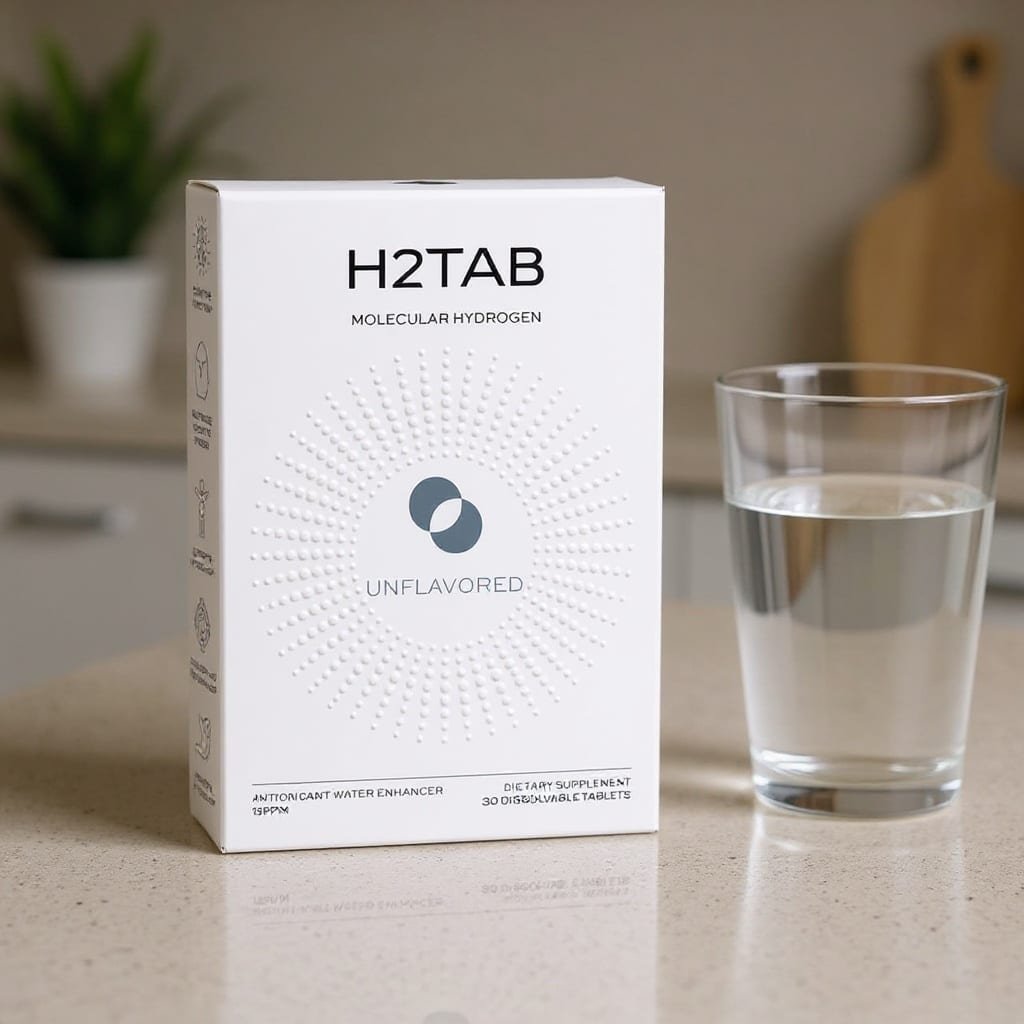
our rating
What we liked
- The core mechanism (H2 as a “selective antioxidant”) is real, published science, not invented supplement-marketing jargon
- Simple format: drop 1 tablet in 12–16 oz water, drink once fully dissolved
- Good safety profile in the human trials that exist so far, no serious adverse events reported
- Cheap way to try the category compared to hydrogen-water machines or inhalation devices
What to know
- The headline “12 ppm” claim is chemically implausible as a sustained concentration — more below
- Human research is real but still early: even researchers in the field call parts of it “anecdotal”
- A 2024 meta-analysis found mixed results, helping with some fatigue markers but not endurance or strength
- No large-scale trial has tested this specific product; the evidence is for the category, not this exact tablet
Key takeaways
- Each tablet is 80 mg of elemental magnesium plus food-grade acids. Dropped in water, the magnesium reacts and releases hydrogen gas — that’s the whole mechanism.
- The idea that H2 gas can act as a “selective antioxidant” traces to a real 2007 paper in Nature Medicine, not a supplement company. The category has grown to 80+ registered clinical trials since.
- The product’s “12 ppm” claim is roughly 7.5x above hydrogen gas’s maximum stable solubility in water at normal conditions — a real chemistry-based reason for skepticism, not an accusation of fraud.
- A 2024 meta-analysis found modest benefits for some fatigue and power measures, and explicitly said it likely doesn’t help endurance or strength. This is a “maybe, modestly” category, not a “definitely” one.
Who it’s for (and who should skip it)
Molecular hydrogen is one of the more interesting recent categories precisely because the mechanism is real even though the marketing has gotten ahead of the evidence. Here’s how we’d split it.
Buy it if…
- You’re curious about molecular hydrogen and want a cheap way to try it (versus $200+ hydrogen water machines)
- You understand you’re trying an early-stage category, not a proven intervention
- You want a simple magnesium-based antioxidant tablet regardless of the hydrogen angle specifically
Skip it if…
- You’re buying it expecting a proven, well-established benefit — that evidence isn’t there yet
- You have kidney disease; your body clears magnesium differently and needs medical guidance first
- You take tetracycline or quinolone antibiotics, or bisphosphonates, without spacing doses apart — magnesium can reduce their absorption
What’s actually in the tablet
Here’s the simple version: it’s not a hydrogen capsule, it’s a reaction starter. Each tablet contains 80 mg of elemental magnesium, plus food-grade acids (malic, tartaric, and adipic acid) that accelerate a chemical reaction. Drop the tablet in 12–16 oz of water, the magnesium reacts with the water, and hydrogen gas (H2) is released into the glass. You drink it once the tablet has fully dissolved.
That’s a real, well-understood chemical reaction — magnesium plus water reliably produces hydrogen gas. The open question isn’t whether the reaction happens. It’s how much of that hydrogen is actually still in the water by the time you drink it, and what it does once it’s in you.
The “12 ppm” problem, explained plainly
This is the part most reviews of hydrogen tablets skip entirely, and it’s worth walking through because it’s simple chemistry, not opinion. Hydrogen gas has a maximum solubility in water at normal room temperature and atmospheric pressure of about 1.6 ppm (parts per million). That’s a physical constant, not a brand-specific limit — it applies to any hydrogen tablet or hydrogen water machine on the market.
We’re not accusing anyone of lying here. We’re saying: treat “ppm” numbers on any hydrogen product, this one included, as a best-case snapshot rather than a guaranteed dose, and don’t let a big number substitute for asking whether the underlying category has solid evidence. Which brings us to the actual research.
What the research on molecular hydrogen actually shows
The core idea isn’t supplement-industry invention. It traces to a 2007 paper in Nature Medicine by Ohsawa and colleagues, which proposed that hydrogen gas works as a “selective antioxidant” — it preferentially neutralizes the most damaging reactive molecules (like hydroxyl radicals) while leaving beneficial signaling molecules alone. That’s a real, testable mechanism that a legitimate research field has grown around since.
| Signal | What it actually shows |
|---|---|
| Registered trials | 81 registered clinical trials as of a 2023 review, growing from about 1/year in 2011 to 6–10/year by 2020–2023 |
| Trial quality | The review’s own authors describe the field as “in its infancy” and say some studies “might be regarded as anecdotal” |
| 2024 meta-analysis (exercise) | 597 participants across 27 studies: modest improvement in some fatigue markers and lower-limb power |
| Same meta-analysis | Explicitly states H2 likely does not meaningfully improve endurance or muscular strength |
Put together: this isn’t a fringe idea with zero science behind it, and it isn’t a settled, well-proven wellness intervention either. It sits in a genuinely early, actively-growing research category, and the broad claims on most hydrogen product labels (gut health, mental clarity, “cellular repair”) run well ahead of what any of these trials have actually tested.
Frequently asked questions
Is molecular hydrogen backed by real science?
Is the “12 ppm” claim on the label accurate?
What’s actually in an H2TAB tablet?
Does it help with exercise performance?
Is it safe?
“A real mechanism, an honestly early research field, and one marketing number that doesn’t survive basic chemistry.”
The underlying science on molecular hydrogen is legitimate and growing, not pseudoscience. But the “12 ppm” claim overstates what actually reaches your glass, and the broader wellness claims on the label run ahead of what the current research has tested. Worth trying if you’re curious and the price is right; not worth buying on the promise of a proven result.

Related reading
-
 ExplainerWhat Is NAD+ and Does Prime’s Version Work?The honest version of the NAD+ supplement story, including a 2026 study that complicates it.
 -
 ReviewIsotonix OPC-3 reviewThe flagship antioxidant formula, isotonic form, strong research base.
 -
 ComparisonIsotonix vs capsulesMost capsule buyers absorb less than they paid for.
Sources
- The foundational 2007 hydrogen research: Ohsawa et al., Nature Medicine.
- Broader review of molecular hydrogen research: NIH PMC review.