 Inspire
Best Cordless Snow Blower in Canada (2026)
Four battery snow blowers sold on Amazon.ca, with the battery costs, cold-weather limits and driveway sizes the product pages gloss over.
November 21, 2026 · 9 min read · Includes affiliate links
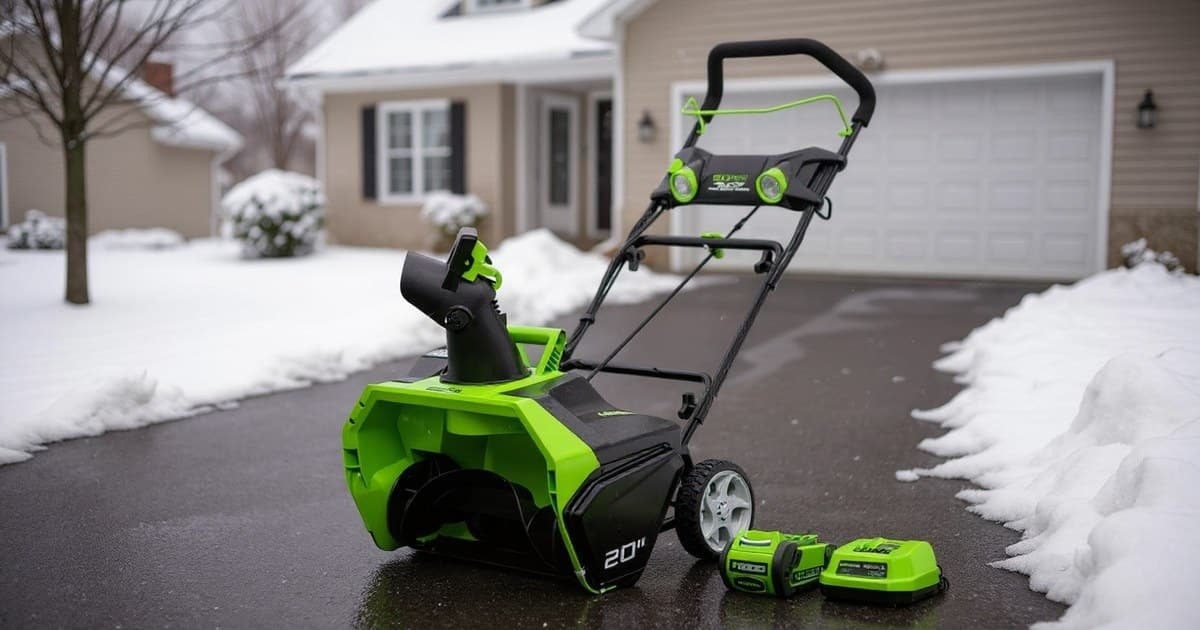
A cordless snow blower suits a small driveway, a townhome or a flight of steps. It’s the wrong tool for deep, wet snow or a long driveway.
Some links on this page are affiliate links. If you buy through them we may earn a commission, at no extra cost to you. It doesn’t change which machines we list.
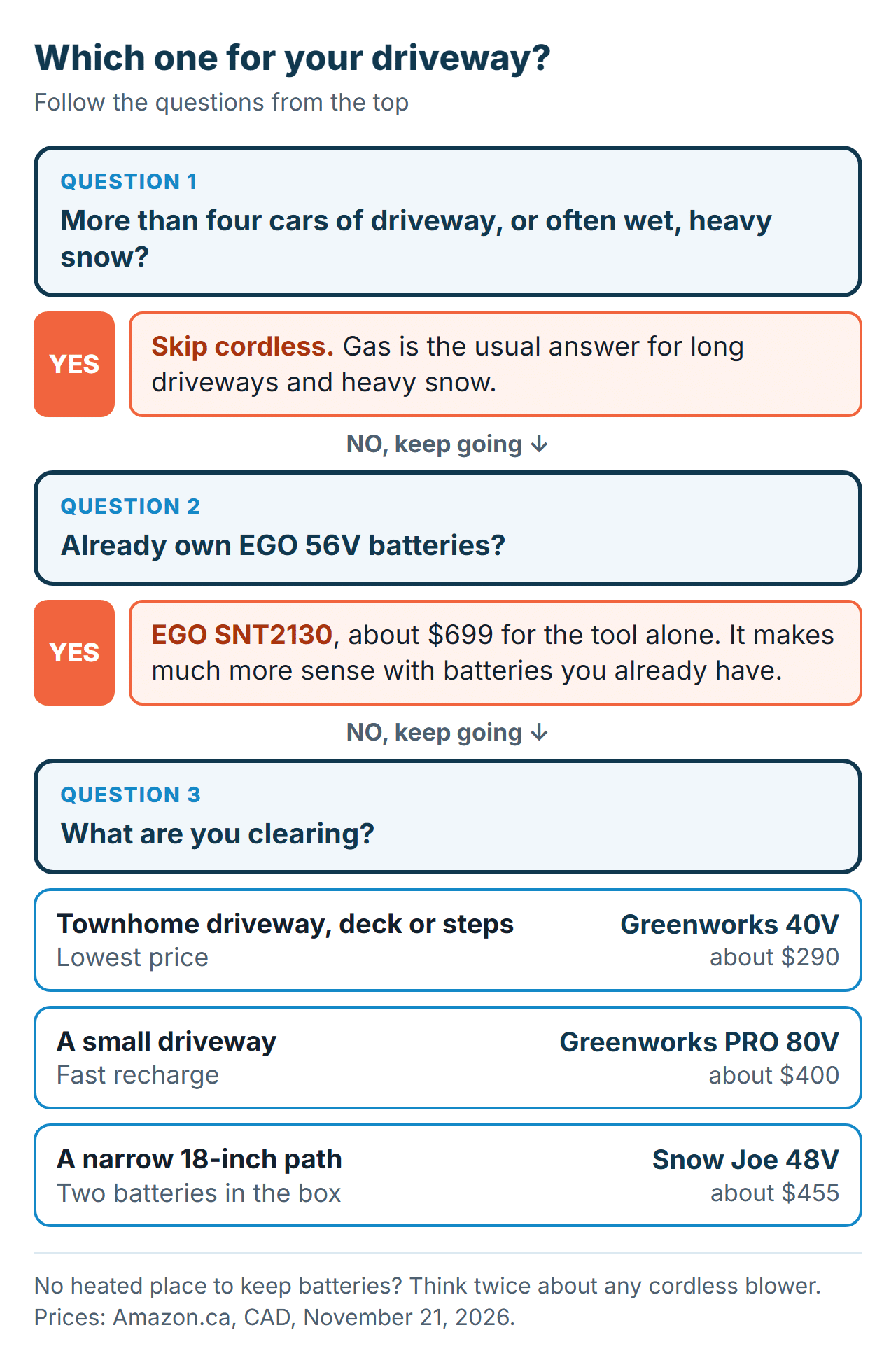
- Greenworks 40V (about $290): the cheapest here. Good for a townhome driveway, a deck or steps.
- Greenworks PRO 80V (about $400): a small driveway. Its battery recharges fast.
- Snow Joe 48V kit (about $455): a narrow 18-inch path, two batteries in the box.
- EGO SNT2130 (about $699, no batteries): the most power on paper. Batteries and charger cost extra.
Prices are Amazon.ca in CAD as of November 21, 2026. They change, and several carry Black Friday pricing right now.
How we picked
We haven’t tested any of these machines. We started with the cordless blowers that were in stock on Amazon.ca on November 21, then checked each one against the manufacturer’s spec page or manual. Where a maker’s number and the Amazon listing disagreed, we say so below. Ratings are Amazon’s, not ours.
Our picks
This section contains affiliate links. We may earn a commission at no extra cost to you.
What the EGO really costs
The $699 buys the machine only. You need two 56V ARC batteries and a charger on top, and that listing shows no EGO battery price, so we can’t give you an honest total.
EGO’s own figure of a 14-car driveway with 8 inches of snow assumes two 6.0Ah batteries. EGO’s page for the SNT2134 kit, which it lists as the same machine with batteries, shows a 5-year tool warranty and a 3-year battery warranty. We haven’t confirmed that those terms apply to this third-party offer. One buyer review on the listing (February 2026) says they were told there was no warranty and couldn’t return it. That’s a single review we can’t verify, so ask the seller in writing before you order. If you already own EGO 56V batteries, this one makes a lot more sense.
The Greenworks 40V listing problem
The Amazon.ca title says a 4.0Ah battery and a 12-inch depth. The bullets say 8 inches. The style selector says 2.0Ah. Greenworks’ Canadian spec page for this model number (2600200) says a 4.0Ah battery and 8 inches. Check the box contents on the listing before you pay.
The four compared
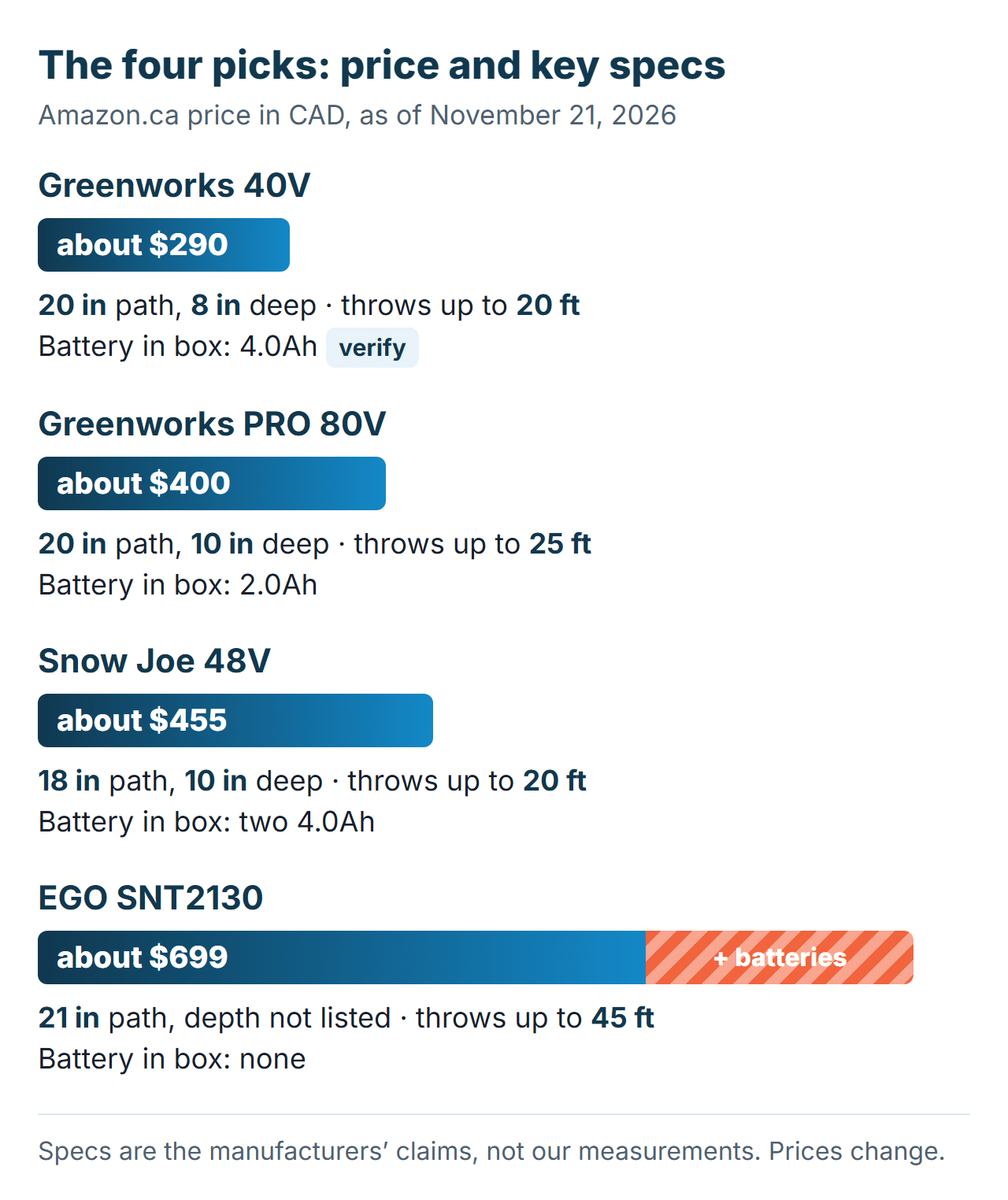
| Model | Path x depth | Max throw | Battery in box | Price (CAD) |
|---|---|---|---|---|
| Greenworks 40V | 20 in x 8 in | 20 ft | 4.0Ah (verify) | about $290 |
| Greenworks PRO 80V | 20 in x 10 in | 25 ft | 2.0Ah | about $400 |
| Snow Joe 48V | 18 in x 10 in | 20 ft | 2 x 4.0Ah | about $455 |
| EGO SNT2130 | 21 in, depth not listed | 45 ft | None | about $699 plus batteries |
Seen on Amazon.ca on November 21, 2026. Prices change. Specs are the manufacturers’ claims, not our measurements.
Cordless vs gas vs corded
Cordless buys you quiet, no fumes and no cord to drag across the driveway. It costs you runtime. Every machine here runs out of battery before a long driveway runs out of snow.
Corded electric never runs flat, but you manage an extension cord the whole time. It’s usually the cheapest to buy. If your driveway is short and you have an outdoor outlet, that’s a fair choice, and none of the machines here beats it on price. We haven’t priced a specific corded model for this guide.
Gas is the usual answer for long driveways and heavy snow. We haven’t researched specific gas models for this guide, so we’re not ranking any. If you clear more than four cars’ worth of driveway after every storm, start there instead.
Cordless fits a small driveway, a townhome, steps, or a second machine for the spots a big one can’t reach. Greenworks says its kits are supplied with enough battery for an average 4-car driveway, with runtime dropping as the load goes up.
Single-stage limits and wet snow
All four are single-stage machines. The auger scrapes the pavement and throws the snow itself, so you push it. Greenworks lists “push” drive on its spec pages. They’re made for paved surfaces. Greenworks and Snow Joe both warn against gravel, because the machine picks up loose stones and throws them.
On wet or heavy snow, stick to what each maker actually says. Snow Joe’s manual lists the type of snow as “light, fluffy.” Greenworks makes no heavy-snow claim on the pages we read. EGO says its blower can clear “even the heaviest, wettest snow.” That’s EGO’s claim, and we haven’t verified it. If your street plow leaves a hard ridge at the end of the driveway, plan to shovel that part.
Cold-weather battery care
The battery is the part that suffers in a Canadian January. What the makers say:
Greenworks. Its FAQ says lithium-ion batteries cope with cold, but it recommends charging and storing them at room temperature. If the internal battery temperature drops below -17°C, voltage output may be reduced. Bring a cold battery inside to warm up (Greenworks says 10 to 20 minutes), then put it on the charger. Greenworks says there should be no long-term harm. The listing for both Greenworks models adds that batteries should be stored at 16 to 23°C, and that a unit that won’t start needs its battery warmed up first.
Snow Joe. The manual is stricter. It gives the safe battery temperature range as -20°C to 45°C and says not to charge the battery outside in freezing weather. It also says charging below 5°C damages the cells, and that packs stored below 0°C for more than 60 minutes must be discarded. A cold pack may charge slowly. Store the pack indoors at 10 to 20°C. Before off-season storage, charge it fully, and don’t use or charge a pack that has sat uncharged for more than 12 months.
EGO. We found no battery cold-weather guidance on EGO’s product page. Check the manual that ships with your batteries.
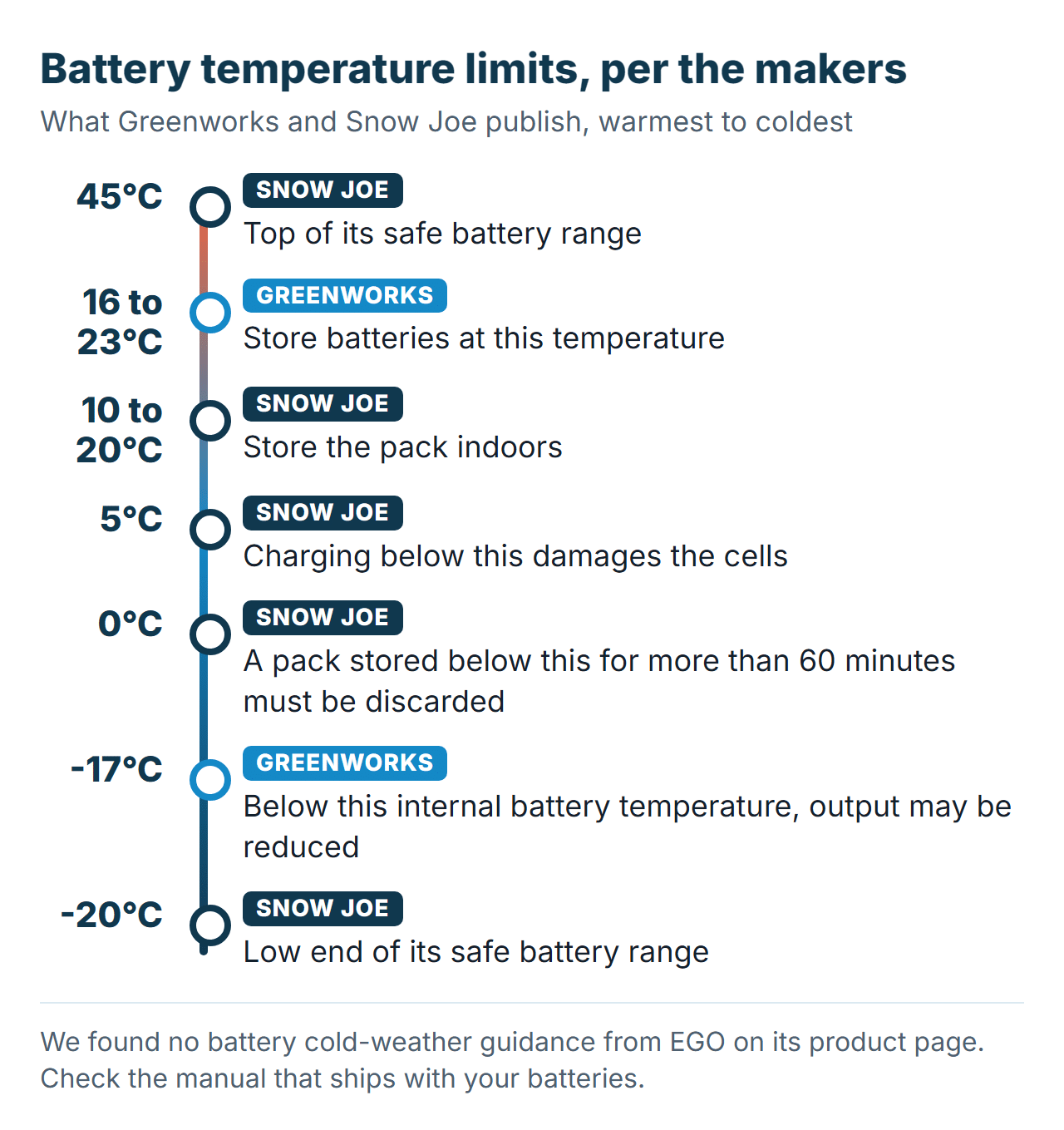
Our practical read, based on those documents: keep batteries inside, carry them out when you start, bring them back when you’re done, and give a cold pack time to warm before charging. A garage that freezes isn’t a good home for the battery.
Driveway size and runtime
Manufacturers measure runtime in ideal conditions. Real snow is heavier, and you’ll run slower or shorter.
- Greenworks PRO 80V: 144 Wh in the included 2.0Ah battery, up to 30 minutes to recharge, and “up to a 4 car driveway” in the specs on Greenworks’ page. The bullets on that page and on Amazon say 5 cars. We’d believe the lower number. Greenworks’ comparison chart on the Amazon listing says up to 45 minutes of runtime.
- Greenworks 40V: 144 Wh in a 4.0Ah battery, up to 120 minutes to recharge, and the same “up to a 4 car driveway.”
- Snow Joe 48V: up to 40 minutes maximum per the 2020 manual, with a full recharge taking 1 hour 50 minutes. A later Snow Joe manual, for the 24V-X2-SB18-RM model, lists 30 minutes maximum on 4.0Ah batteries (about 470 sq ft of 3 in. snow). Snow Joe’s figures differ between documents, so expect 30 to 40 at best.
- EGO SNT2130: 14 cars with 8 inches of snow, on two 6.0Ah batteries that aren’t included. We found no minutes-per-charge figure from EGO, so we won’t print one.
The watt-hour math, which is our arithmetic and not a runtime promise: Snow Joe’s two 4.0Ah batteries at a nominal 21.6V come to about 173 Wh together. That’s a little more than the single 144 Wh Greenworks battery, and the Snow Joe has to throw snow through a narrower 18-inch path. Battery size matters more than the brand name here.
A second battery roughly doubles your clearing time before you wait on a charger. For a driveway at the edge of what a machine can do, that matters more than choosing between these models.
Charging in a power outage
Winter storms that bring snow can take the power out too, and a dead charger means a dead blower. A power station can run a charger if the wattage fits. Snow Joe’s manual lists its charger input at 160 W. We couldn’t find a charger wattage for the Greenworks kits, so read the label on yours.
Compare that with the output rating of whatever backup you own. Our portable power station guide and the Jackery 2000 v2 vs 3000 Pro comparison list output ratings, and our portable generator guide covers the bigger option. We haven’t tested any of these chargers on a power station, so check compatibility before you rely on it.
Who should skip a cordless blower
- Your driveway holds more than four cars, or you clear it after every big dump.
- You regularly get wet, heavy snow. Only EGO claims to handle it, and that’s unverified.
- You’ve no heated place to keep batteries.
- You’d rather not spend on extra batteries. The cheap sticker price is only part of the real cost.
Winter prep goes beyond the driveway. If your house is dry or cold inside, see our guides to humidifiers for dry Canadian winters and smart thermostats for Canada.
Frequently asked questions
Will a cordless snow blower work at -20°C?
It depends on the battery temperature, not the air. Greenworks says output may be reduced if the internal battery temperature drops below -17°C, and advises warming a cold battery indoors. Snow Joe’s manual lists -20°C as the low end of its safe battery range. Keep the batteries indoors until you head out.
How long does the battery last?
Snow Joe’s manuals list 30 to 40 minutes maximum, depending on the model and revision. Greenworks’ comparison chart on the Amazon listing shows up to 45 minutes for the 80V. EGO gives a driveway-size claim rather than minutes. All are manufacturer claims, and heavy snow will cut them.
Can it handle heavy, wet snow?
Only EGO claims to, and we haven’t verified that claim. Snow Joe’s manual lists light, fluffy snow. Greenworks makes no heavy-snow claim on the pages we read.
Can I charge it during a power outage?
Probably, from a power station or generator that can supply the charger. Snow Joe lists a 160 W charger input. Check the label on any other charger and compare it with your backup’s output.
Can I use it on a gravel driveway?
No. Greenworks doesn’t recommend its single-stage blowers on gravel, because loose stones get thrown and can damage the machine and hurt people nearby. Snow Joe’s manual says to use its blower on paved surfaces, and not on gravel unless you adjust it as the manual describes.
How do I clear a clog safely?
Never use your hand. Snow Joe’s manual calls hand contact with the impeller the most common cause of snow thrower injuries. Shut the motor off, wait 10 seconds for the blades to stop, then use a clean-out tool.
Last updated November 21, 2026. Prices and stock change often.
As an Amazon Associate we earn from qualifying purchases.