 Inspire
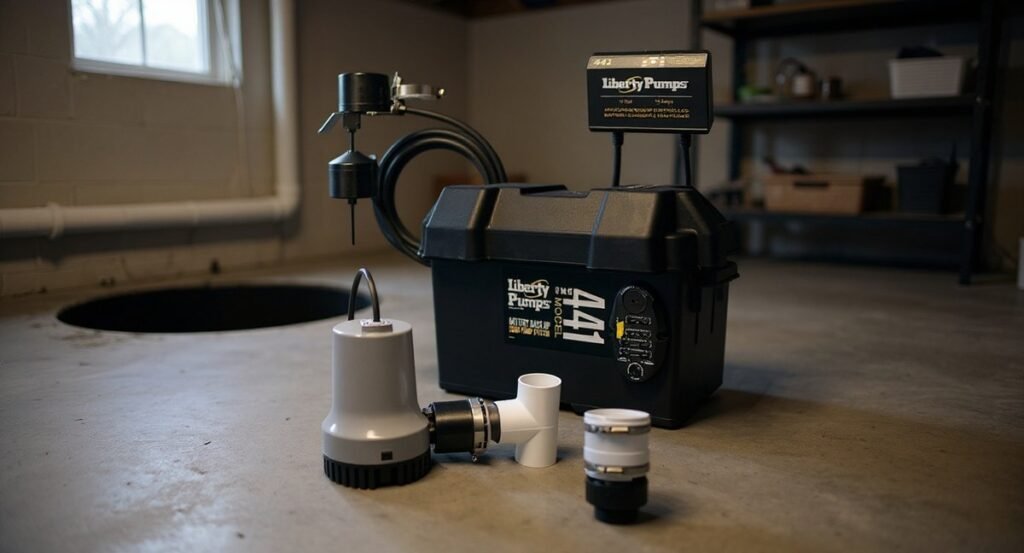
Best Battery Backup Sump Pump in Canada (2026)
3 battery backup systems you can buy on Amazon.ca, compared on flow at 10 ft, the makers’ runtime claims and price. Plus what Toronto will pay toward one.
November 21, 2026 · 9 min read · Includes affiliate links
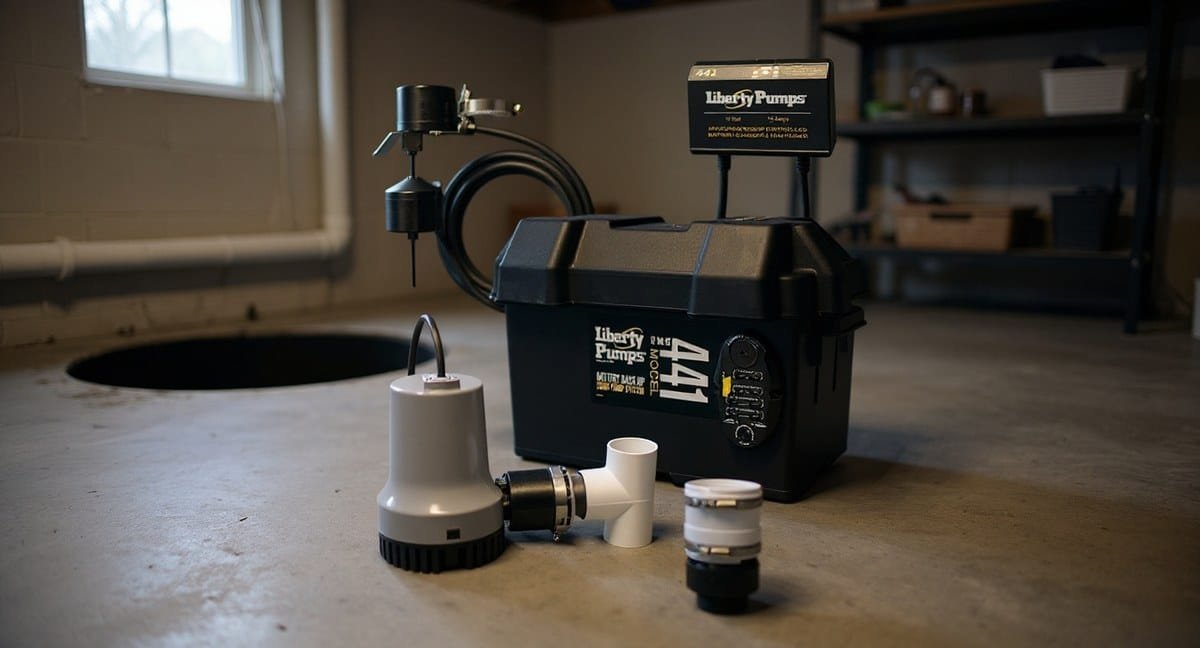
Your sump pump stops when the power does. After the March 30, 2025 ice storm, more than a million Ontario homes and businesses lost power at some point, and about 44,000 were still out on April 7.
Buy a 12-volt backup pump that sits beside your main pump. The battery is a separate purchase.
- Liberty 441: best documented, with a full installation manual.
- Wayne ESP25: most flow at 10 ft of lift (1,680 gph).
- Basement Watchdog BWE: lowest price, but it ships from Amazon US.
This isn’t electrical or plumbing advice. Have a licensed plumber and electrician install and check any wired unit.
Some links below pay us a referral fee. Doesn’t change our picks.
Our picks
This section contains affiliate links. We may earn a commission at no extra cost to you. As an Amazon Associate we earn from qualifying purchases.
Prices below are what Amazon.ca showed on November 21, 2026, in Canadian dollars. Prices change.
How they compare
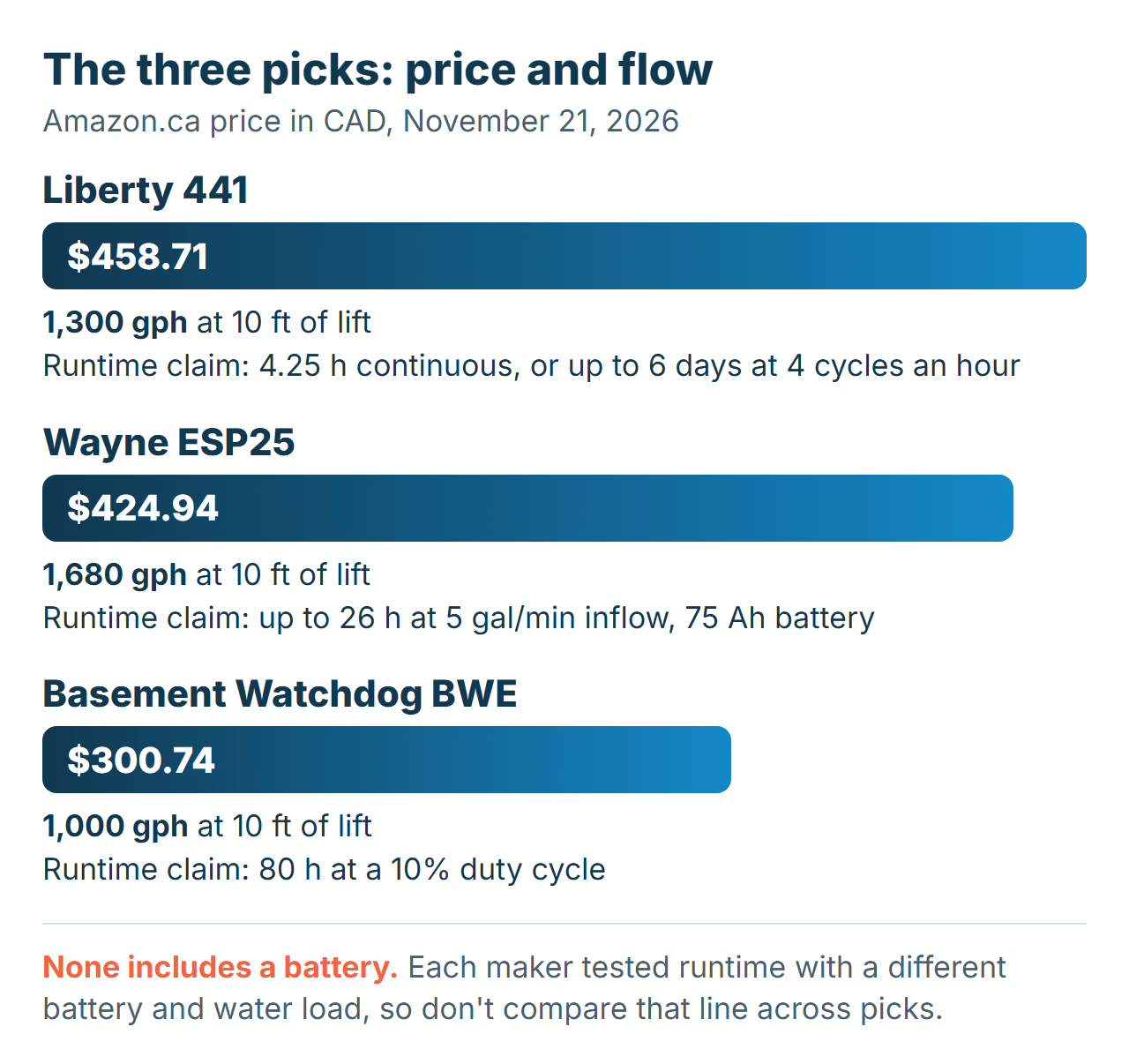
| Model | Price (CAD, about) | Flow at 10 ft | Runtime claim (maker’s test) | Battery included |
|---|---|---|---|---|
| Liberty 441 | $458.71 | 1,300 gph | 4.25 h continuous, or up to 6 days at 4 cycles an hour, Group 27 or 31 battery | No |
| Wayne ESP25 | $424.94 | 1,680 gph | Up to 26 h at 5 gal/min inflow, Wayne 75 Ah battery | No |
| Basement Watchdog BWE | $300.74 | 1,000 gph | 80 h at a 10% duty cycle, BW-27AGM battery | No |
Don’t compare the runtime column across rows. Each maker used a different battery and a different water load. The flow column is the closest thing to apples-to-apples, and even that comes from three different maker sources.
How we picked
We haven’t tested these pumps. We chose systems with a live Amazon.ca page, then read each maker’s manual or product page for flow, battery and warranty. Where a maker’s figures disagreed with themselves, we used only the one we could pin down. Reviews are quoted as what owners wrote, not as our findings. We couldn’t confirm a CSA or ETL listing for any of the three from the maker pages, so check the label on whatever you buy.
What we left out, and why
Zoeller Basement Sentry 507. It was on Amazon.ca at about $554.62 with one unit left. But Zoeller’s discontinued-products page marks the Basement Sentry 507 as obsolete and points to the Aquanot Key 507. We couldn’t find that replacement on Amazon.ca.
Dual 115 V pump sets. A second AC pump adds capacity if the first one fails mechanically. But it runs on mains power, so it does nothing in an outage. We looked at one (a Red Lion dual set) and left it out for that reason. It’s flood-capacity insurance, not outage protection.
Some people run a regular pump from a generator or power station instead. How that gets wired is an electrician’s call. Our guides cover the units themselves: best portable generator in Canada and best portable power station in Canada.
How to size a backup pump
Start with lift, the vertical distance from the bottom of the pit to where the water leaves your house. Then read the maker’s flow at that lift, not the headline number at 0 ft.
Gallons per hour is easier to judge as gallons per minute. At 10 ft, the Liberty moves about 21.7 gal/min (1,300 ÷ 60), the Wayne about 28 (1,680 ÷ 60) and the Basement Watchdog about 16.7, which is the figure its maker gives.
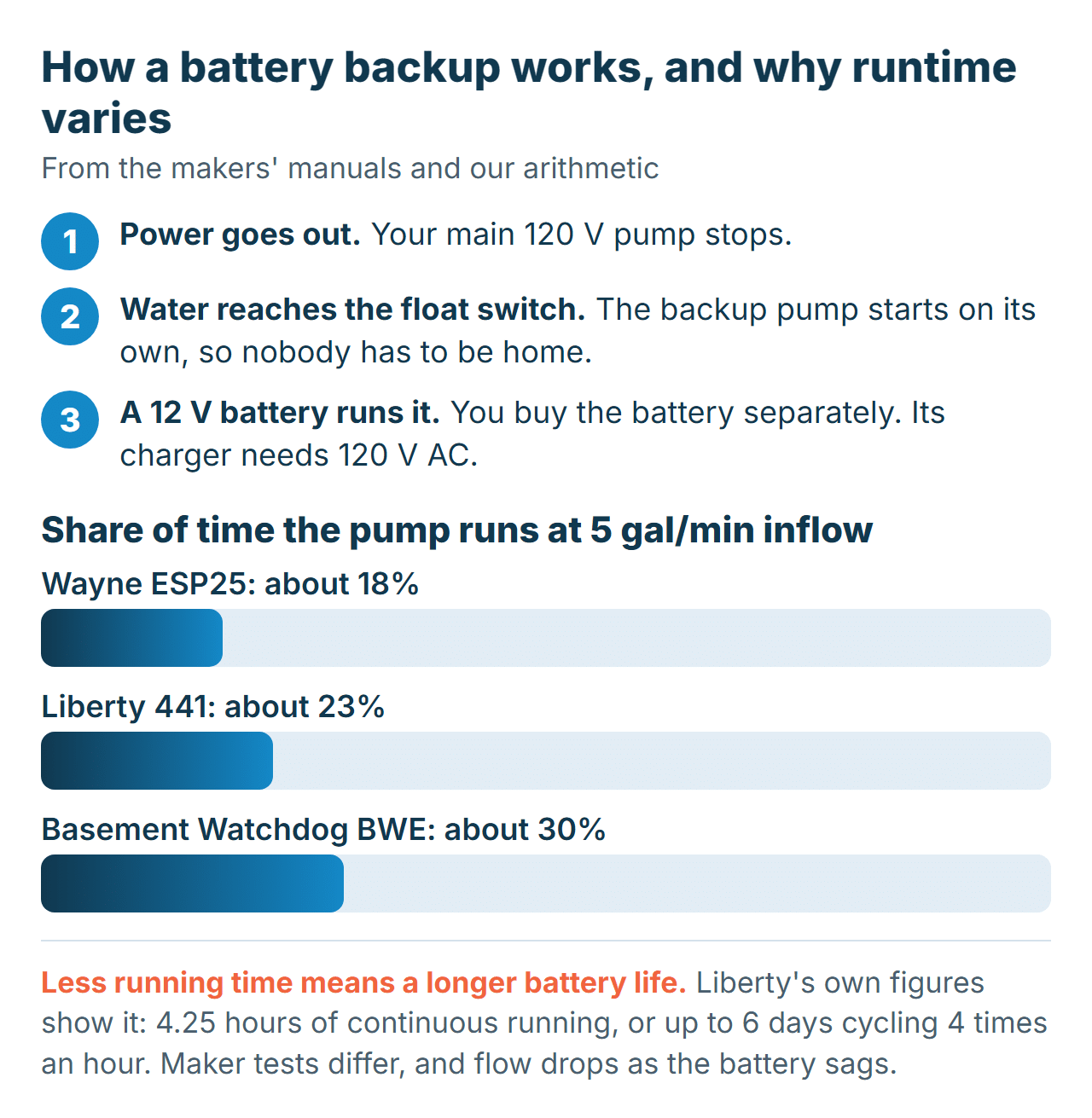
Now compare that to how fast water enters your pit. If it fills at 5 gal/min (300 gal/h), our arithmetic says the Wayne runs about 18% of the time, the Liberty about 23% and the Basement Watchdog about 30%. That assumes steady inflow. It also ignores that flow drops as the battery sags. Liberty says its flow figures assume 12.1 V at the battery and fall below that.
The less time the pump runs, the longer the battery lasts. That’s the real reason higher flow matters. If your pit fills faster than any of these can empty it, you have a drainage problem a bigger backup won’t fix.
The battery is a separate purchase
None of the three listings includes one. One Amazon.ca reviewer of the Liberty put the battery at another $200 to $450, depending on size. That’s one owner’s estimate, so price the battery yourself.
All three use a 12 V lead-acid deep-cycle battery. Liberty recommends a marine-type Group 27 or Group 31, AGM or wet cell, and says a standard car battery isn’t recommended. Basement Watchdog recommends its BW-27AGM and says two batteries aren’t recommended. Wayne suggests its 75 Ah WSB1275.
The charger needs 120 V AC. Liberty says its charger can take up to 19 hours to bring a healthy battery to a maintenance charge, so a battery drained once won’t be full again the next day. Liberty also says never to charge lithium-ion batteries with that charger, and to keep the battery box in a dry spot that can’t flood, off a bare concrete floor.
Install, alarms and testing
Hire a licensed plumber and electrician for the wiring and the pipework. Liberty’s manual says installation and maintenance should be done by qualified personnel and that the charger should be plugged into a properly fused GFCI outlet. We aren’t giving electrical or plumbing advice here.
Liberty also says to install the system when the main pump isn’t needed, because the pit may fill while you work.
Alarms matter more than they sound. Basement Watchdog’s page says its panel won’t warn you if the backup pump fails, so a test you run yourself is the only check. Our suggestion: use the test steps in your manual a few times a year and after any long outage.
The Insurance Bureau of Canada and the Institute for Catastrophic Loss Reduction advise replacing any sump pump over 10 years old and fitting a system with battery backup and an alarm.
Toronto and other cities may pay part of the cost
The City of Toronto’s Basement Flooding Protection Subsidy covers 80% of the invoiced cost of a sump pump, up to $2,250, and an additional 80% up to $300 for a sump pump battery backup. That’s for work completed on or after November 12, 2025, with one sump pump per property, and applications opened May 1, 2026. These are the figures on the City’s page as we read it on November 21, 2026.
The catches. Funding is first-come, first-served and depends on annual Council approval. You must own a single-family to fourplex property in Toronto. Your downspouts must be disconnected from the City sewer, or exempted. Contractors need valid City business licences, and the battery backup must be itemized separately on the invoice. The rules are built around contractor invoices, so check with the City before planning a DIY install. There are also lifetime limits per property.
The City also lists a subsidy for backwater valves, which address sewer backup, a different problem from a failed pump. Read the City’s subsidy program page for current figures. We haven’t checked programs in other cities, so ask your municipality.
Frequently asked questions
Do I need a battery backup if I have a generator?
It depends on whether someone is home to start the generator and connect it. A battery backup pump starts on its own when water reaches its float switch, so nobody has to be home. That reasoning is ours, not a rule. Either way, have an electrician set up any connection to the pump.
Does home insurance cover a sump pump failure?
Not automatically. The IBC says water damage from a sewer backup is only covered if you add optional sewer backup coverage. Whether a pump failure or overflow is covered depends on your policy wording, so ask your broker.
Can a backup pump be my only pump?
No. Liberty’s manual says the 441 isn’t a substitute for a primary sump pump. It’s designed to back one up during an outage or other problem.
How long will the battery last?
It depends on your battery and how fast water enters the pit. Liberty says 4.25 hours of continuous running, or up to 6 days cycling 4 times an hour at 10 ft of lift. Wayne claims up to 26 hours at 5 gal/min of inflow with its 75 Ah battery. Basement Watchdog claims 80 hours at a 10% duty cycle. Those are maker figures from different test setups.
Can I get money back for installing one?
In Toronto, possibly. See the subsidy section above for the amounts and limits. For other cities, check with your municipality.
Is my old pump worth keeping?
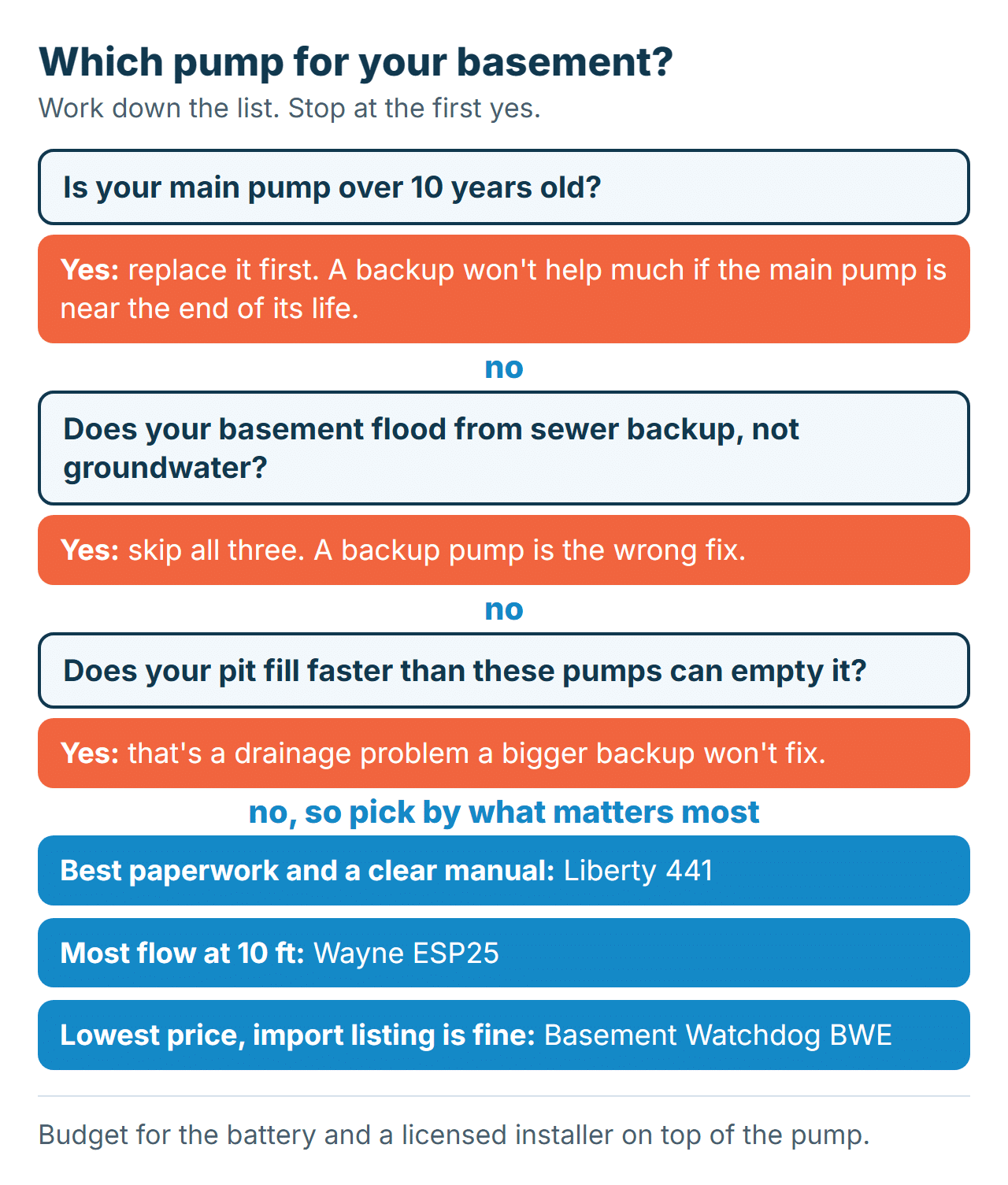
The IBC and ICLR say to replace any sump pump over 10 years old. A backup pump won’t help much if the main one is already near the end of its life.
The bottom line
If you want the best paperwork and a clear manual, buy the Liberty 441. If you want the most flow at 10 ft, buy the Wayne ESP25. If budget decides it and you’re fine with an import listing, the Basement Watchdog BWE is the cheapest way in.
Skip all three if your main pump is more than 10 years old (replace that first), or if your basement floods from sewer backup rather than groundwater. And budget for the battery and a licensed installer on top of the pump.
Once the water side is sorted, damp air is the next problem. See our best dehumidifier for a basement in Canada.
Related reading
Prices and availability checked on Amazon.ca on November 21, 2026. They change.
As an Amazon Associate we earn from qualifying purchases.