 Inspire
Isotonix Multivitamin With Iron vs Without Iron: A Label Review
You can buy the Isotonix Multivitamin with iron or without it, and the product page doesn’t say who should pick which. On the US labels the only real nutrient difference is 15 mg of iron, so the question is whether you want it. Neither bottle is the Multivitamin Fifty Plus, which is a separate formula with a 2-capful serving. For this label review we read both Supplement Facts panels line by line, checked the numbers against NIH, and found the formula changes by country.
Key takeaways
- Pick by iron. With Iron has 15 mg (83% of the 18 mg Daily Value) and Without Iron has the same nutrient amounts minus that line. NIH lists the iron RDA as 8 mg for men and for women 51 and older, and 18 mg for women 19 to 50.
- The US store charges $62.95 for With Iron and $59.95 for Without Iron, 90 one-capful servings either way, or $0.69 and $0.66 a day by its own math.
- This is not the Fifty Plus formula in our other review. It has 90 servings instead of 45, 25 mcg of vitamin D3 instead of 5 mcg, and 25 mg of magnesium instead of 200 mg.
- The formula changes by country. Canada’s page lists 4.5 mg of iron, while the Hong Kong, Taiwan, Malaysia, Australia and Indonesia pages list none, so check your own country’s label.
- The weak spots are small calcium (4% DV) and magnesium (6% DV), niacin at 40 mg NE against NIH’s 35 mg limit, and a 90 to 95% absorption claim with no absorption study in the US page’s reference list.
Isotonix Multivitamin with iron or without: which one fits you
If you’re an adult man or a woman 51 or older who eats animal products, Without Iron is the natural pick. NIH lists the iron RDA at 8 mg for both groups. Its iron fact sheet adds that multivitamins for men or seniors frequently contain less or no iron.
Women 19 to 50 are different. Their RDA is 18 mg, and the With Iron bottle’s 15 mg covers 83% of the Daily Value. NIH says premenopausal women are at risk of getting too little, and names heavy menstrual bleeding and frequent blood donation as risk groups.
That still isn’t a reason to take iron by default. Iron deficiency is diagnosed with blood tests, so settle it with your doctor.
✓ With Iron makes sense if
- You’re a woman 19 to 50 (RDA 18 mg) and no one has told you to avoid iron
- You follow a vegetarian diet. NIH says the iron requirement is 1.8 times higher
- You have heavy periods or give blood often, and your doctor knows
✕ Skip With Iron, or ask first, if
- You’re a man or a woman 51 or older who eats animal products (RDA 8 mg)
- You have hemochromatosis. NIH reports that the American Association for the Study of Liver Diseases recommends avoiding iron and vitamin C supplements as part of treatment, and both versions contain 150 mg of vitamin C
- You take levothyroxine or levodopa. NIH says iron can reduce how much of either you absorb
- Small children can reach the bottle. NIH reproduces the FDA warning that accidental iron overdose is a leading cause of fatal poisoning in children under 6
The two bottles are otherwise the same, and the US store prices them close together:
| With Iron | Without Iron | |
|---|---|---|
| US price, one-time | $62.95 | $59.95 |
| Store’s per-day figure | $0.69 | $0.66 |
| Iron per capful | 15 mg (83% DV) | None |
| Every other line on the panel | Same amounts | Same amounts |
One oddity: the Without Iron label image on the official page prints zinc as 7.5 mcg. That has to be a typo for 7.5 mg, because the 68% of Daily Value beside it only works out at 7.5 mg against an 11 mg Daily Value. The same panel prints 2% for added sugars where the With Iron panel prints 1%, for the same under-1-g amount.
What’s in one capful of Isotonix Multivitamin (US label)
Both bottles list 1 capful (3.3 g) and 90 servings per container. Here is the With Iron panel; for Without Iron, drop the iron row.
| Nutrient (form) | Per capful | % DV |
|---|---|---|
| Vitamin A (as beta-carotene) | 3,000 mcg RAE | 333% |
| Vitamin C (ascorbic acid) | 150 mg | 167% |
| Vitamin D3 (cholecalciferol) | 25 mcg | 125% |
| Vitamin E (D-alpha-tocopheryl succinate) | 45 mg | 300% |
| Thiamin (thiamin HCl) | 2.6 mg | 217% |
| Riboflavin | 3 mg | 231% |
| Niacin (niacin and niacinamide) | 40 mg NE | 250% |
| Vitamin B6 (pyridoxine HCl) | 4 mg | 235% |
| Folate ((6S)-5-methyltetrahydrofolate calcium) | 215 mcg DFE | 54% |
| Vitamin B12 (methylcobalamin) | 75 mcg | 3,125% |
| Biotin | 300 mcg | 1,000% |
| Pantothenic acid (D-calcium pantothenate) | 20 mg | 400% |
| Calcium (lactate and tricalcium phosphate) | 50 mg | 4% |
| Iron (ferric pyrophosphate), With Iron only | 15 mg | 83% |
| Iodine (potassium iodide) | 150 mcg | 100% |
| Magnesium (carbonate) | 25 mg | 6% |
| Zinc (lactate) | 7.5 mg | 68% |
| Selenium (amino acid chelate) | 55 mcg | 100% |
| Copper (gluconate) | 0.1 mg | 11% |
| Manganese (gluconate) | 2 mg | 87% |
| Chromium (nicotinate) | 120 mcg | 343% |
| Potassium (bicarbonate) | 110 mg | 2% |
Other ingredients include fructose, rebaudioside A (stevia leaf), luo han guo fruit extract, maltodextrin and natural fruit flavors.
The big percentages sit on the B vitamins, vitamin C and vitamin E. Calcium and magnesium are small: 50 mg of calcium (4% DV) and 25 mg of magnesium (6% DV). The product page’s key-ingredient tile calls out magnesium as citrate, but the panel lists magnesium carbonate.
Chromium is the headline: 120 mcg, 343% of the 35 mcg Daily Value. The page ties it to healthy blood sugar.
NIH reports that the Food and Nutrition Board linked no adverse effects to high chromium intakes and set no upper limit, though it said caution may be warranted because the data are limited, and that people with kidney or liver disease might be susceptible to adverse effects from high intakes. On blood sugar, a 2019 review it cites found chromium lowered fasting glucose and HbA1c only slightly in people with diabetes, and NIH calls the clinical significance unclear. Don’t count on this bottle for blood sugar.
Chromium taken with insulin could raise the risk of low blood sugar, NIH says, and might add to the effect of metformin and other diabetes medicines. If you take any of those, or have kidney or liver disease, ask your doctor or pharmacist before using either version.
Vitamin A comes entirely as beta-carotene. NIH says the vitamin A upper limit (3,000 mcg RAE a day for adults) applies to preformed vitamin A (retinol and its esters), and that the Food and Nutrition Board set none for beta-carotene, though the Board advises against beta-carotene supplements for the general population except as a source of vitamin A to prevent deficiency.
Smokers, and possibly former smokers, should avoid multivitamins with large amounts of beta-carotene or vitamin A, NIH says, after two trials linked them to more lung cancer in smokers. Those trials used 20 mg and 30 mg of beta-carotene a day. At NIH’s conversion of 2 mcg supplemental beta-carotene per 1 mcg RAE, this label works out to roughly 6 mg. That’s below those doses, but NIH says multivitamins often carry 750 to 1,050 mcg RAE, so 3,000 mcg RAE is nearly three times the top of that range. Tell your doctor if you smoke or used to.
The iron is ferric pyrophosphate. NIH says ferrous iron is more bioavailable than ferric, so read 15 mg as what’s in the capful, not what your body absorbs.
The label says to pour 1 small capful into a cup, add 2 fl oz (60 ml) of water and take it once a day, with maximum absorption on an empty stomach. NIH says iron doses of 45 mg a day or more may cause nausea and constipation, and this is 15 mg, but taking iron with food can help minimize stomach upset. If With Iron sits badly on an empty stomach, ask your pharmacist about timing.
How the doses compare with NIH upper limits
| Nutrient | On the label | NIH upper limit, adults | Share of limit |
|---|---|---|---|
| Niacin | 40 mg NE | 35 mg | About 114% |
| Iron | 15 mg | 45 mg | About 33% |
| Vitamin D3 | 25 mcg (1,000 IU) | 100 mcg (4,000 IU) | 25% |
| Zinc | 7.5 mg | 40 mg | About 19% |
| Vitamin C | 150 mg | 2,000 mg | About 8% |
| Vitamin E | 45 mg | 1,000 mg | About 5% |
| Vitamin B6 | 4 mg | 100 mg | 4% |
Every other dose in this table sits well under the NIH limit. The label gives niacin as 40 mg NE (niacin and niacinamide) with no split, and NIH says its 35 mg adult limit applies to both forms of supplemental niacin, so one capful runs about 14% over it. NIH bases that limit on skin flushing, which niacinamide doesn’t cause, and says it doesn’t apply to people taking niacin under medical supervision.
The catch is stacking. Excess intakes are more likely among multivitamin users who also take single-nutrient supplements, NIH says, so if you add niacin, vitamin D, B6 or zinc on top, add the numbers up. The Activated B-Complex lists 20 mg NE of niacin, which would take the total to 60 mg NE.
How it differs from Fifty Plus and Daily Essentials
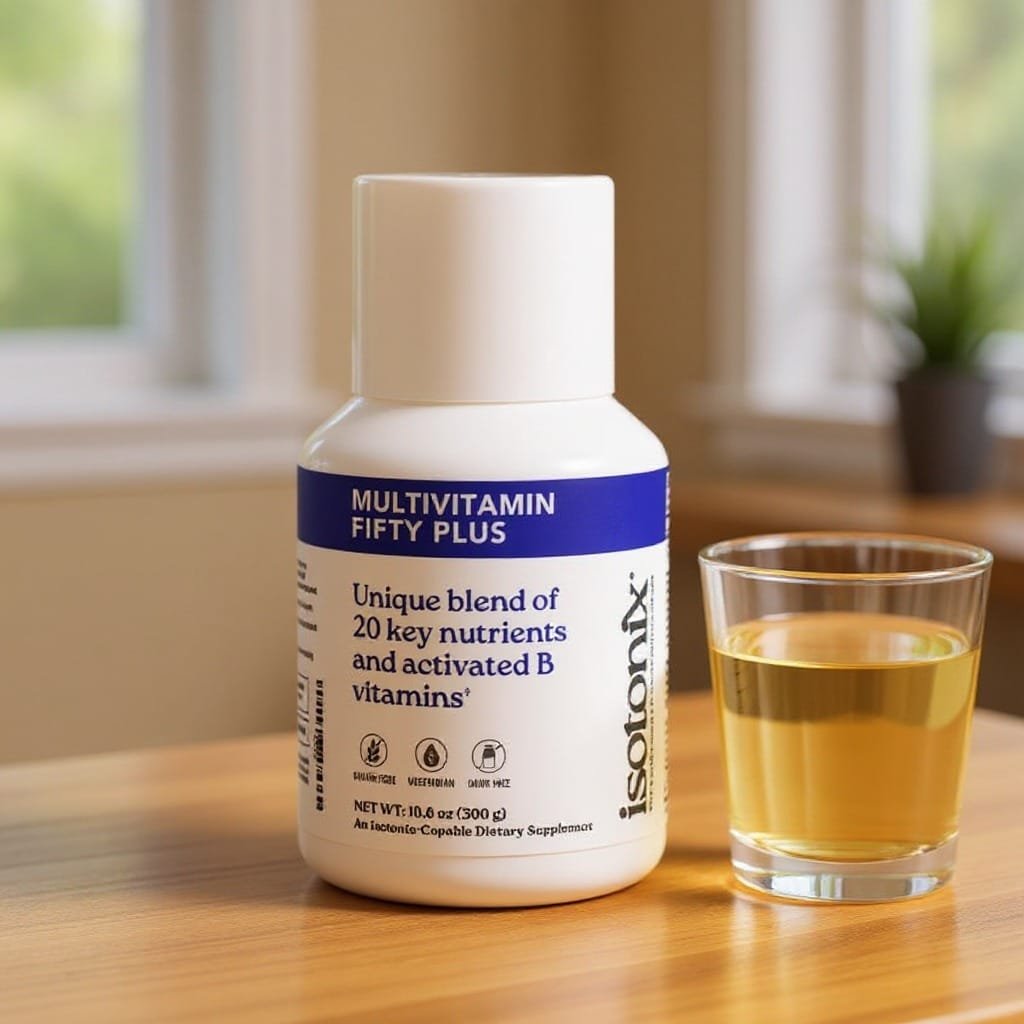
Our existing Isotonix Multivitamin Fifty Plus review covers a separate bottle with its own panel. Here are the differences, from both US labels:
| With Iron | Fifty Plus | |
|---|---|---|
| Serving | 1 capful (3.3 g) | 2 capfuls (6.6 g) |
| Servings per bottle | 90 | 45 |
| US price | $62.95 | $49.95 |
| Store’s per-day figure | $0.69 | $1.11 |
| Iron | 15 mg | None |
| Vitamin D3 | 25 mcg | 5 mcg |
| Vitamin B12 | 75 mcg | 10 mcg |
| Vitamin B6 | 4 mg | 37.5 mg |
| Magnesium | 25 mg | 200 mg |
| Calcium | 50 mg | 100 mg |
| Zinc | 7.5 mg | 15 mg |
| Chromium | 120 mcg | 25 mcg |
Fifty Plus costs about 60% more per day on the store’s own figures. The standard formula has five times the vitamin D and 7.5 times the B12. NIH says formulas for older adults often carry more of both, so this pair runs the other way.
Fifty Plus does carry more calcium, magnesium and B6. Its 37.5 mg of B6 is under the US upper limit of 100 mg but over the 12 mg limit from the European Food Safety Authority that NIH mentions, so count it if you take a separate B6.
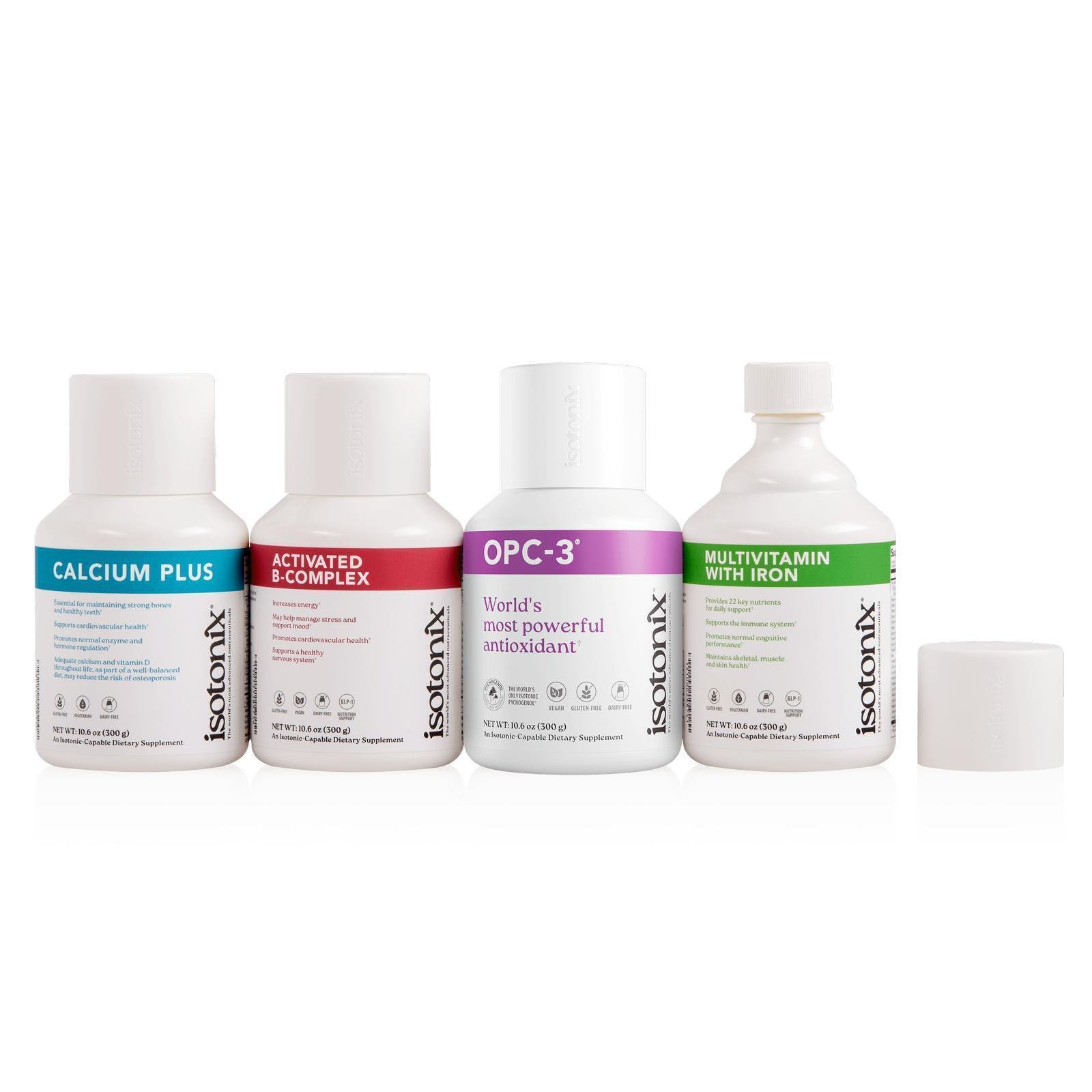
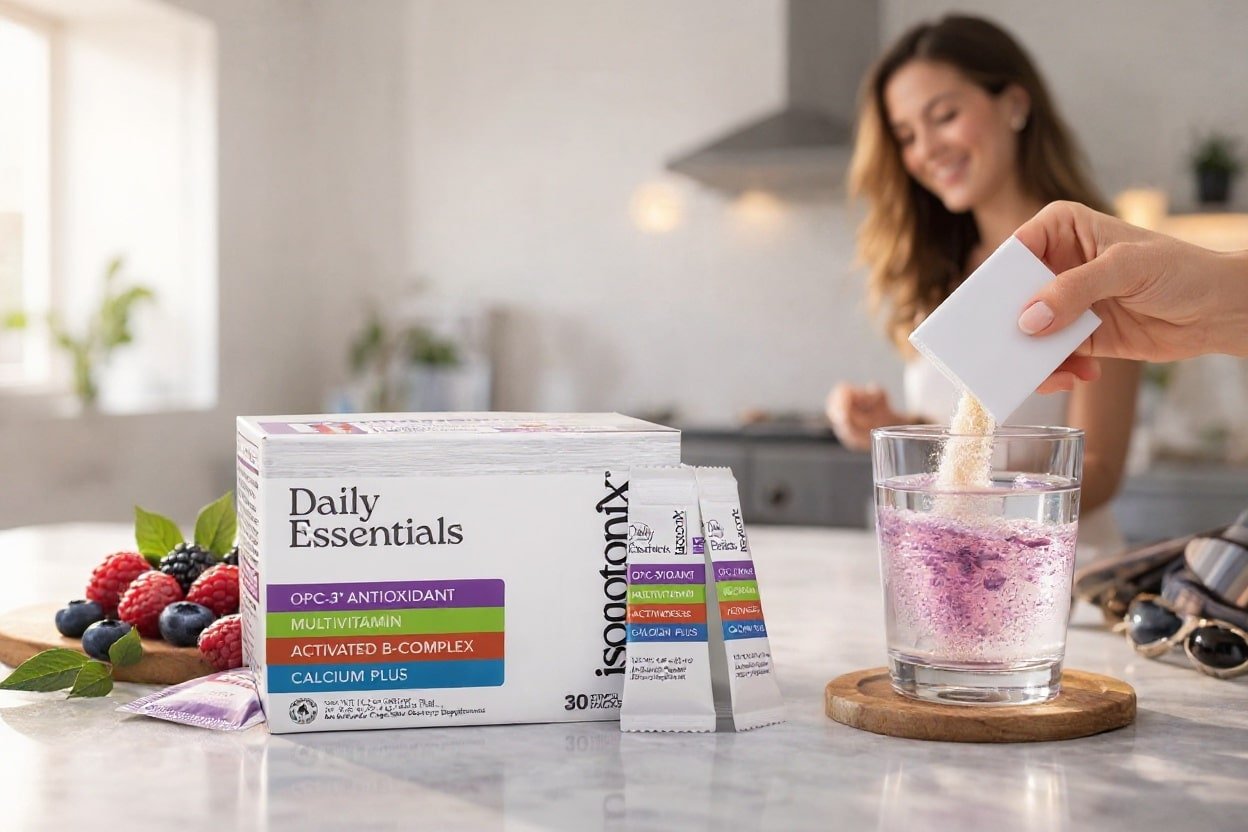
Daily Essentials is a bundle that includes this formula. The official Daily Essentials Kit (With Iron) lists a multivitamin with iron, OPC-3, Activated B-Complex and Calcium Plus, 90 servings of each, for $219.95. A Without Iron kit costs the same.
On current US prices the four single 90-serving bottles cost $224.80 ($74.95 OPC-3, $62.95 multivitamin with iron, $59.95 Activated B-Complex, $26.95 Calcium Plus), so the With Iron kit saves $4.85 (about 2%) and the Without Iron kit $1.85 (about 1%). See our Daily Essentials review.
Calcium might interfere with iron absorption, NIH says, though that has not been definitively established, and experts suggest taking separate calcium and iron supplements at different times. The With Iron kit puts both in one box, but its page says the products can safely be taken together if you follow each serving size. Ask your pharmacist if timing matters for you.
What the page claims, and what we can’t verify
The official page says nutrients are delivered for absorption at 90 to 95% from an isotonic solution, against 20 to 30% from standard capsules and tablets.
The US With Iron page’s reference list shows 19 citations, from Anderson to Gleeson, and appears to stop at G. Every citation is a paper, book chapter or report on an individual nutrient or nutrition topic, dated 1982 to 2000. None of them tests isotonic absorption. Canada’s page for this product shows more than 150 entries, and none of its titles mentions isotonic or osmolality.
Our explainers on what isotonic means and Isotonix versus capsules cover the physiology, including why the format matters less for fat-soluble vitamins. This formula has three of those (A, D and E).
On the With Iron page, the main product image carries a badge saying 125+ doctors recommend the product through nutraMetrix. The small print says those doctors are program participants who may receive commissions on product sales. Weigh it accordingly.
A multivitamin is insurance, not treatment. NIH says multivitamins may help people who don’t eat a variety of nutritious foods, and that overall they do not appear to reliably reduce the risk of chronic disease. If you’re pregnant, nursing, on prescription drugs or managing a condition, the bottle itself says to check with your health care provider first.
Where it’s sold, and how the formula changes by country
Only the US page names both versions. Bottles are 90 servings unless noted. For store-by-store buying detail, see our guides for the US, Canada, Australia, Singapore and Hong Kong and Taiwan, or open the US store page.
| Country (listed as) | Price | Iron on the page |
|---|---|---|
| US (With / Without Iron) | $62.95 / $59.95 | 15 mg / none |
| Canada (Isotonix Multivitamin) | Can$87.31 | 4.5 mg |
| Hong Kong (powder drink) | HK$465.00 | None listed |
| Singapore (Without Iron) | S$87.25 (GST incl.) | Named Without Iron |
| Malaysia (Multivitamin and Minerals) | RM130.00 (30 servings) to RM285.00 (90) | None listed |
| Taiwan (powder) | NT$1,970 (VAT incl.) | None listed |
| Australia | A$104.00 (GST incl.) | None listed |
| Indonesia (Ixonix Multivitamin & Minerals) | Rp1,036,000 (VAT incl.) | None listed |
Canada is the clearest example of a different formula. Its page lists 4.5 mg of iron, 25 mcg of chromium (US: 120 mcg), 400 IU of vitamin D3 (US: 1,000 IU) and vitamin B12 as cyanocobalamin at 15 mcg (US: 75 mcg of methylcobalamin). It also lists 1,500 mcg RAE of vitamin A as palmitate, which is preformed vitamin A, on top of the beta-carotene.
The Hong Kong, Australian and Indonesian ingredient lists show cyanocobalamin and folic acid, not the methylated forms the US label and marketing talk about.
Singapore is the odd one out. Its ingredient box lists boron, which no other multivitamin page does, and its short list of nine ingredients matches the US store’s Calcium Plus list rather than a multivitamin’s, so we can’t tell you the Singapore formula from the page. Read the bottle you receive.
Frequently asked questions
Is Isotonix Multivitamin better with iron or without iron?
How much iron is in Isotonix Multivitamin With Iron?
What is the difference between Isotonix Multivitamin and Multivitamin Fifty Plus?
Is Isotonix Multivitamin powder absorbed better than a pill?
Is an isotonic multivitamin the same as Isotonix Multivitamin?
How do you take Isotonix Multivitamin?
Can I take Isotonix Multivitamin with Calcium Plus or B-Complex?
Is Isotonix Multivitamin safe during pregnancy?
How much does Isotonix Multivitamin cost?
“A plain once-a-day panel at $0.66 to $0.69 a day, with niacin a little over NIH’s limit and an absorption claim the page doesn’t back with a study.”
If we were buying for an adult man or a woman over 50 who eats animal products, it would be Without Iron at $59.95. For a woman 19 to 50 it would be With Iron, after a word with her doctor. We haven’t scored it: this is a label review, not a lab test, and the formulas in Canada and other countries aren’t the one we read.

See the Subscribe and Save option →
Sources
- Iron RDAs, upper limit, risk groups, hemochromatosis, supplement forms, medication interactions: NIH Office of Dietary Supplements, Iron: Health Professional Fact Sheet.
- Multivitamin safety, stacking, smokers and beta-carotene, what 50+ formulas usually contain: NIH ODS, Multivitamin/mineral Supplements.
- Vitamin A, RAE conversion and beta-carotene: NIH ODS, Vitamin A and Carotenoids.
- Upper limits and Daily Values: NIH ODS fact sheets for vitamin D, zinc, vitamin C, vitamin E, vitamin B6, niacin and chromium.
- Labels, prices and ingredient lists, checked October 17, 2026: Multivitamin With Iron, Without Iron, Fifty Plus, Daily Essentials Kit (With Iron) and (Without Iron); single-bottle prices and labels for OPC-3, Activated B-Complex and Calcium Plus; country stores at Market Canada, Market Hong Kong, Market Singapore, Market Malaysia, Market Taiwan, Market Australia and Market Indonesia.
Related reading
-
 ReviewIsotonix Multivitamin Fifty Plus reviewThe 50+ formula, a different bottle with no iron and its own doses.
-
 ReviewIsotonix Daily Essentials reviewThe bundle that includes a multivitamin, OPC-3, B-Complex and Calcium Plus.
-
 ReviewIsotonix Prenatal Activated Multivitamin reviewThe separate formula built for pregnancy, with its own iron and folate.