 Inspire
Waterdrop vs. Aquasana: Which Under-Sink Filter Actually Fits Your Kitchen? (2026)
Waterdrop and Aquasana solve the same problem in genuinely different ways. We checked the certification databases, the real output numbers, and the verified complaint history behind both, not just the spec sheets.
Updated August 14, 2026 · 10 min read · ✓ Fact-checked · Includes affiliated links
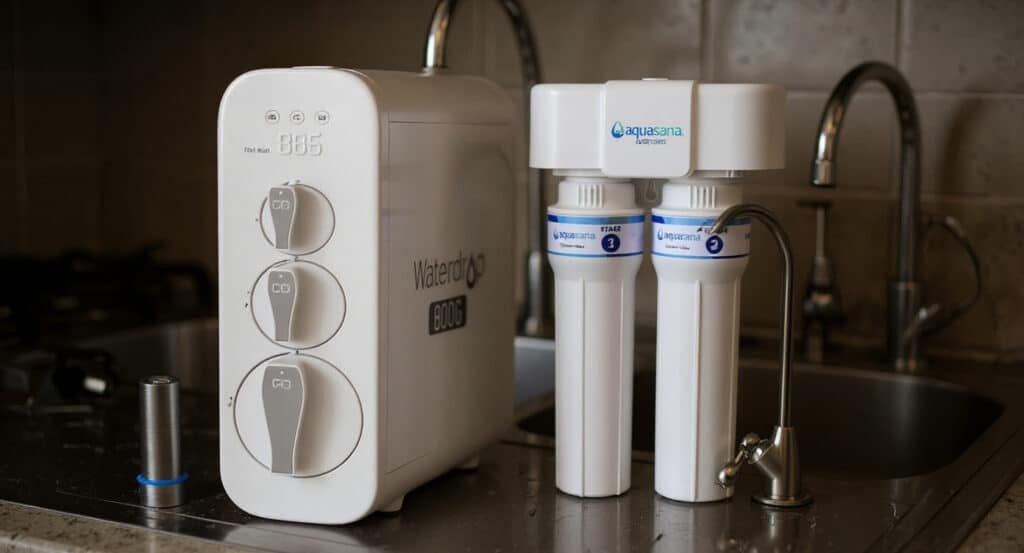
Waterdrop and Aquasana solve the same problem, filtered water at the tap, with almost nothing else in common under the hood.
Want the highest output and the easiest Canadian shipping, the Waterdrop G3P800 runs tankless at up to 800 gallons a day and Waterdrop ships from real Canadian warehouses with CAD pricing, no customs surprise at the door. Want a lower-cost RO system, the Waterdrop G3P600 drops to 600 GPD at a lower price with the same certification set. Don’t want to tap a drain line at all, Aquasana’s Claryum 3-Stage skips reverse osmosis entirely for carbon and ion exchange, real zero-waste-water filtration, though it can’t remove fluoride or arsenic the way an RO system can. Considering Aquasana’s SmartFlow RO system, read the output numbers and the complaint pattern below before you subscribe to their filter-replacement plan.
Both brands’ RO systems are certified through IAPMO or WQA, not NSF International directly, so checking NSF’s own database won’t show either one. That’s normal, not a red flag, and it’s covered in detail below.
Our picks
Prices, ratings, and certifications below were checked against manufacturer spec pages and IAPMO/WQA/NSF records as of August 2026, not just each brand’s own claims. RO system pricing shifts often with retailer bundles and promo codes, confirm the current price before buying.
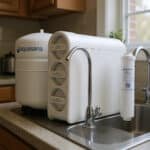
Waterdrop vs. Aquasana, side by side
| Waterdrop G3P800 | Aquasana SmartFlow | Aquasana Claryum 3-Stage | |
|---|---|---|---|
| Technology | Tankless reverse osmosis | Tank-based reverse osmosis | Carbon + ion exchange (no RO) |
| Real output | Up to 800 GPD, continuous | 25.7 GPD actual + 3.2-gal tank | Continuous, no tank needed |
| Wastewater | 3:1 pure-to-drain | Not published (RO always wastes some) | None, not an RO system |
| Drain line needed | Yes | Yes | No |
| Electricity needed | Yes, pump/UV/display | Not confirmed either way | No |
| Fluoride / arsenic removal | Yes (RO) | Yes (RO) | No, structural limitation |
| PFOA/PFOS claim basis | Waterdrop-commissioned lab testing, outside formal cert scope | Part of formal NSF/ANSI 53 (P473) certification | Part of formal NSF/ANSI 53 (P473) certification |
| Certifying body | IAPMO R&T | WQA Gold Seal | WQA Gold Seal |
| Annual filter cost (approx.) | $130-165 | Not confirmed | ~$140 |
| Canada shipping | Dedicated .ca site, Canadian warehouses, CAD pricing | Ships from the US, duties/taxes collected at delivery | Ships from the US, duties/taxes collected at delivery |
The certification mix-up most comparisons get wrong
Neither brand’s flagship RO system shows up in NSF International’s own certified-product database. We checked directly. That’s not because the certifications are fake, it’s because both brands are certified through IAPMO R&T or the Water Quality Association (WQA Gold Seal) instead, two separate, legitimate, ANSI-accredited certifying bodies that run their own databases, not NSF’s. A generic “just check NSF’s site” tip will turn up nothing for either brand and might wrongly read as a fake certification when it isn’t.
There’s a second wrinkle specific to Waterdrop’s marketing: the G3P800’s listing prominently includes NSF/ANSI 372 alongside 42, 53, and 58. Standard 372 certifies that the product’s own plumbing components don’t leach lead, it says nothing about what the system removes from your water. Listing it next to the performance standards makes the certification list look broader than it actually is for contaminant removal specifically. Our NSF/ANSI standards verification table sets out what 42, 53, 58, 401 and 372 each cover.
800 GPD tankless vs. 25.7 GPD actual: what the gap really means
Waterdrop’s tankless systems produce filtered water continuously and on demand, up to 800 GPD for the G3P800. Aquasana’s SmartFlow works differently: its own spec page lists 51.4 GPD as the membrane’s rated capacity, but 25.7 GPD as actual production, filling a 3.2-gallon pressurized tank you draw from at 0.7 GPM.
In practice, that tank buffers short bursts fine, filling a glass, a coffee pot. It’s a large household filling multiple pots back-to-back, or running the tap steadily for a while, where the gap shows up: SmartFlow’s tank can empty faster than the system refills it, while Waterdrop’s tankless design just keeps producing. If you’re a single person or couple with light, spread-out use, this gap may never matter. If you cook for a family or fill large containers regularly, it’s worth sizing correctly before you buy either system.
Aquasana’s complaint pattern, verified, not from a competitor’s marketing
We checked Aquasana’s record on Trustpilot, the Better Business Bureau, and PissedConsumer rather than repeating either brand’s own claims. Aquasana’s Trustpilot rating sits in the “Bad” range, roughly 1.3 to 1.6 out of 5 across about 150-160 reviews as of this writing, a small sample but a consistent one across snapshots. The dominant complaint theme isn’t the filters themselves, it’s Aquasana’s “Water for Life” auto-ship filter subscription: price increases without advance notice, cancellation available only by phone (no online option in the complaints we reviewed), and billing continuing on accounts customers believed they’d cancelled. Aquasana holds an A+ BBB rating but is not BBB-accredited.
Separately, ClassAction.org lists an active investigation (last updated February 2026, at the time of our research) into reports of Claryum-line under-sink filter housings cracking or leaking, with at least one homeowner reporting significant water damage. To be precise about what this is and isn’t: it’s an open investigation soliciting reports, not a filed lawsuit and not a settlement. Aquasana is owned by A.O. Smith Corporation (NYSE: AOS), a large, well-capitalized parent company, which is worth knowing precisely because it makes a sustained complaint pattern more notable, not something you’d expect from a company without the resources to handle service issues well.
None of this means Aquasana’s filtration technology doesn’t work, Claryum’s NSF/ANSI 53 certification is real and formally includes the PFOA/PFOS claim. It means the subscription and support experience is where the real risk sits, not the filter itself, worth weighing before you sign up for auto-ship.
Shipping to Canada: a genuinely different experience
This is a real, verifiable gap, not a minor detail. Waterdrop runs waterdropfilter.ca as a fully localized Canadian storefront, CAD pricing, ships from Canadian warehouses, plus retail distribution through Best Buy Canada and Amazon.ca. Coverage excludes only the far-north X and Y postal code prefixes.
Aquasana ships to Canada from the United States. One-time purchases fulfill from a US facility (only auto-subscription orders ship from a Canadian warehouse, per Aquasana’s own shipping policy), and Canadian orders are subject to duties, taxes, and carrier brokerage fees collected at delivery, the customer’s responsibility. Aquasana’s policy is explicit that an unpaid or unaccepted duty charge can get a shipment marked “abandoned” and ineligible for a full refund. If you’re ordering from Canada, that’s a real cost and hassle difference worth knowing before you check out, not just a footnote.
Frequently asked questions
Is Aquasana or Waterdrop more effective at removing PFAS?
This is genuinely mixed, not a clean win for either brand. Aquasana’s PFOA/PFOS reduction claim is part of its formal NSF/ANSI 53 certification (the P473 protocol written specifically for PFOA/PFOS). Waterdrop’s PFAS numbers come from Waterdrop-commissioned SGS lab testing, outside the formal certification scope that covers TDS, chlorine, and lead. Certification rigor favors Aquasana here, even though Waterdrop wins on real-world output and Canadian shipping.
Why can’t I find either brand’s RO system on NSF International’s website?
Because neither is certified directly by NSF International. Both use IAPMO R&T or the Water Quality Association (WQA Gold Seal) instead, both legitimate, ANSI-accredited certifying bodies with their own separate databases. Checking only NSF’s site is a common mistake that makes a real certification look like it doesn’t exist.
Do I need a drain line for either brand’s system?
For any Waterdrop RO system or Aquasana’s SmartFlow, yes, reverse osmosis always produces some wastewater that needs somewhere to go. Aquasana’s Claryum line is the exception: it’s carbon and ion exchange, not RO, so it needs no drain line and produces no wastewater at all, at the cost of not being able to remove fluoride or arsenic.
Is the Aquasana ClassAction.org investigation a lawsuit I should worry about as a buyer?
As of this writing it’s an open investigation gathering reports of cracking or leaking Claryum-line filter housings, not a filed lawsuit and not a settlement. It doesn’t mean every unit fails, but it’s worth knowing about, and worth checking your own installation periodically for leaks regardless of which brand you buy.
Which one actually costs less to run per year?
On the numbers we could confirm, Waterdrop’s G3P800 runs roughly $130-165/year in filters and Aquasana’s Claryum 3-Stage runs roughly $140/year, close enough that it shouldn’t be the deciding factor between those two. We could not confirm a reliable current annual filter cost for Aquasana’s SmartFlow specifically, check the live replacement-filter pricing before you buy.
The bottom line
Waterdrop G3P800
The stronger pick for most households: real tankless output that doesn’t run dry, tighter water-waste ratio, and by far the easier, cheaper experience for Canadian buyers. No remineralization standard and needs a power outlet.
Aquasana Claryum 3-Stage
The right pick specifically if you want to skip the drain-line install and RO’s wastewater entirely, and don’t need fluoride or arsenic removal. Its PFOA/PFOS certification is genuinely more rigorous than Waterdrop’s. Skip Aquasana’s SmartFlow subscription plan until you’ve read the complaint pattern above.
Related reading
 Water & AirBest Under-Sink Water Filters (2026): RO vs Carbon vs 2-StageEvery under-sink filter type compared, not just two brands.
 Water & AirReverse Osmosis vs Carbon Filter: Which Is Better in 2026?The technology behind Waterdrop’s RO and Aquasana’s Claryum, explained.
 Water & AirDoes Waterdrop, SpringWell, or Epic Water Ship to Canada? (2026)The full Canadian-shipping picture across every brand we carry.