 Inspire
Best Countertop Reverse Osmosis Water Filters in Canada (2026)
Five plug-in RO units for renters and condo owners, and what their certification wording actually says.
November 21, 2026 · 9 min read · Contains affiliate links
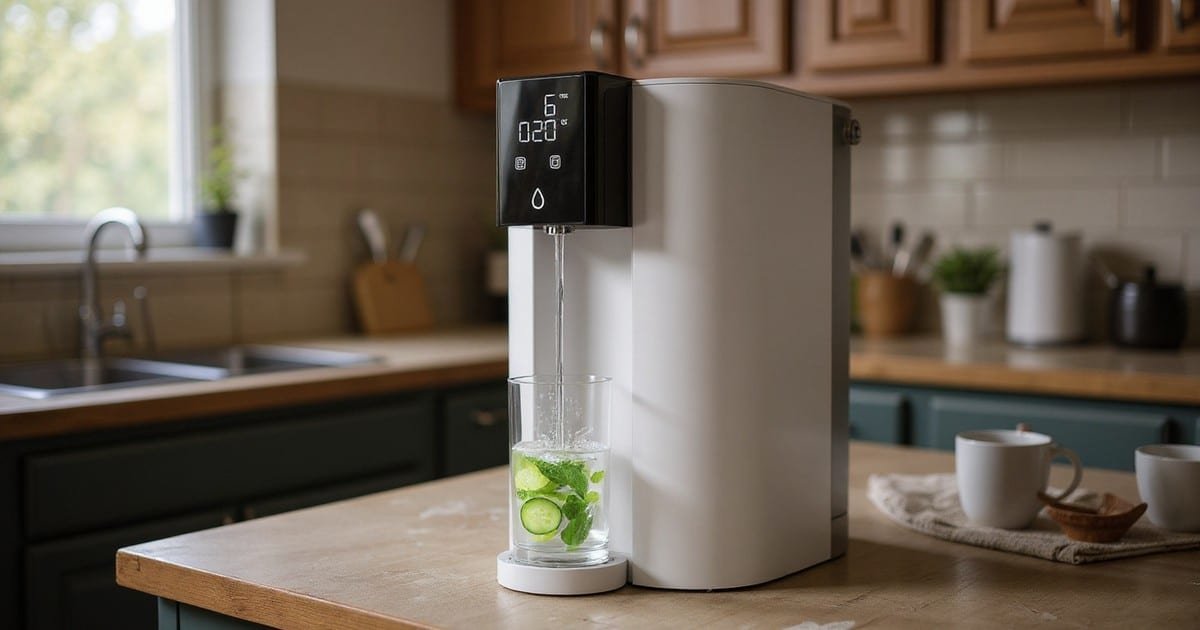
You can get reverse osmosis without touching your plumbing. Plug a countertop unit in, fill the tank, wait a few minutes. The catch is the fine print. None of the five listings below points to an independent NSF/ANSI 58 certificate that we could confirm.
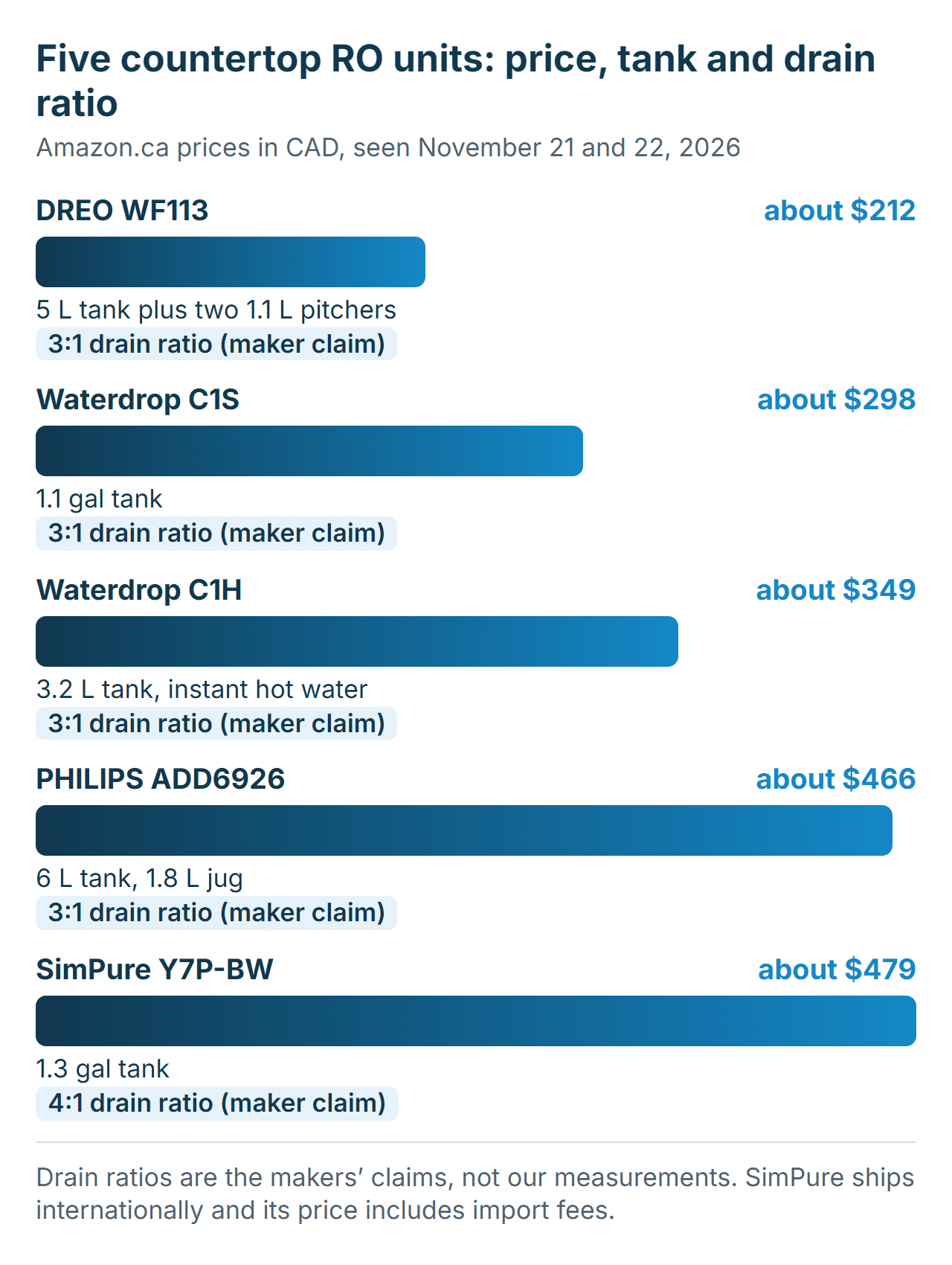
- DREO (about $212): lowest price, two pitchers that fill themselves.
- Waterdrop C1S (about $298): simplest setup, room-temperature water only.
- Waterdrop C1H (about $349): the same idea with instant hot water.
- PHILIPS ADD6926 (about $466): biggest tank, aimed at 2 to 5 people.
- SimPure Y7P-BW (about $479): the best drain-ratio claim. Amazon.ca lists it as shipped internationally, with import fees in the price.
Prices are CAD as we saw them on Amazon.ca on November 21 and 22, 2026. Prices change, so check before you buy.
Some links below are affiliate links. If you buy through them we may earn a commission, at no extra cost to you. It doesn’t change our picks.
Who a countertop RO unit is for
Renters and condo owners, mostly. A standard under-sink RO system ties into your cold line and your drain pipe, and that’s a problem if your lease or your building’s rules say no plumbing changes. A countertop unit needs a plug and counter space. When you move, it moves with you.
It’s a weaker fit in a few cases:
- A big household. The tanks on these units hold roughly 3 to 6 litres, and you refill them by hand.
- Anyone who wants water on demand with no refilling. An under-sink system with its own tap does that. See our best under-sink water filters guide.
- Untested well water with a high mineral load. Both Waterdrop listings say not to use the unit on well water or on source water over 500 TDS.
- Anyone who needs a certificate for a specific health reason, like lead from old plumbing. More on that below.
The 5 compared
| Model | Price (CAD) | Tank | Drain ratio (maker claim) | Certification wording on the listing |
|---|---|---|---|---|
| DREO (WF113) | about $212 | 5 L, plus two 1.1 L pitchers | 3:1 | “Tested by SGS meeting NSF/ANSI 58 Standards” |
| Waterdrop C1S | about $298 | 1.1 gal | 3:1 | No certification claim in the listing text |
| Waterdrop C1H | about $349 | 3.2 L (listing detail table) | 3:1 | NSF/ANSI 372 (lead-free materials) and “SGS-tested” |
| PHILIPS ADD6926 | about $466 | 6 L tank, 1.8 L jug | 3:1 | NSF/ANSI/CAN 372, filter core “certified by SGS” |
| SimPure Y7P-BW | about $479 | 1.3 gal (listing description) | 4:1 | Title says “NSF/ANSI 58 Certified.” First bullet says “Tested by SGS: Against NSF/ANSI 58.” |
Prices and specs come from each Amazon.ca listing on November 21, 2026. Drain ratios are manufacturer claims. We didn’t measure them.
“Tested by SGS” is not the same as certified
Health Canada says it “strongly recommends” buying a drinking water treatment device certified to the applicable NSF/ANSI standard, and it tells you to look for a certification mark. For reverse osmosis, the standard it lists is NSF/ANSI 58. The certifiers it names include CSA Group, NSF International, the Water Quality Association, UL and Truesdail Laboratories, all accredited by the Standards Council of Canada.
NSF describes the 58 standard as covering the structure of the system, how well it cuts total dissolved solids, its efficiency and recovery ratings, and any contaminant-reduction claims the maker wants to make. The 372 standard is a different thing. On the Waterdrop listing it’s described as a “lead-free material” standard, so it speaks to what the parts are made of, not to what the filter removes.
Here’s what each listing says:
- DREO: “tested by SGS meeting NSF/ANSI 58 Standards.”
- Waterdrop C1S: no certification claim in the text we read.
- Waterdrop C1H: NSF/ANSI 372 plus “SGS-tested.”
- PHILIPS: NSF/ANSI/CAN 372 for the unit, and SGS for the filter core.
- SimPure: the title says “Certified,” and the bullet underneath says “Tested by SGS.”
An SGS test means a lab ran some tests. It doesn’t tell you which edition of the standard, which claims, or under what conditions, and we can’t see a report. It isn’t a certificate you can look up. Health Canada also notes that certification only covers the claims the standard verifies, and that makers can print other claims that sit outside it.
One limit on our side: we read five listings on one day. A certificate might exist that a listing doesn’t mention. If a seller says one does, ask for the certificate number and search the certifier’s public database for the company and model. If you find one, tell us and we’ll update this page.
The 5 units
This section contains affiliate links. We may earn a commission at no extra cost to you.
Ordered by price, lowest first. Every spec here comes from the Amazon.ca listing or the brand’s own claims.
Countertop vs under-sink RO
The biggest difference is the tank. An under-sink system makes water as you draw it. A countertop unit holds a few litres of source water, filters it into a second container, and stops. When it runs out, you pour out whatever is left in the source tank and refill it. Buyers on the SimPure and Waterdrop listings describe exactly that routine, and the Waterdrop listing says to empty and refill during the first flush.
Drain ratios look better on paper for the countertop units. The five here claim 3:1 or 4:1. The under-sink Waterdrop G3P600 listing shows 2:1. These are the makers’ numbers, not ours, and the units work differently, so don’t read the gap as a measured saving. Our reverse osmosis vs carbon filter guide has a section on water waste if that’s your worry.
If you own your place, can plumb in a unit, and want a certification you can look up, start with our best reverse osmosis system in Canada guide instead. We searched the NSF database for the six under-sink systems in it and found NSF/ANSI 58 listings for two (the iSpring RCC7AK-BN and the Express Water RO5DX), so the others still need the same lookup.
Running costs in CAD
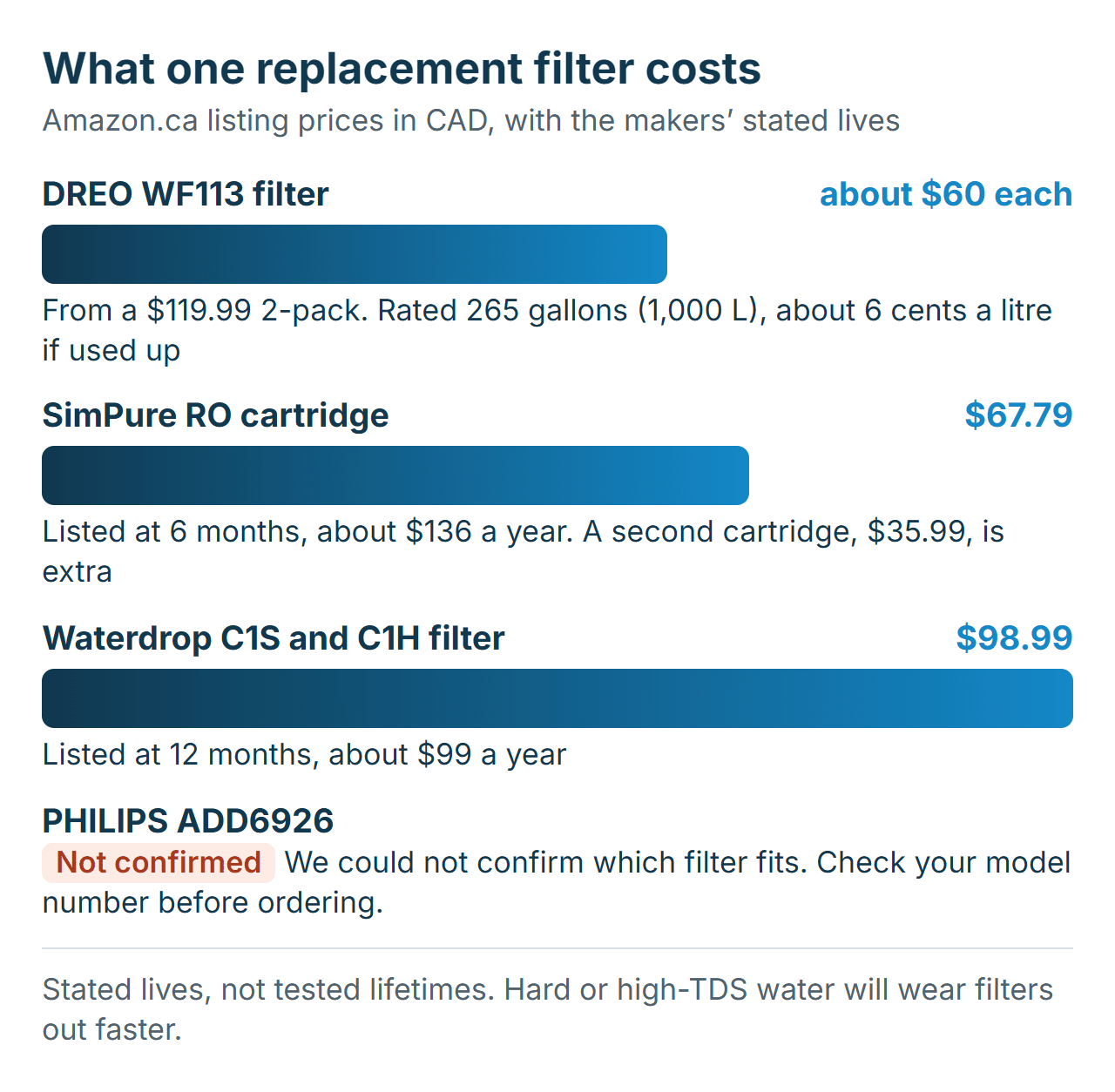
Filters are the ongoing cost. These are the Amazon.ca listing prices and the makers’ stated lives, not tested lifetimes. Hard or high-TDS water will wear filters out faster.
- Waterdrop C1S and C1H: the C1RF replacement filter is $98.99 and is listed at 12 months, so about $99 a year.
- DREO: a 2-pack is $119.99. Each filter is rated for 265 gallons (1,000 L), so about $60 each, or roughly 6 cents a litre if you use one up.
- PHILIPS: we didn’t confirm which replacement filter fits the ADD6926. A filter listed at $97.33 on the page is for a different model, so check your model number before ordering.
- SimPure: the RO cartridge is $67.79 and listed at a 6-month life. That’s about $136 a year for that one cartridge, and a second cartridge (listed at $35.99) is extra.
A handheld TDS meter, such as the HM Digital TDS-EZ at about $26 on Amazon.ca, tells you when the output creeps up and it’s time to change a filter.
Do you need RO for Canadian city water?
Often not. Municipal water in Canadian cities is treated and tested, and plenty of people buy RO for taste or for the low-mineral result. That’s a fine reason. It just isn’t a health fix.
RO strips out calcium and magnesium along with everything else. Health Canada says water is a minor source of those minerals next to food, and that with a reasonably balanced diet you don’t need a mineral supplement. If hardness is your real problem, a countertop unit only treats the water you pour into it, not your kettle, shower or pipes. Check Ontario municipal water hardness by city to see where you sit.
If you worry about lead from older pipes, test first, and look for a device certified for lead reduction. Our NSF/ANSI standards explainer shows what each number covers. On a private well, start with a proper test. Our guide to what Ontario’s well water test checks explains what that test misses.
How we picked
We didn’t lab-test any of these units and we haven’t had them in our hands. We read each Amazon.ca listing on November 21, 2026, including the title, bullets, detail tables, price and ratings. We compared the certification wording with Health Canada’s guidance on treatment devices and NSF’s description of the 58 standard. Anything we couldn’t confirm from those sources is left out.
FAQ
Is countertop RO as good as under-sink?
It depends on what you need. A countertop unit is limited by its tank (1.1 gallons on the Waterdrop C1S, for example) and you refill it by hand. Makers claim 3:1 to 4:1 drain ratios for these five, against 2:1 on the under-sink Waterdrop G3P600 listing. We haven’t measured any of them, so we can’t say which cleans better.
Is “SGS tested to NSF 58” the same as certified?
No. Health Canada tells buyers to look for a mark from a certification body accredited by the Standards Council of Canada, such as CSA Group, NSF International, the Water Quality Association or UL. A lab test report from a company the maker hired is a different thing.
Will a countertop RO unit work on well water?
Check the listing. The Waterdrop C1S and C1H say not to use them on well water or on source water over 500 TDS. SimPure says tap or well water under 500 ppm TDS. PHILIPS recommends tap water or another clear source. Get the water tested first, then compare the result to those limits.
Does RO remove the good minerals too?
Yes, it removes calcium and magnesium. Health Canada says water is a minor source of those minerals compared with food, and that a reasonably balanced diet means you don’t need a supplement.
How often do the filters need changing?
The listings say 12 months for the Waterdrop units and the PHILIPS, 265 gallons per filter for the DREO, and 6 months for the SimPure RO cartridge. Your own water’s TDS changes that, so a TDS meter is the better guide.
Our take
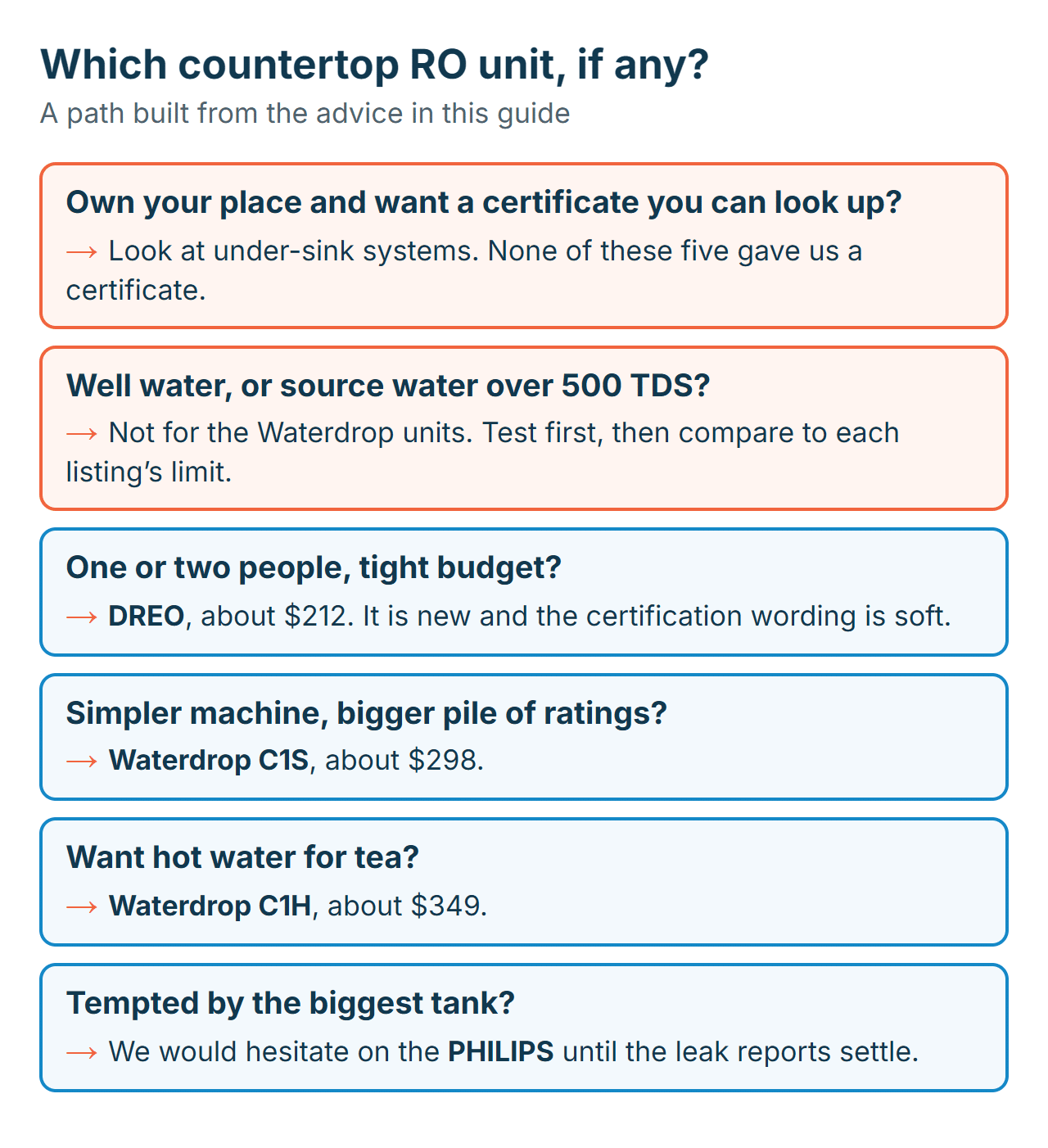
For one or two people on a tight budget, we’d start with the DREO, knowing it’s new and the certification wording is soft. For a simpler machine with a bigger pile of ratings behind the brand, the Waterdrop C1S is the pick, and the C1H if you want hot water. We’d hesitate on the PHILIPS until the leak reports settle. And if you need a certificate you can verify, none of these five gave us a certificate to point to. Ask the seller, or look at under-sink units.