 Inspire
What Is Pentaxyl? Ingredients, How to Use It and Side Effects
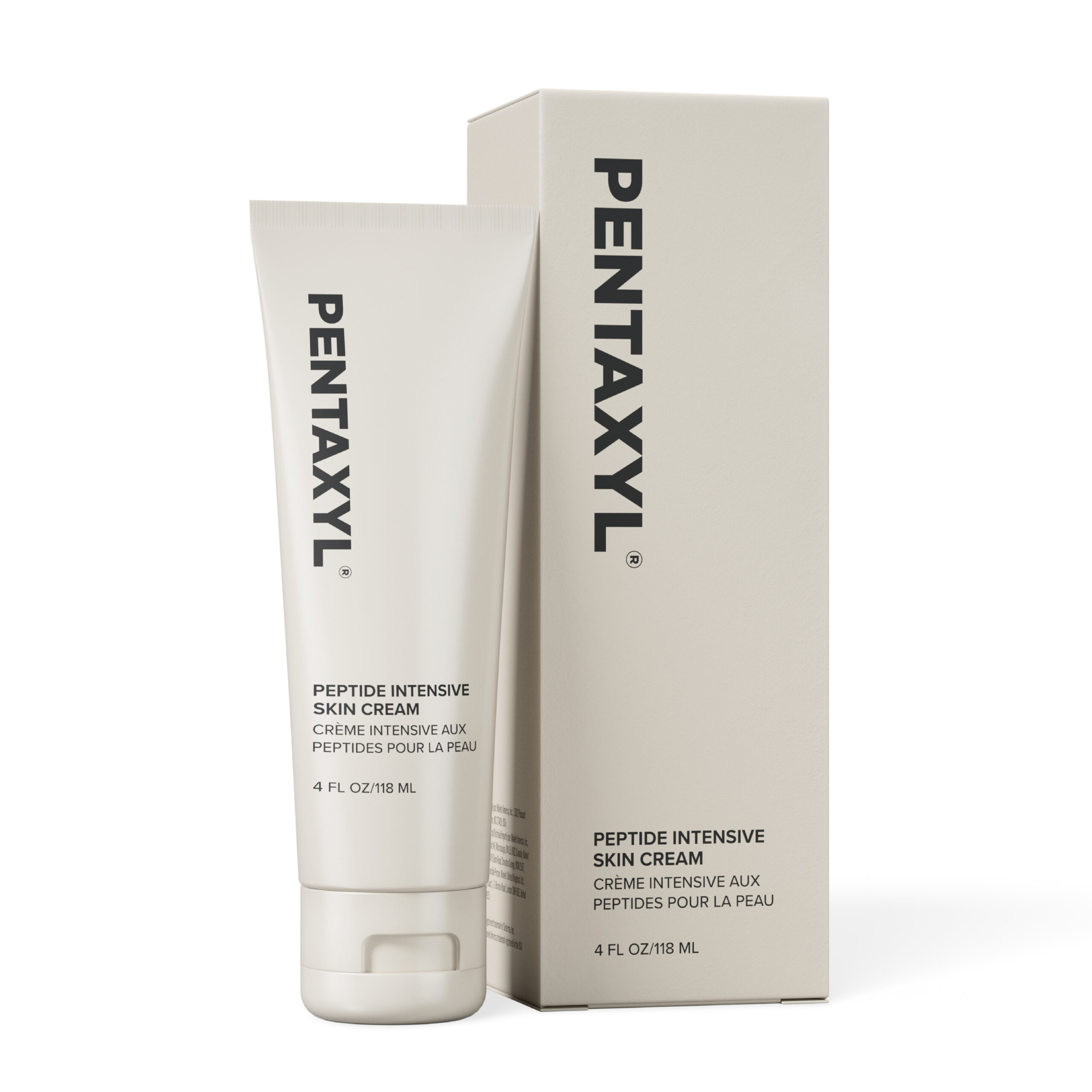
You keep seeing Pentaxyl in wrinkle and stretch mark posts, but the product page only singles out its peptides and doesn’t explain the rest of what’s in the tube. It’s Market America’s peptide skincare cream. The label lists 48 ingredients, three of them named peptides, and we found no published study of the cream itself.
Key takeaways
- Pentaxyl is Market America’s peptide skincare cream (118 ml tube, US$83.95), sold for the look of wrinkles and stretch marks on the face and body.
- The label lists 48 ingredients: three named peptides (short chains of amino acids), forms of vitamins A, C and E, oils and butters, plant extracts and preservatives. Amounts aren’t published.
- Official directions: warm it in your fingertips, massage it into clean, dry skin up to three times a day and no more, and keep it off the eyelid and the skin directly under the eye.
- We found no published study of Pentaxyl itself. We cite trials of two of its three peptides, in other formulas, and a 2017 review calls the clinical evidence for cosmetic peptides often weak.
- Patch test first. The label says it isn’t for children under 18. Ask a doctor before using it if you’re pregnant or nursing, allergic to sesame, almond, wheat or mint, or using a prescription skin product.
What is Pentaxyl?
Pentaxyl is a peptide-based skincare cream that Market America sells in a single 118 ml (4 fl oz) tube. The front of the tube is labeled Peptide Intensive Skin Cream. The product page lists it for the look of wrinkles and stretch marks on the face and body, and says visible results show up in about 28 days. Those are the company’s claims.
The name shifts by country. Hong Kong lists it as Pentaxyl®抗皺修護乳霜 (anti-wrinkle repair cream), Taiwan as 平泰秀®青春配方, and the Malaysian page, written in Malay, as plain Pentaxyl®. If you searched 平泰秀, it’s the same product. All three use product code 11150 with a country prefix.
The tube label says Made in U.S.A. and Distributed by Market America, Inc., but no page we found names the manufacturer or says when it launched, so we won’t guess. We’re an independent Market America distributor and earn a commission on purchases through our links. This page is built from the label, Market America’s own pages and published research, not from lab testing of our own.
Pentaxyl ingredients: what’s in the tube
The US product page lists 48 ingredients, and the Hong Kong page shows the same list in Chinese. There are no percentages. US labeling rules let anything at 1% or less appear in any order, so apart from the first few, list position says little about how much of each is in the tube.
The three peptides
Peptides are short chains of amino acids. Market America’s product description names three, and all three are on the label.
Everything else, in groups
On the label: retinyl palmitate, tetrahexyldecyl ascorbate, tocopheryl acetate.
On the label: sesame seed oil, sweet almond oil, shea butter, cocoa seed butter, mango seed butter, C12-15 alkyl benzoate, caprylic/capric triglyceride, glyceryl stearate, stearic acid.
On the label: glycerin, butylene glycol, propylene glycol, urea, glucosamine HCl, hydrolyzed wheat protein, hydrolyzed wheat starch.
On the label: peppermint oil, centella, licorice root, echinacea, emblica fruit, Sigesbeckia, imperata root, uva-ursi leaf, kelp (Laminaria), yeast.
On the label: water, cetearyl olivate, sorbitan olivate, PEG-100 stearate, polysorbate 20, xanthan gum, carbomer, acrylates crosspolymer, PPG-12/SMDI copolymer, polymethyl methacrylate, glyceryl polymethacrylate, sodium hydroxide, disodium EDTA, phenoxyethanol, potassium sorbate, ethylhexylglycerin.
Does the evidence back it up?
We found no published study of Pentaxyl itself. A PubMed search for the name returned zero results on October 17, 2026. What exists is research on individual peptides, usually in other formulas. Pentaxyl doesn’t publish its concentrations, so you can’t tell whether it matches any of them.
Reviews are guarded. A 2007 review said the evidence for cosmetic peptides is growing, though the benefits may not be as rigorously tested as drugs. A 2017 review listed the downsides: clinical evidence is often weak, absorption may be poor and prices can be quite high.
On timing, the page promises results in about 28 days. The American Academy of Dermatology (AAD) says most anti-aging products take at least six weeks and sometimes up to three months. For stretch marks, the UK’s National Health Service (NHS) says many creams claim to prevent or reduce them but there’s very little evidence they work. And in the US, cosmetics don’t need FDA premarket approval, so the page’s claims aren’t backed by an FDA approval.
How to use Pentaxyl
These are Market America’s own directions, from the FAQ on its US product page. The Hong Kong and Taiwan pages, in Chinese, give the same steps but say to massage gently rather than firmly.
- Start with cleansed, dry skin.
- Warm a little in your fingertips first. The page says that activates the ingredients.
- Massage it in with a firm, circular motion until it’s fully absorbed.
- Up to three times a day. The page says to “apply three times daily” for best results and “Do not exceed three applications per 24-hour period.”
- Around the eyes, massage it gently onto the skin over the orbital bone. The page warns: “Do not apply Pentaxyl directly underneath the eye or on top of the eyelid as it may cause irritation.”
- Layer from thinnest to thickest. The page says it can be combined with “virtually any products” but to test new combinations on a small area first.
The page doesn’t say how much to use each time. AAD warns that some skincare products cause problems if you use more than directed, so start small. Add sunscreen too: AAD says sun protection helps reduce signs of premature aging.
Our long-term Pentaxyl review suggests a different technique from the official firm circular massage: start with a pea-size amount and press it in with your palms instead of rubbing. That’s our own tip, not Market America’s, and it doesn’t change the three-a-day limit. The review also covers what people report at 8 to 12 weeks.
Side effects, patch testing and who should skip it
The page text lists no side effects, but the label shown in the product images carries a warning: for topical use only, avoid eye contact, not for children under 18, test a small area such as your forearm or wrist before regular use, and stop using it if itching, rash or redness occurs. The page text adds the eye-area warning, the three-a-day limit, a note to test new combinations on a small area, and advice to ask a physician if you use a prescription skincare product. Neither the label nor the page says anything about pregnancy or specific allergens, and we found no published safety study of the finished cream. So the useful question is what on the label could bother you.
- Allergic or irritant reactions. AAD says a skincare ingredient, such as a preservative, can trigger allergic contact dermatitis: red, itchy, swollen skin. This label includes sesame seed oil, sweet almond oil, hydrolyzed wheat protein and starch, peppermint oil, nine other plant and yeast extracts, and the preservatives phenoxyethanol and potassium sorbate.
- Stinging or tingling. AAD says to stop a product that stings, burns or tingles. Our long-term review notes some users find Pentaxyl minty, and the label does list peppermint oil.
- Eyelids and under-eye skin. The page itself says to keep it off, and the label says to avoid eye contact.
Patch test first. The label says to test a small area such as your forearm or wrist before regular use. AAD’s method: pick a quarter-sized spot on the underside of your arm or the bend of your elbow, use your normal amount and thickness, and repeat twice a day for 7 to 10 days. If you get red, itchy or swollen skin, wash it off gently and don’t use it again.
✓ It may suit you if
- You want a non-prescription peptide cream for face and body
- You can wait at least 6 weeks before judging it
- Your patch test stays clear
- You’re fine paying US$83.95 for 118 ml
✕ Skip it or ask first if
- You’re under 18 (the label says not for children under 18)
- You’re pregnant, trying or nursing
- You’re allergic to sesame, almond, wheat or mint, or reacted to anything on the list
- You use a prescription skincare product, manage a skin condition or take regular medication (ask your doctor or pharmacist first)
- Wrinkles are your only goal and you want the deepest evidence
Pregnancy and nursing
Ask your doctor or midwife first if you’re pregnant or nursing. The product page gives no guidance for either. The label lists retinyl palmitate, a vitamin A ester in the retinoid family, and the NHS says not to use retinoid creams in pregnancy because they may harm the baby (it names tretinoin). Retinyl palmitate is an indirect form that has to be converted in several steps to become active, and Pentaxyl’s amount isn’t published. So we can’t say it’s a problem. We can’t say it isn’t. We found no source on nursing either, so ask there too.
Pentaxyl vs retinol
Pentaxyl isn’t sold as a retinol product, but it isn’t retinoid-free either. Its headline actives are the three peptides. The label also lists retinyl palmitate, number 31 of 48, with no amount given.
| Pentaxyl | Retinol or tretinoin | |
|---|---|---|
| Main actives | Three peptides, plus a vitamin A ester at an unpublished amount | Vitamin A forms: retinol, and tretinoin (retinoic acid) |
| Evidence for wrinkles | Small trials of single peptides, none of Pentaxyl itself | Tretinoin is the most widely studied retinoid for photoaging. For retinol, one controlled trial reported a fine-wrinkle benefit after 12 weeks |
| Main downside | Possible irritation or allergy from the ingredient list, plus price | Burning, scaling and dermatitis, worst with tretinoin; retinol is milder |
| Pregnancy | No guidance on the page, so ask your doctor | NHS: don’t use retinoid creams if pregnant |
If wrinkles are your main goal and your skin tolerates retinoids, that route has the deeper evidence, and a dermatologist can choose the strength. Pentaxyl makes sense if you want a moisturizing, non-prescription peptide cream and you’re fine with less proven results. The page doesn’t rule out using both, but AAD says to start with one product at a time, because several anti-aging products at once can irritate your skin.
Pentaxyl price by country
It’s one 118 ml tube everywhere. These are the one-time prices on each official Market America country store on October 17, 2026, with the 10% Subscribe & Save price in parentheses. Malaysia’s page is in Malay, with English and Chinese options.
| Country | Price (Subscribe & Save) |
|---|---|
| United States | US$83.95 (US$75.56) |
| Canada | Can$116.44 (Can$104.80) |
| Hong Kong | HK$691.00 (HK$621.90) |
| Taiwan | NT$2,965 (NT$2,669) |
| Singapore | S$118.00 (S$106.20) |
| Australia | AUD$127.00 (AUD$114.30) |
| Malaysia | RM411.00 (RM369.90) |
| Indonesia | Rp1,404,000 (Rp1,263,600) |
At US$83.95 for 118 ml, that’s about 71 cents per ml. The US store’s own US$0.93-a-day figure treats a tube as 90 servings, one a day. The directions allow up to three applications daily and the page never says how much one application is, so your real cost per day depends on how much you use. US orders over US$125 ship free, which a single tube doesn’t reach.
Market America sells through its own country stores and through independent distributors like us, and the buy button below opens your country’s official store. New to the site? Our guide to shopping on MarketAmerica.com explains how to buy through us and what changed when SHOP.COM moved there, and our Market America products guide lists the rest.
Frequently asked questions
What is Pentaxyl?
What is Pentaxyl cream used for? (Apa kegunaan Pentaxyl?)
What are the ingredients in Pentaxyl?
How do you use Pentaxyl, and how often?
What are the side effects of Pentaxyl cream?
Is Pentaxyl a retinol?
Can you use Pentaxyl while pregnant or breastfeeding?
Does Pentaxyl work?
How much does Pentaxyl cost, and where can you buy it?
“Pentaxyl is a rich peptide moisturizer with a thin evidence trail. Try it if your patch test is clean, and talk to a dermatologist about retinoids first if wrinkles are your only goal.”
The label is reasonable, with three peptides and three vitamin derivatives. But we found no published study of this exact cream and the amounts aren’t disclosed, so US$83.95 asks you to take a lot on trust. It earns a trial if your patch test is clean and you’ll give it at least six weeks. The label says it isn’t for children under 18. If you’re pregnant or nursing, ask your doctor first, and stop using it if your skin itches, stings or burns.

See Pentaxyl at the official store →
Sources
- Ingredients, directions, label warning, FAQ and US price: official Pentaxyl product page, Market America (the label appears as an image in the product gallery), checked October 17, 2026.
- Country names and prices, checked October 17, 2026: official stores for Canada, Hong Kong, Taiwan, Singapore, Australia, Malaysia and Indonesia.
- Palmitoyl pentapeptide-4 trial: Robinson LR, et al. “Topical palmitoyl pentapeptide provides improvement in photoaged human facial skin.” Int J Cosmet Sci 27(3):155-60, 2005 (PMID 18492182).
- Acetyl hexapeptide-8 trial: Wang Y, et al. “The anti-wrinkle efficacy of argireline, a synthetic hexapeptide, in Chinese subjects: a randomized, placebo-controlled study.” Am J Clin Dermatol 14(2):147-53, 2013 (PMID 23417317). Skin penetration review: Zdrada-Nowak J, et al. “Acetyl Hexapeptide-8 in Cosmeceuticals-A Review of Skin Permeability and Efficacy.” Int J Mol Sci 26(12), 2025 (PMID 40565185).
- Palmitoyl tripeptide-1 (Pal-GHK): Mortazavi SM, et al. “Topically applied GHK as an anti-wrinkle peptide: Advantages, problems and prospective.” Bioimpacts 15:30071, 2025 (PMID 39963574).
- Peptide evidence overviews: Lupo MP, Cole AL. “Cosmeceutical peptides.” Dermatol Ther 20(5):343-9, 2007 (PMID 18045359); Pai VV, et al. “Topical peptides as cosmeceuticals.” Indian J Dermatol Venereol Leprol 83(1):9-18, 2017 (PMID 27451932).
- Retinoids and photoaging: Mukherjee S, et al. “Retinoids in the treatment of skin aging: an overview of clinical efficacy and safety.” Clin Interv Aging 1(4):327-48, 2006 (PMID 18046911).
- Neutral ingredient references: palmitoyl pentapeptide-4, palmitoyl tripeptide-1, retinyl palmitate and tetrahexyldecyl ascorbate on INCIDecoder (now INKEEDecoder).
- Patch testing, timing and layering: American Academy of Dermatology, How to test skin care products and How to maximize results from anti-aging skin care products.
- Stretch marks and retinoids in pregnancy: NHS, Stretch marks (last reviewed April 30, 2024).
- Ingredient order and cosmetic approval: FDA, Summary of Cosmetics Labeling Requirements and FDA Authority Over Cosmetics.
Related reading
-
 ReviewPentaxyl Review: What Long-Term Users Report After 8 to 12 WeeksWhat users describe over a full cycle, plus application tips and customer photos.
-
 ReviewVitaShield OPC-3 Triple Serum Review: What the Real Product Page SaysA dual-chamber vitamin C serum from the same Market America family as OPC-3 and Cellular Laboratories.
-
 ReviewPure Collagen+ Review: Grass-Fed Bovine Collagen with BiotinWhat is in Pure Collagen+, where the collagen comes from, and what the science says.