 Inspire
Best Solar Panels for RV and Off-Grid Living (2026)
JJN’s own spec sheet claims about 500 Wh a day from a single 100-watt panel. Here’s how to size a real system for your rig, not just the number on the box.
Updated July 29, 2026 · 8 min read · ✓ Fact-checked · Includes affiliated links
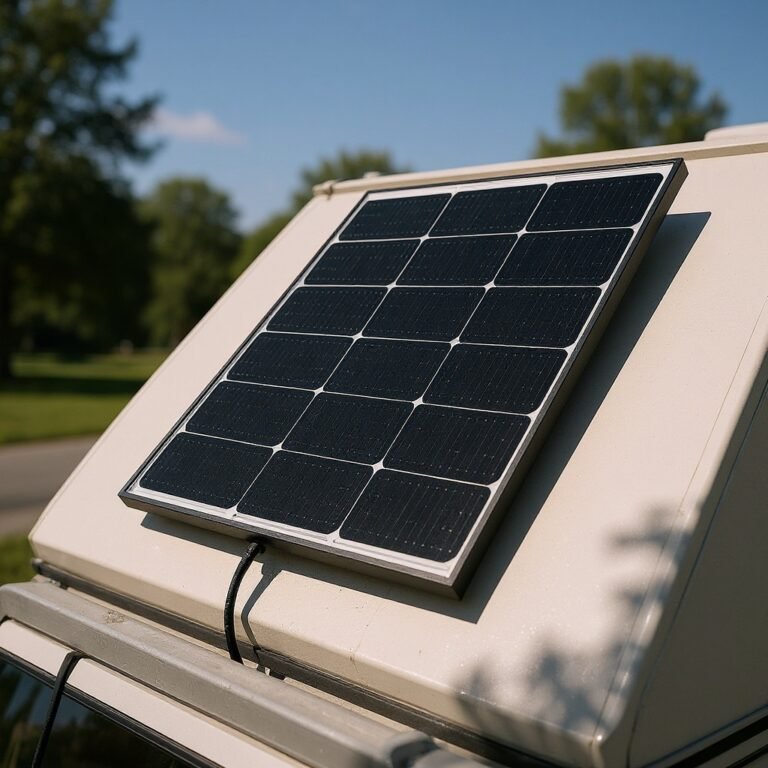
Most RV solar guides tell you to buy the biggest panel you can afford. The right size depends on how much power you actually use each day, not the biggest number on the box.
Just want to test whether solar is worth it on your rig, JJN’s 100W N-Type panel is light enough (13.4 lb) for one person to test-fit before committing to a full array. It’s the cheapest way into JJN’s lineup.
Mounting a permanent rigid array on an RV, van, or cabin roof, the 425W bifacial pair carries an actual UL 61730 safety listing, not just a badge.
Feeding a cabin or a bigger off-grid battery bank, the 550W bifacial pair is JJN’s highest-wattage rigid option at 1,100W combined.
These are all rigid panels, not the foldable/portable kind. None of them have a deep review history yet since JJN is a newer, smaller brand on Amazon, and JJN’s own site prices can run different from what you’ll see on Amazon. Confirm your charge controller’s maximum input voltage before wiring any of these in, especially in series.
Our picks

How much solar wattage do you actually need?
Every solar panel listing promises a number. JJN’s own spec sheet for the 100W panel claims about 500 Wh of electricity per day, for instance. Treat that as a best-case figure measured in ideal sun, not a guarantee for your driveway in October. Real output depends on your location’s peak sun hours, the season, your mounting angle, and anything casting even partial shade across the cells.
Rather than guess, run your own numbers through PVWatts Calculator, a free tool from the U.S. Department of Energy’s National Laboratory of the Rockies (formerly NREL) that estimates solar output for a specific address and panel setup. It won’t know your exact roof angle unless you tell it, but it’s a far better starting point than a manufacturer’s headline number.
Rough bands, if you want a starting point
Off-grid sizing calculators generally land in the same rough bands, regardless of which one you use:
- Around 200W keeps a couple of device batteries and some lighting topped up on an occasional-use rig.
- 400 to 800W, which is where JJN’s 425W pair lands, covers moderate RV or van use, including a compressor fridge, as long as you’re not running it around the clock in cloudy weather.
- Full-time boondockers, or a small cabin trying to stay off-grid, often end up wanting 800 to 1,200W or more, plus a battery bank sized to match.
None of this replaces actually tracking what your specific appliances draw over a full day.
Rigid vs. foldable, and what bifacial actually buys you
Rigid panels are a different tool than foldable ones
JJN’s lineup here is all rigid, aluminum-framed glass panels built for a permanent mount, a rooftop, a rack, or a ground mount you’re not moving often. That’s a real tradeoff, not just a spec difference. A rigid panel is more durable long-term, with no hinges, zippers, or fold lines to fail, and some installs rate it as walk-on safe. But once it’s bolted down, it stays where you put it.
If what you actually want is something you carry to a campsite, angle toward the sun by hand, and fold up when you leave. That’s a foldable or portable panel, a different product category JJN’s current lineup doesn’t cover. Don’t buy a rigid panel expecting portable-panel flexibility.
Bifacial gains depend almost entirely on how you mount it
Two of the picks above are bifacial, meaning both the front and back of the panel are photoactive. The back catches light reflected off whatever surface sits underneath it.
The National Laboratory of the Rockies (formerly the National Renewable Energy Laboratory) has studied the technology directly and found it costs manufacturers only around 5 cents more per watt to produce than a standard panel; one reason bifacial has gotten cheap enough to show up in a budget lineup like this one at all.
Here’s the part panel marketing tends to skip: the “up to 25 to 30% more energy” claims you’ll see from bifacial manufacturers assume the panel is elevated on a rack with real air gap underneath and a reflective surface below it, white gravel, light concrete, snow.
A panel bolted flat to an RV roof or a low rigid rack has little to no reflective surface behind it and almost no gap for light to bounce into. You’ll likely still see some gain over a monofacial panel of the same size, just don’t expect anywhere near the marketing number in a flush rooftop mount.
Will it work with your charge controller or power station?
JJN’s panels use standard MC4 connectors, the industry-standard plug most dedicated solar charge controllers, Renogy and Victron among them, are built around. If you’re wiring into a charge controller rather than an all-in-one power station, the main thing to check is voltage, not just wattage.
PWM or MPPT?
A PWM controller needs the panel’s voltage to roughly match the battery’s voltage and tops out around 75 to 80% efficiency. An MPPT controller converts the panel’s higher voltage down to whatever the battery needs and typically runs 95%+ efficient, per side-by-side technical comparisons published by charge-controller makers Renogy and Morningstar.
Pair one of the 425W or 550W panels above with an older PWM controller and you’re leaving real output on the table. Those higher-wattage bifacial panels are a better match for an MPPT controller.
Wiring panels in series raises your voltage, not just your wattage
Wire two panels in series, positive to negative, and their open-circuit voltages add together, not just their wattage. JJN’s spec sheet lists 38.59V open-circuit for the 425W panel and 49.92V for the 550W panel, so two 425W panels in series would approach 78V, and two 550W panels would approach 100V.
Check your charge controller’s or inverter’s maximum input voltage before wiring anything in series. Wiring in parallel instead keeps voltage the same as a single panel and adds the amperage, which brings its own wire-gauge and fuse considerations.
Already have a portable power station?
If you’re pairing this with a Jackery, EcoFlow, Bluetti, or similar all-in-one power station rather than a standalone charge controller, check that station’s own solar input spec sheet first.
Many portable power stations use a proprietary barrel connector rather than a plain MC4 input, and every model caps out at a different maximum input voltage and wattage. An adapter cable can bridge JJN’s MC4 connectors to most proprietary inputs, but the station’s own voltage ceiling is the real limit, not the panel’s wattage rating.
Frequently asked questions
Will a JJN solar panel work with my Jackery, EcoFlow, or Bluetti power station?
Probably, with an adapter. JJN’s panels use standard MC4 connectors, and most portable power stations use a different, often proprietary, input port. Check your specific power station’s solar input specs (maximum voltage and wattage) before buying, since that ceiling, not the panel’s rated wattage, is what actually limits how much of the panel’s output you can use.
What’s the real difference between the 100W panel and the bifacial panels?
The 100W panel is a single monofacial (front-only) panel sized to test whether solar makes sense for your setup at a low cost and low weight. The bifacial panels add a second light-catching surface on the back and come as pairs (425W x2 or 550W x2), aimed at a permanent, higher-output rooftop or ground-mount install rather than a first test panel.
Do I need a separate charge controller?
If you’re wiring straight into a battery bank, yes. A solar panel needs a charge controller, PWM or MPPT, in between to avoid overcharging the battery. If you’re pairing the panel with an all-in-one portable power station instead, the charge controller is usually already built in, but check that station’s documentation to be sure before assuming.
Is a rigid panel or a foldable panel better for a van or RV?
Neither is universally better, they suit different habits. A rigid panel bolted to the roof charges automatically without you doing anything, at the cost of a permanent install and less flexibility to chase the sun.
A foldable panel can be angled directly at the sun and moved into shade or storage, but someone has to set it up and pack it away every time. JJN’s current lineup is rigid panels only, so if you specifically want a foldable design, this isn’t the right product line.
Does the UL certification on the 425W panel mean my whole install is code-compliant?
No. UL 61730 certifies the panel module itself against a recognized safety-testing standard, it isn’t a certification of your specific mounting job, wiring, or grounding. Permanent installs, especially anything tied into a cabin’s or home’s electrical system, should still follow the National Electrical Code and your local permitting requirements, and a licensed installer if you’re not confident doing it yourself.