 Inspire
Does Your City Even Accept Compostable Green Bin Bags? Canada Rules by City (2026)
Calgary requires certified bags in the actual bin. Halifax won’t collect the cart if it sees one. Here’s what happens after pickup, city by city.
Updated July 2026 · 7 min read · ✓ Fact-checked · Includes affiliated links
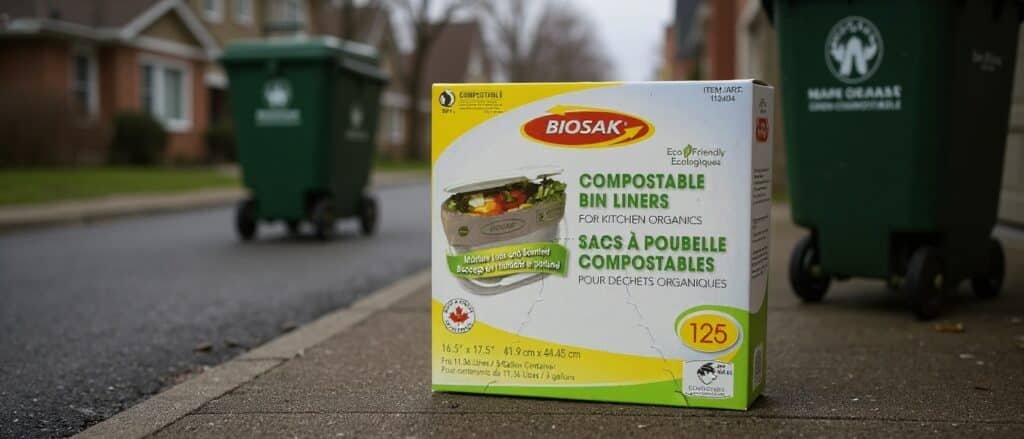
Buy the wrong bag for your program and one of two things happens. Nothing, because every bag gets stripped out before composting starts, compostable or not. Or your whole cart gets left at the curb. Which one applies to you depends entirely on your city, and there’s no national standard behind any of it.
Calgary only accepts certified compostable bags in the green cart, and rejects plain plastic. Toronto and Ottawa strip every bag out during processing, so a compostable one buys you nothing in the actual bin. Halifax bans them outright. Check your city’s own waste page before you buy a case of anything.
The one place a compostable bag earns its keep no matter what your city does: the kitchen caddy under your sink, where it’s holding scraps for a few days, not going through an industrial composter.
Key takeaways
Certified compostable isn’t one universal pass. Canada has two certification marks in circulation: the U.S.-based BPI logo and Quebec’s BNQ 0017-088 standard. A few regions, like Niagara, keep their own list of specific approved brands rather than just checking for a logo.
Whether a compostable bag does anything in your actual outdoor bin depends on how your city processes organics, not on the bag itself. Cities running anaerobic digestion (Toronto, Ottawa) rip every bag open before composting and landfill the plastic, compostable or not. Cities running aerobic composting (Calgary) need the bag to break down on-site, so they require certification and reject plain plastic.
A compostable bag is never wasted at the kitchen caddy stage. That’s a few days of countertop storage, not a trip through a municipal facility, and the rules below don’t touch it.
If your city takes certified bags
This section contains affiliate links — we may earn a commission at no extra cost to you. See our full evaluation policy at the end of this guide.
What 6 Canadian programs actually do
| City / region | What happens to the bag | Compostable bag needed? |
|---|---|---|
| Calgary | Only certified compostable bags accepted in the green cart. Plain plastic is left uncollected. | Yes, required |
| Niagara Region, ON | BPI-logo bags accepted from an approved list. Paper works too, no certification needed. | Optional, must be certified if used |
| Toronto | Anaerobic digestion rips every bag open before processing. Compostable bags are landfilled with the rest. | No benefit |
| Ottawa | Same processing method as Toronto. Bags of any kind are screened out and sent to landfill. | No benefit |
| Halifax | Green cart won’t be collected if staff spot a compostable or biodegradable bag inside. | Banned |
| Metro Vancouver | Not accepted at most local facilities. A contaminated load can be rejected in full. | Risk of rejection |
What the certification logo actually promises
Two logos show up on Canadian compostable bags. The BPI (Biodegradable Products Institute) mark means a product passed ASTM D6400 testing: it has to break down within 180 days under commercial composting conditions, sustained high heat and controlled moisture that a municipal facility provides, not a backyard bin. BNQ 0017-088 is the Quebec-specific version of roughly the same test, run to ISO 17088 and 18606 standards. Biosak carries both.
Neither logo means “biodegradable.” That word has no testing requirement behind it at all. “Oxo-degradable” bags are worse: they’re regular plastic with an additive that makes them fragment into smaller pieces, which just means invisible microplastic instead of a visible bag. If a bag doesn’t carry the BPI or BNQ logo, don’t assume it composts anywhere.
How to check your own city in 2 minutes
Search “[your city] green bin what goes in” and open the .gov result, not a retailer page.
Look for the word certified. If the page doesn’t mention a certification logo by name, treat compostable bags as unreviewed there, not automatically approved.
Still unsure? Call the waste info line. Every city runs one. A 5-minute call beats guessing with a $20 case of bags.
The one use case where the rules don’t matter
None of this affects your kitchen counter. A caddy liner holds scraps for a day or three before you empty it, whatever your city requires, into the outdoor bin, a backyard pile, or a paper bag for pickup. It never goes through a composting facility itself, so certification rules that govern outdoor bins don’t apply to it.
That’s the split worth remembering: the 3-gallon kitchen liner is a safe buy in any city. The 24 x 30 outdoor liner is only worth it if your program actually takes certified bags in the bin itself.
Frequently asked questions
What’s the actual difference between "biodegradable" and "compostable"?
“Compostable” has a testing standard behind it (ASTM D6400 for the BPI logo, ISO 17088/18606 for BNQ): break down within 180 days under commercial composting heat, with no toxic residue left behind. “Biodegradable” has no required testing or timeline. A plastic bag will technically “biodegrade” over enough centuries. That doesn’t make it compostable.
My city doesn’t accept compostable bags in the green bin. Is buying them pointless?
Not entirely. They still work as a kitchen caddy liner, where the appeal is odor and leak control on your counter, not what happens to the bag after pickup. If your city screens out every bag anyway, empty the caddy into your outdoor bin loose, or use whatever your city’s own page recommends for the actual cart.
Are BPI and BNQ the same certification?
They test for the same outcome, commercial compostability, through similar standards (ASTM D6400 vs ISO 17088/18606), but they’re separate certification bodies. Some cities recognize one and not the other by name, which is part of why checking your specific city’s page matters more than assuming any certified bag qualifies.
What happens if I use a regular plastic bag in a city that requires certified compostable?
In Calgary, the cart is typically left uncollected until the plastic bag is removed. It’s treated as contamination, the same way a pizza box in the recycling bin gets a cart tagged and skipped in most cities.
The bottom line
Don’t buy a case of anything before you check your own city’s page. If you’re in Calgary, Niagara Region, or a program with a similar certified-bag requirement, the BIOSAK 24 x 30 is a safe, dual-certified pick for the outdoor bin. If you’re in Toronto, Ottawa, Halifax, or Metro Vancouver, save your money on the outdoor liner and put it toward the kitchen caddy instead, where it does something regardless of what your city’s facility does with the bag afterward.
Related reading
-
 Home Care & DIYWhat Not to Use Bar Keepers Friend On (7 Surfaces to Avoid)What not to use Bar Keepers Friend on: 7 surfaces the oxalic acid formula can damage — including some that surprised us. Know these before you grab the can.
 -
 Home Care & DIYBar Keepers Friend Soft Cleanser vs Bon Ami: Which Is Safer for Glass?Bar Keepers Friend Soft Cleanser vs Bon Ami: which is safer for glass surfaces? We compare abrasive level, ingredients, and real results on stove tops and shower doors.
 -
 Home Care & DIYHow to Clean Glass Without Scratching (Safe, Foolproof Method)How to clean glass without scratching: rinse off grit first, use clean microfiber, keep pressure light. Most scratches come from friction — not from the cleaner itself.