 Inspire
DNA Miracles Review: Are They Legit Kids’ Vitamins?
Three chewable products, three very different evidence levels. Here’s the honest breakdown, strain by strain and ingredient by ingredient, of what real pediatric research actually supports — and where the label claims get ahead of it.
our rating
What we liked
- Full ingredient lists and doses are disclosed and age-gated (4+ warning on the OPC-3 chews specifically)
- Chewable Probiotics uses studied strains (L. rhamnosus among them) at a real, if modest, 5 billion CFU dose
- Essential Omega 3 dosing scales properly by age (2–3 vs. 4+) rather than one-size-fits-all
- Allergens are labeled clearly: milk (probiotics), fish (omega-3), soy (OPC-3 chews)
What to know
- The three products have very different evidence strength — treating them as equally “proven” would be dishonest
- OPC-3 Chews have essentially no pediatric research on 4 of 5 ingredients; the one exception (Pycnogenol) is studied at higher, medically-supervised doses for specific conditions, not this wellness-chew format
- “Immune support” language on the probiotics isn’t well supported for healthy kids specifically — the real evidence is narrower
- Chewables are a real choking risk under age 4, and combining multiple supplements can stack fat-soluble vitamins toward upper limits
Key takeaways
- The evidence strength across the 3 products, strongest to weakest: Chewable Probiotics > Essential Omega 3 > OPC-3 Chews. That order matters more than any single “does it work” answer.
- Probiotics have real, condition-specific pediatric evidence (preventing antibiotic-associated diarrhea, easing acute gastroenteritis) — but not for general “immune support” in already-healthy kids.
- DHA’s role in early brain and eye development is biologically well-established. Whether supplementing a healthy, adequately-fed child improves measurable outcomes is a much thinner, less consistent body of evidence.
- OPC-3 Chews carry the label’s own “not recommended under age 4” choking warning, and 4 of its 5 antioxidant ingredients have essentially zero pediatric research behind them.
Who these are for (and who should check with a pediatrician first)
Because this is really three different products under one brand, “who it’s for” depends on which one you’re asking about. Here’s the general split.
Reasonable to try if…
- Your child is 2 or older (4+ specifically for the OPC-3 chews) and generally healthy
- You’re using the probiotics around a course of antibiotics, or the omega-3 as a general nutrition top-up
- You’re comfortable reading the OPC-3 chews as “not well studied in kids” rather than a proven brain-support product
Check with a pediatrician first if…
- Your child is immunocompromised or has a central line — probiotics carry a real, documented infection risk in that specific group
- Your child already takes another multivitamin — fat-soluble vitamins can stack toward upper limits across products
- Your child is under 4 — chewable/gummy supplements are a recognized choking risk at that age, and the OPC-3 chews say so directly on the label
- Your child has a milk, fish, or soy allergy — each of the three products carries one of those allergens respectively
DNA Miracles Chewable Probiotics: the strongest evidence of the three
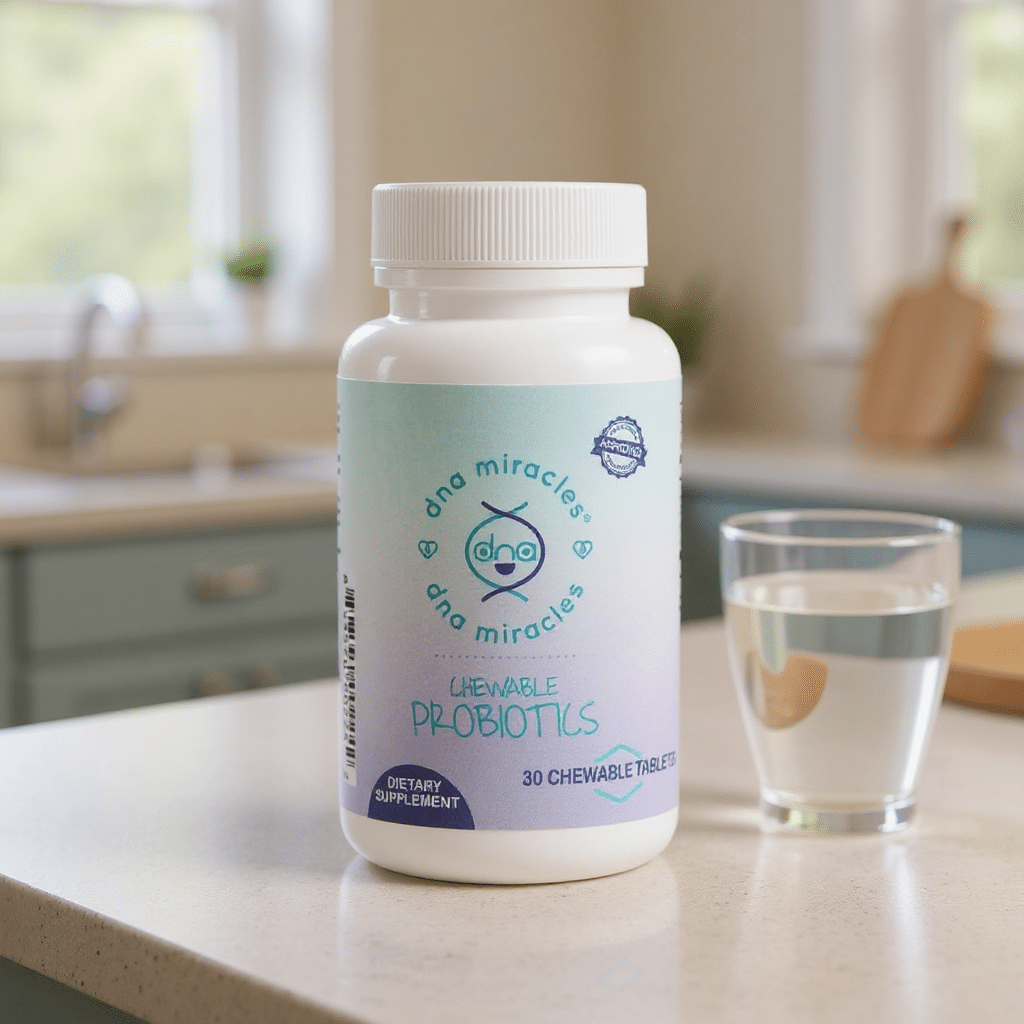
Each tablet delivers a 5-strain blend (Streptococcus salivarius, Lactobacillus rhamnosus, L. salivarius, L. paracasei, L. plantarum) totaling 5 billion CFU at time of manufacture, for ages 2 and up, 1 tablet daily. Contains milk.
Here’s the honest evidence picture: the American Academy of Pediatrics’ report on probiotics doesn’t recommend routine use for healthy children — the real evidence is strain- and condition-specific. A Cochrane review covering 33 randomized trials and over 6,300 children found probiotics (strongest with L. rhamnosus specifically) cut antibiotic-associated diarrhea from 19% down to 8% of children, and separately there’s decent evidence for easing acute viral gastroenteritis. L. rhamnosus is one of the five strains here, which is a real point in this product’s favor.
What the label claims that isn’t as well backed: general “immune system” and “bacterial balance” support in a child who isn’t sick or on antibiotics. That framing runs ahead of what the pediatric evidence actually tested.
DNA Miracles Essential Omega 3: real biology, thinner supplementation evidence
A fish-oil liquid (anchovies and sardines) dosed by age: ages 2–3 get 1 tsp/day (250 mg EPA + 150 mg DHA), ages 4+ get 2 tsp/day (500 mg EPA + 300 mg DHA). Contains fish.
DHA’s role in early brain and retina development is genuinely well-established biology — retinal DHA accumulation is essentially complete near birth, and brain accumulation continues to around age 2. That part isn’t in question. What’s thinner: NCCIH states that randomized trials of DHA supplementation “have not shown consistent benefits… on infant cognition or visual development,” and a 2023 review of 36 studies found no evidence omega-3 supplements improve ADHD symptoms specifically.
The honest read: DHA matters for development, but if your child already eats a reasonably varied diet, the case that an added chewable measurably changes cognitive outcomes is weaker than the “supports brain health” label language implies. One regional note: the Canadian version of this product carries a “Pediatrician Approved” claim that doesn’t appear on the US listing — worth knowing the marketing isn’t identical across regions.
DNA Miracles OPC-3 Chews: the thinnest evidence of the three, and the label says so
125 mg total antioxidant blend per chew (25 mg each of grape seed extract, red wine extract, Pycnogenol pine bark extract, bilberry extract, and citrus bioflavonoids). Contains soy. The product’s own label states it’s not recommended for children under 4 due to choking risk — a real, printed safety line worth taking seriously regardless of anything else in this section.
Even the adult-level evidence for Pycnogenol specifically is thin: the Cochrane Library’s own review of 27 studies across roughly 10 conditions concluded no definitive conclusions on efficacy or safety were possible, due to small sample sizes and inconsistent methodology. That’s the most rigorous independent verdict available on the single best-studied ingredient in this chew, and it’s “insufficient evidence,” not “proven.”
Safety basics that apply across the line
- Choking risk. Chewable and gummy children’s supplements are a recognized choking hazard, especially under age 4 — which is exactly why the OPC-3 chews carry that age restriction directly on the label.
- Stacking risk. If your child takes more than one supplement product (say, these plus a separate multivitamin), fat-soluble vitamins (A, D, E, K) can add up toward the tolerable upper limit even if no single product looks excessive on its own.
- Immunocompromised children and probiotics. This is a real, documented risk category, not a hypothetical one — the FDA has described a case involving a preterm infant, and case series exist involving probiotic-linked bloodstream infections in immunocompromised pediatric patients. If your child has a weakened immune system or a central line, talk to a doctor before starting a probiotic.
- Regulatory context worth knowing. Dietary supplements, including all three of these, are regulated as food, not drugs — the FDA doesn’t approve them for safety or effectiveness before they reach shelves. That’s standard across the entire supplement industry, not specific to this brand, but worth knowing as a parent.
Frequently asked questions
Are DNA Miracles supplements safe for kids?
Do the probiotics actually help kids’ immune systems?
Does the Omega 3 actually support brain development?
Is the OPC-3 Chews product well studied for kids?
What allergens should I know about?
“Well-labeled and appropriately dosed, but the three products deserve three different confidence levels, not one blanket verdict.”
The Chewable Probiotics have the most real pediatric evidence behind them, for specific situations rather than general wellness. The Omega 3 rests on solid DHA biology but thinner supplementation-specific evidence. The OPC-3 Chews are the weakest link — the label’s own under-4 choking warning and the near-total lack of pediatric research on most of its ingredients are worth knowing before you buy.

Related reading
-
 ExplainerIs NutriClean Safe? What’s Actually in the CleanseIngredient by ingredient, plus what six medical bodies say about detox claims.
 -
 ReviewIsotonix OPC-3 reviewThe adult-strength antioxidant formula this chews line is modeled after.
 -
 ReviewIsotonix Digestive Enzymes reviewFive enzyme classes in isotonic form.
Sources
- Probiotics and antibiotic-associated diarrhea in children: Cochrane review.
- DHA’s role in cognitive development: NIH PMC on DHA and Cognitive Development.